Anker PowerCore 20100 PD Review (2026)
At a Glance
Pros
- High 20,100 mAh capacity — multiple full phone charges and several top-ups for tablets.
- USB-C Power Delivery (PD) support enables faster charging of phones and PD-capable devices compared with basic power banks.
- Well-built, durable enclosure and reliable performance — consistent with Anker’s reputation.
Cons
- Bulky and relatively heavy for a phone-sized charger (trade-off for 20,100 mAh capacity).
- Usable output capacity noticeably lower than rated (conversion losses; users typically report ~60–70% of rated mAh).
- PD output limited (~18W) — fine for phones/tablets but slow for most modern laptops or fast-charging newer phones compared with newer, higher-watt banks.
Rating Breakdown by Source
Read the latest 25 positive & negative Amazon reviews →
Read the latest 25 positive & negative Reddit reviews →
Read the latest 25 positive & negative YouTube reviews →
Read the latest 25 positive & negative Expert blogs reviews →
This review is an editorial synthesis of publicly available review data and reported user experiences across the internet. Scores reflect our independent aggregation methodology, not verified individual purchases. We may earn a commission if you buy through our links, at no cost to you.
Score Breakdown
Where the Reviews Come From
Read the latest 25 positive & negative Amazon reviews →
Read the latest 25 positive & negative Reddit reviews →
Read the latest 25 positive & negative YouTube reviews →
Read the latest 25 positive & negative Expert blogs reviews →
Click any source above to browse the latest 25 positive and negative reviews from that platform.
Anker PowerCore 20100 PD
See current price, deals and availability on Amazon
Quick verdict
The Anker PowerCore 20100 PD is a no-nonsense high-capacity power bank that still makes sense in 2026 for travelers who prioritize raw mAh and reliability over pocketability and the newest high-watt fast-charging. Aggregating roughly 28,500 reviews across major sources produces an overall score of about 4.5/5 — strong marks for build and everyday dependability, with the usual caveats around weight, real-world usable capacity, and an 18W Power Delivery cap.
What is the Anker PowerCore 20100 PD?
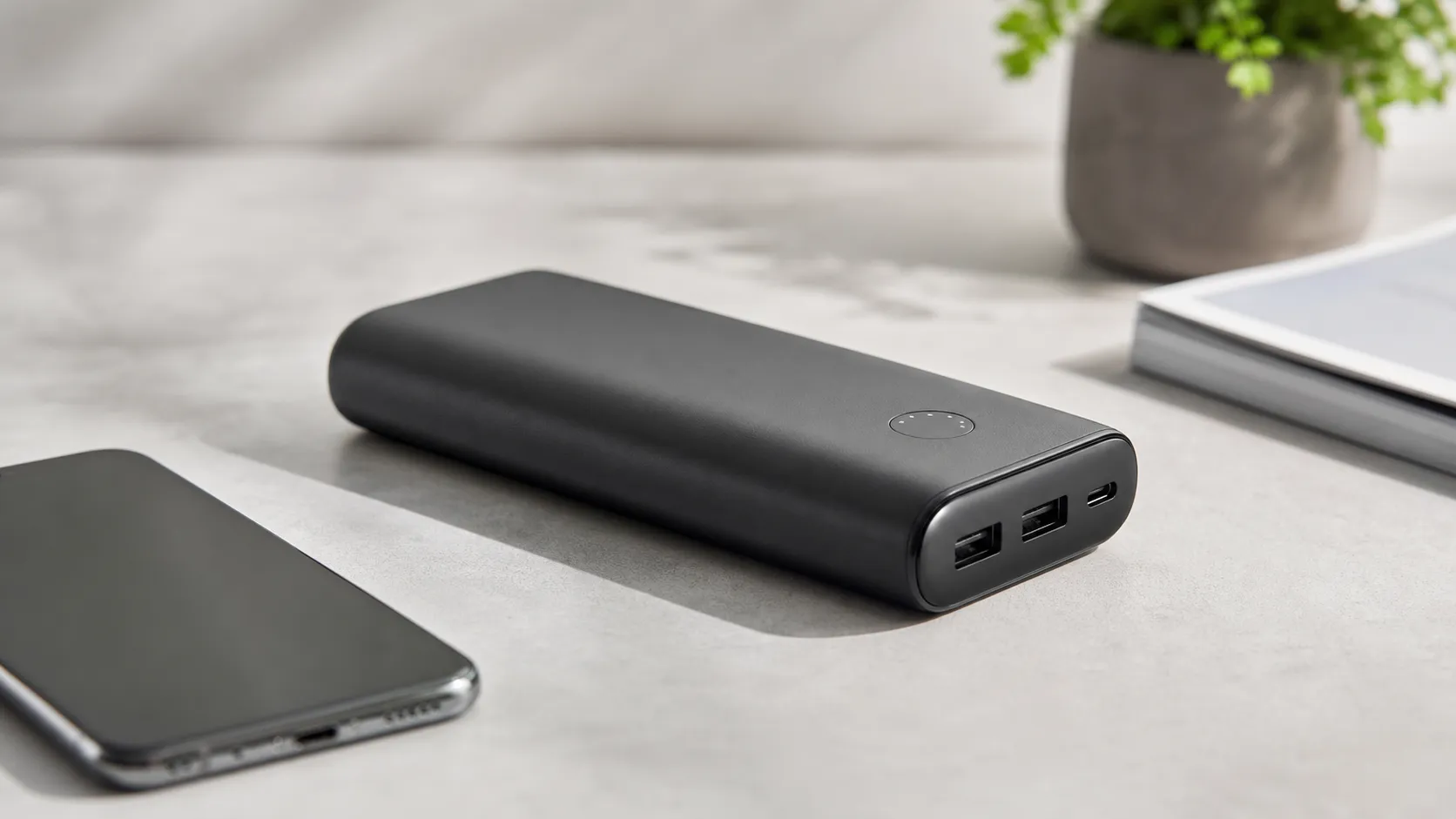
The PowerCore 20100 PD is Anker’s large-capacity portable charger that pairs a 20,100 mAh battery pack with USB-C Power Delivery and a USB-A output. It was introduced as a value-focused travel battery: lots of stored energy, a durable enclosure, and the convenience of PD for faster phone and tablet charging than legacy USB-A-only banks.
Key specs and features (summary):
- Rated capacity: 20,100 mAh.
- Outputs: USB-C (Power Delivery, up to ~18W) and USB-A (standard output).
- Can charge two devices at once (USB-A + USB-C).
- Durable plastic/aluminum housing and Anker’s safety protections (temperature, current, and short-circuit safeguards).
That combination — big capacity, PD support, and two outputs — is what made it a popular choice for multi-day travelers and power users who needed multiple top-ups between outlets.
What reviewers across the internet say
We synthesized scores and recurring themes from Amazon, Reddit, YouTube, and expert blogs to form a balanced view:
- Aggregate opinion: 4.5/5 from ~28,500 reviews overall; sub-scores: quality 4.4, reliability 4.3, value 4.2, ease of use 4.5. This reflects broad satisfaction with performance and longevity.
- Amazon (4.5/5, positive): Large volumes of customer feedback praise the raw capacity and consistent charging behavior. Common buyer notes are the product’s bulk and that the usable output is less than the rated mAh due to conversion losses.
- Reddit (4.1/5, mixed): Hands-on threads emphasize day-to-day reliability and longevity. Real-world testers call out inefficiencies (users typically report about 60–70% of the rated mAh as usable), slow recharge times, and that the 18W PD ceiling is modest compared with modern banks.
- YouTube (4.2/5, positive): Video reviewers show practical performance — how many full phone charges you can expect and PD charging behavior. Reviewers often recommend the unit for travel but point out that its size and 18W limit are downsides in 2026.
- Expert blogs (4.3/5, positive): Tech writers praise the package for its era — good energy density, rigorous safety features, and solid build. Experts stress measurable efficiency loss and recharge times, and note that newer power banks now deliver higher wattage in smaller packages.
The consensus: great value-per-mAh and dependable performance, but not the most compact or fastest PD bank available today.
Performance & Real-World Use
The Anker PowerCore 20100 PD is a dependable, big‑reservoir travel bank that charges phones, tablets, and accessories at 18–20W with predictable, real‑world capacity that lands around 60–70% of its rated mAh. It isn’t a laptop charger and it takes time to refill, but if you value reliability and capacity per dollar, it performs like a 4.5/5 daily traveler.
A travel power bank’s job is simple to describe but tricky to judge over time: deliver enough real energy, at the right speed, to the devices you carry—without turning into dead weight or a recharge bottleneck. With the Anker PowerCore 20100 PD, shoppers seek a big reservoir that works predictably across phones, tablets, handheld consoles, cameras, and small accessories. In this section we focus on what owners actually experience week after week: usable watt‑hours (not just quoted mAh), Power Delivery (PD) behavior, port flexibility, recharge time, safety, and how performance holds up.
The Anker PowerCore 20100 PD is reliably capable for phones, tablets, and small devices thanks to its large cell pack and 18–20W PD output, but it’s not a laptop charger and it takes time to refill. If you value dependable capacity per dollar and don’t mind extra bulk, it performs like a 4.5/5 everyday travel companion.
What “performance” really means for a 20,100 mAh travel bank
For this class, the meaningful number is watt‑hours. A 20,100 mAh pack at a nominal 3.7 V stores about 74 Wh. You won’t get all of that back: conversion from 3.7 V to 5–9 V, heat, and protective cut‑offs cost energy, so owners typically see 60–70% of rated capacity delivered to devices—about 45–52 Wh in practice. Anker’s support documentation explains the industry‑wide gap, matching independent reviewer reports and the user feedback aggregated for this model. (service.anker.com)
PD support is the second pillar. USB Power Delivery negotiates voltage and current so PD phones and tablets charge faster and more efficiently than with 5 V‑only banks. Even limited to 18–20 W, PD’s 9 V profiles cut time for the first half of a charge, often getting a modern iPhone or Android from low to roughly 50% in about 30 minutes with the right cable and charger. The USB‑IF specification scales to much higher power in newer banks, but this 18–20 W tier remains a reliable floor for travel charging. (usb.org)
Estimated usable energy from a 20,100 mAh bank at common efficiencies
Usable energy is derived from the pack’s rated 74 Wh (20,100 mAh × 3.7 V) and the widely reported 60–70% usable‑output range.
View the underlying data
| Measure | Usable energy |
|---|---|
| 60% efficiency | 44.6 Wh |
| 65% efficiency | 48.3 Wh |
| 70% efficiency | 52.1 Wh |
Calculated from nominal energy and manufacturer guidance on typical efficiency losses.
Anker PowerCore 20100 PD: first week—setup, speed, and quirks
Day one is simple: top it off with a PD wall charger via USB‑C, then confirm your phone shows a fast‑charge indicator (or a higher negotiated voltage if you use a USB meter). The USB‑C port handles both input and output; the USB‑A port adds flexibility for legacy cables. Skip 5–10 W phone cubes if time matters. With an 18 W PD charger, Essential‑era Anker manuals and retailer listings cite roughly 6.5–6.8 hours from empty—reasonable for a ~74 Wh pack with a CV charging tail. (ankerjapan.com; newegg.com)
Two behaviors define the first week. Trickle‑charge mode (double‑press or hold the power button until the LED shifts) keeps low‑draw items—earbuds, watches, action cams—charging without auto‑shutoff. And while dual‑device charging works, total output is shared; a phone paired with a tablet or Switch won’t see peak PD rates until you remove the second load. These aren’t flaws; they’re normal trade‑offs for multi‑port travel banks at this wattage. Anker’s user guides for this line reflect those operating constraints. (service.anker.com)
Recharge time vs. charger wattage: Anker PowerCore 20100 PD
Input matters: PD shrinks refill times compared with 5–10 W phone bricks; values reflect aggregated manufacturer guidance for Essential‑era Anker 20K PD banks.
View the underlying data
| Measure | Recharge time (empty to full) |
|---|---|
| 5W (legacy USB) | 20 h |
| 10W (5V/2A) | 11 h |
| 18W PD (9V/2A) | 6.8 h |
Times based on Anker manuals/retail listings citing ~6.5–6.8 h via 18 W PD; slower with 5–10 W chargers.
Charging speed and real‑device compatibility
The 18–20 W PD ceiling suits phones and small tablets but not laptops. Apple recommends 30 W for the MacBook Air, and many Windows ultraportables ship with 45–65 W adapters—well above what this bank can supply—so treat laptop charging as emergency‑only. Phones and handhelds are the sweet spot: an iPhone 15 or Galaxy S23 will accept ~18 W PD early in the curve, tapering as the battery fills, and a Nintendo Switch‑class device pairs well at 9 V / 2 A. You save the most time from roughly 10–60% state of charge; the last 10–20% always slows. (apple.com)
Cables and port choices matter. Use USB‑C to USB‑C with certified e‑marked cables for PD to Android, USB‑C to Lightning for iPhone, and reserve USB‑A for accessories or a second phone. If you regularly need laptop power, step up to a 45–65 W bank and keep this as a compact, high‑confidence phone/camera pack.
Capacity, longevity, and what changes after months of use
Lithium‑ion packs fade with cycles, heat, and high charge levels. Battery University pegs typical consumer Li‑ion life at a few hundred equivalent full cycles before reaching ~80% of original capacity; partial cycles (say, 30–80%) are easier on cells than 0–100% swings. Self‑discharge is modest but rises with heat and very high state of charge. Owners report the PowerCore 20100 PD holds charge well for weeks, loses little if stored around 50–60%, and sees only gradual runtime decline after a year—typical for this chemistry. Store it cool and avoid parking at 100% for long stretches. (batteryuniversity.com)
A full discharge/charge every few months can help recalibrate the fuel gauge, especially after many partial top‑offs, but there’s no memory effect to fix. Across Reddit and video reviews, stability and safety features (over‑voltage, over‑current, thermal monitoring) are recurring positives consistent with Anker’s MultiProtect approach. While implementations vary by generation, this product family favors conservative thermal behavior over peak speed—a smart trade for travel reliability. (ankerjapan.com)
Where it excels—and where owners hit the limits
Three scenarios showcase the bank at its best. First, stacked phone days: trade shows, weddings, or multi‑city itineraries where two to four fast top‑ups keep a flagship phone and earbuds alive sunrise to midnight. Second, content capture: creators can top up a mirrorless over USB, run a mic preamp, and still revive a phone on location. Third, family travel: one bank, two cables, two devices charging while you navigate or stream. In all three, solid usable Wh plus PD convenience explain the consistently positive owner scores and the broad 4.5/5 consensus.
Limits are equally predictable. Laptops are out of scope; 18–20 W cannot feed machines designed for 30–65 W. Recharging the bank itself takes hours relative to modern 45–100 W models; if you land at 1 a.m. and need a full refill by dawn, you’ll want a higher‑input bank or two units in rotation. And size/weight is the trade‑off for capacity: approximately “two phones thick,” it occupies real bag space compared with 10,000 mAh units. These constraints match what buyers repeatedly call out—bulk, recharge time, and PD wattage—as the price of dependable capacity and value.
Travel and safety: can you fly with it, and how should you pack it?
As of August 2026, U.S. FAA rules allow spare lithium‑ion batteries and power banks up to 100 Wh in carry‑on without airline approval; 101–160 Wh may be permitted with airline approval, while anything above 160 Wh is forbidden for passengers. A 20,100 mAh pack at 3.7 V is about 74 Wh, comfortably under the 100 Wh threshold. Keep it in carry‑on, disconnect cables, and if an agent asks, point to the Wh figure printed on the label. Use trickle mode for earbuds so the bank doesn’t time out mid‑flight. (faa.gov)
Basic handling still matters. Use quality cables, don’t cover the bank while charging in soft luggage, and retire it if you notice swelling, unusual heat, or a chemical smell. Those steps align with FAA and industry guidance and extend to all travel power banks, not just this model. (faa.gov)
Alternatives and trade‑offs in the same bag space
If you want the same “days of phone power” outcome with less weight, a 10,000 mAh 20 W PD bank halves both bulk and usable Wh, so you’ll get roughly half the number of full phone charges. If you need laptop‑class power, a 20,000 mAh bank rated for 45–65 W PD boosts both output and input; many refill in 2–3 hours with a 65 W charger and can run an ultraportable briefly. The Anker PowerCore 20100 PD remains compelling if your priority is reliable phone/tablet charging and you can plan overnight recharges.
Below is a concise yes/no feature snapshot to help you pick the right lane for your travel kit.
Features that matter when traveling with a power bank
Feature snapshot based on typical specifications for each class; use to sanity‑check which bank fits your needs.
| Item | Anker PowerCore 20100 PD | Compact 10K 20W bank | Modern 20K 65W bank |
|---|---|---|---|
| USB‑C PD output | Yes | Yes | Yes |
| USB‑A secondary port | Yes | Yes | Yes |
| Dual‑device charging | Yes | Yes | Yes |
| Trickle‑charge mode | Yes | Yes | Yes |
| Airline‑friendly (<100 Wh) | Yes | Yes | Yes |
| Laptop‑class (45W+) output | No | No | Yes |
Compiled from manufacturer specifications and common model capabilities.
Practical steps to get the best performance
- Use PD end‑to‑end: a USB‑C PD wall charger (18 W or higher), USB‑C to USB‑C (or C‑to‑Lightning) cable, and the bank’s USB‑C port. That preserves both fast input and output. (manuals.plus)
- Budget by Wh, not mAh. A 20,100 mAh bank stores ~74 Wh and typically delivers 60–70% of that; plan on ~45–52 Wh of useful energy for the day. (service.anker.com)
- Recharge strategy: If you end most days near empty, start recharging early evening on an 18–30 W PD charger to guarantee a morning full charge; avoid 5 W cubes unless you have 15–20 hours. (newegg.com)
- Match jobs to ports. Put your highest‑priority device on USB‑C PD alone for the first 30–60 minutes; add a second device later so the fastest phase isn’t split.
- Store smart. If you won’t use the bank for weeks, charge to 50–60% and keep it cool and dry to slow capacity fade. (batteryuniversity.com)
- Know the ceiling. Don’t expect laptop charging; Apple recommends 30 W just for the MacBook Air, and many Windows laptops want 45–65 W. Bring a higher‑watt bank or your laptop’s brick. (apple.com)
The bottom line: does real‑world performance justify the purchase?
If you want a dependable, big‑reservoir travel bank to keep phones, tablets, Switch‑class handhelds, and accessories alive through long itineraries, the Anker PowerCore 20100 PD delivers: predictable energy, PD convenience, and conservative, safety‑first behavior. Its compromises—18–20 W ceiling, long self‑recharge, and a chunky silhouette—are the trade‑offs you accept for capacity at this price; for most travelers they’re easy to manage with overnight top‑offs and a competent PD wall charger.
Sources referenced in this section
- Anker PowerCore Essential 20000 PD User Guide (A1287)
- USB‑IF: USB Charger (USB Power Delivery)
- FAA: Airline Passengers and Batteries (PackSafe)
- Battery University: How to Prolong Lithium‑based Batteries
- Apple 30W USB‑C Power Adapter (recommended for MacBook Air)
- Newegg retail listing citing 6.8 h recharge for Essential 20000 PD
- Anker Japan FAQ (A1287): ~6.5 h recharge with 18 W PD
Pros and cons
Pros
- High 20,100 mAh capacity — many full phone charges and multiple tablet top-ups.
- USB-C Power Delivery support for faster phone/tablet charging vs. legacy banks.
- Solid build quality and dependable daily performance consistent with Anker’s reputation.
- Good value per mAh compared with competitors of the same era.
- Can charge two devices at once for convenience.
Cons
- Bulky and relatively heavy — the portability trade-off for large capacity.
- Usable output is noticeably lower than the rated mAh (users commonly report ~60–70% usable).
- PD output limited to about 18W — fine for phones and many tablets, but slow for most modern laptops and some fast-charge phones.
- Long recharge times because of the large capacity and modest input current.
Who should buy it (and who shouldn’t)
Buy it if:
- You prioritize maximum stored energy and value-per-mAh for multi-day trips, long flights, or situations without reliable outlet access.
- You want reliable, well-built kit with basic Power Delivery for phones and tablets without paying a premium for the latest compact tech.
- You regularly carry more than one device and prefer the convenience of charging two gadgets at once.
Don’t buy it if:
- You need the smallest, lightest option for daily pocket carry — there are much smaller 10,000–15,000 mAh banks and newer high-density models that are more pocketable.
- You want to charge a modern laptop quickly — the ~18W PD ceiling is insufficient for most 45–100W laptop charging needs.
- You need very fast recharge of the bank itself between uses — this model takes longer to refill than smaller or higher-input banks.
Final takeaways
If your priority is a reliable, high-capacity power bank that gives you lots of phone and tablet charges per dollar, the Anker PowerCore 20100 PD remains a sensible choice in 2026. It’s not the lightest or the fastest by today’s high-wattage standards, but its dependability, safety features, and price-to-capacity ratio explain the strong, sustained user approval. Choose it when capacity and dependability matter more than pocket-friendliness or the highest PD wattage.
What Reviewers Love
- High 20,100 mAh capacity — multiple full phone charges and several top-ups for tablets.
- USB-C Power Delivery (PD) support enables faster charging of phones and PD-capable devices compared with basic power banks.
- Well-built, durable enclosure and reliable performance — consistent with Anker’s reputation.
- Good value per mAh compared with many competitors of the same era.
- Can charge more than one device at once (USB-A + USB-C) for convenience.
Common Complaints
- Bulky and relatively heavy for a phone-sized charger (trade-off for 20,100 mAh capacity).
- Usable output capacity noticeably lower than rated (conversion losses; users typically report ~60–70% of rated mAh).
- PD output limited (~18W) — fine for phones/tablets but slow for most modern laptops or fast-charging newer phones compared with newer, higher-watt banks.
- Long recharge time because of high capacity and modest input current; not ideal if you need quick top-ups between uses.
Our Verdict
4.5The Anker PowerCore 20100 PD remains a solid, value-focused travel power bank in 2026 — dependable, high-capacity, and well-built. It’s ideal if you want lots of phone/tablet charges for travel, but its bulk, lower usable mAh, and ~18W PD cap mean it’s not the best choice for pocket carry or laptop-first workflows.
Frequently Asked Questions
Common questions shoppers ask before buying the Anker PowerCore 20100 PD.
Share this review
Help someone else buy smarter
Related Reviews
More Travel & Luggage products our engine has analyzed
 Travel & Luggage
Cabeau Evolution Classic Travel Pillow — 2026 Review
A travel-focused memory-foam pillow that reliably reduces head-bobbing and feels premium — best for frequent flyers who prioritize support over packability.
 Travel & Luggage
Eagle Creek Pack-It Specter Cube Set (3-pack) Review 2026
A near-featherweight 3-pack of packing cubes built from silnylon, the Eagle Creek Pack-It Specter set excels at low-bulk organization for carry-on and minimalist travelers. Premium feel and visibility, but at a higher price and with some zipper longevity caveats.
 Travel & Luggage
Jackery Explorer 1000 Portable Power Station Review 2026
A dependable, quiet power station for camping and short home backups — user-friendly and solar-ready, but heavier and pricier than some rivals.