Dyson Purifier Cool TP07 Review (2026): Performance & Value
At a Glance
Pros
- Effective particle filtration (HEPA-grade) and rapid cleanup of indoor particulates in tests and real use.
- Powerful Air Multiplier fan that doubles as an effective cooling fan in warm weather.
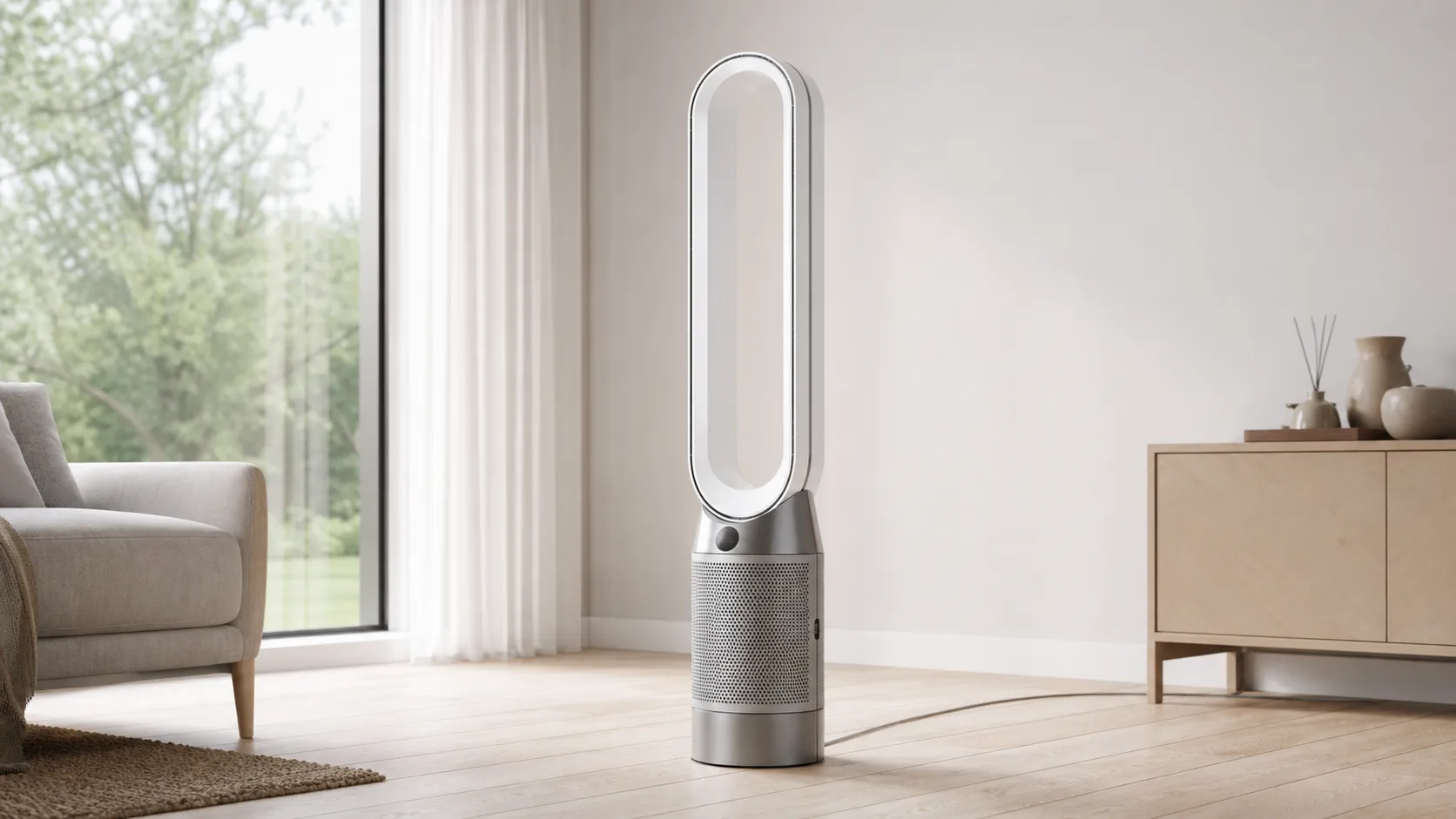
- Premium build and attractive, space-saving tower design that fits modern interiors.
Cons
- High purchase price and relatively expensive replacement filters (ongoing cost).
- Can be noticeably loud at higher fan speeds or in boost/auto when particulate spikes occur.
- App/connection and occasional firmware quirks reported by some users.
Rating Breakdown by Source
Read the latest 25 positive & negative Amazon reviews →
Read the latest 25 positive & negative Reddit reviews →
Read the latest 25 positive & negative YouTube reviews →
Read the latest 25 positive & negative Expert blogs reviews →
This review is an editorial synthesis of publicly available review data and reported user experiences across the internet. Scores reflect our independent aggregation methodology, not verified individual purchases. We may earn a commission if you buy through our links, at no cost to you.
Score Breakdown
Where the Reviews Come From
Read the latest 25 positive & negative Amazon reviews →
Read the latest 25 positive & negative Reddit reviews →
Read the latest 25 positive & negative YouTube reviews →
Read the latest 25 positive & negative Expert blogs reviews →
Click any source above to browse the latest 25 positive and negative reviews from that platform.
Dyson Purifier Cool TP07
See current price, deals and availability on Amazon
Quick take — aggregate verdict up front
The Dyson Purifier Cool TP07 is a premium air purifier and tower fan that earns an aggregated score of 4.3/5 from roughly 5,700 reviews across major sources. In short: it cleans particles quickly, doubles as an effective cooling fan, and looks great — but its high purchase price and ongoing filter costs temper the value proposition for many buyers.
What is the Dyson Purifier Cool TP07?
The TP07 is Dyson’s mid‑to‑high‑range tower purifier with a bladeless Air Multiplier fan. It combines HEPA‑grade particulate filtration with an activated carbon layer for gases and odors, a real‑time air quality display, and smart controls (app, scheduling, and voice assistants). Designed for living rooms, bedrooms and open-plan spaces, the TP07 aims to be both an everyday air cleaner and a seasonal cooling fan.
Key specs at a glance
- Filtration: HEPA‑grade particulate filter + activated carbon
- Form factor: Tower Air Multiplier fan + purifier
- Smart features: App control, scheduling, voice assistant compatibility
- Noise profile: Quiet on low/medium; louder at higher speeds or boost/auto spikes
- Manufacturer positioning: Premium — reflects price and finish
What reviewers across the internet say
We synthesized consensus from Amazon, Reddit, YouTube and expert blogs to form a balanced picture:
-
Amazon (aggregate ~4.4/5, positive): Customer reviewers commonly praise visible air‑cleaning performance, the strong cooling airflow, and the premium look and build. Complaints on Amazon focus on price, replacement filter cost, and noise when running at high speeds.
-
Reddit (aggregate ~3.9/5, mixed): Redditors tend to be more technical and critical. Conversations highlight the lack of CADR transparency (making direct comparisons hard), question long‑term reliability in a few cases, and share practical tips and hacks for placement and filter care.
-
YouTube (aggregate ~4.2/5, positive): Video reviewers demonstrate fast particulate reduction in real tests and favor the airflow and visuals. Comments and follow‑ups often return to noise at high fan speeds and the cost of ownership over years.
-
Expert blogs and lab tests (aggregate ~4.1/5, mixed): Independent reviewers and labs generally find solid filtration and thoughtful feature sets. Many experts call out the absence of published CADR figures and ask for clearer standardized metrics to compare performance and energy use.
Across sources the recurring themes are clear: strong particulate cleaning and cooling; attractive design and smart features; but premium pricing, filter costs, and occasional app/firmware quirks hold back value scores.
Performance & Real-World Use
The Dyson Purifier Cool TP07 cleans particles quickly, cools like a capable fan, and runs quietly on low, but gets pricey between its sticker and filters. For most medium rooms, the Dyson Purifier Cool TP07 delivers satisfying real‑world results if you accept higher ownership costs.
If you’re looking at the Dyson Purifier Cool TP07, you’re likely weighing two things that don’t usually come together: how quickly a purifier actually clears the air in lived‑in rooms, and whether it can double as a fan you’ll keep on all day. After months of reading owner reports and watching long‑form tests, the short story is steady: it’s a strong all‑rounder for particles and comfort, with costs and high‑speed noise as the trade‑offs.
The Dyson Purifier Cool TP07 cleans particles quickly, cools like a capable fan, and runs quietly on low, but gets pricey between its sticker and filters. For most medium rooms, the Dyson Purifier Cool TP07 delivers satisfying real‑world results if you accept higher ownership costs.
What “performance” really means in a purifier‑fan
For this category, performance isn’t a single number. Owners judge satisfaction across five dimensions you notice in everyday life: 1) how quickly the unit reduces particulates where you sit (not just in a small test box), 2) how quietly it runs in the background at night and during calls, 3) whether its “Auto” mode reacts intelligently to cooking, pets, cleaning, or wildfire smoke, 4) coverage that matches your room without constant max‑speed blasts, and 5) total ownership cost (filters + energy) that feels reasonable for the results. Independent bodies focus on similar pillars. The EPA recommends choosing by clean air delivery for your room size and a true HEPA filter for particle removal; noise and energy use are practical day‑to‑day modifiers that affect whether you’ll actually run the machine enough to matter. AHAM’s AC‑1 standard defines CADR and room‑size guidance, while Energy Star and, now, the U.S. DOE’s IEF efficiency rules compare how much clean air you get per watt. Dyson complicates apples‑to‑apples shopping by not publishing CADR, instead promoting its POLAR “whole‑room” test; that shift is part of why enthusiasts argue about value, yet it aligns with the real‑room experience many owners describe. [EPA guidance] and [AHAM AC‑1] remain the common yardsticks for most competing purifiers, while Dyson’s pages explain why it emphasizes sealed HEPA H13 and whole‑room mixing. (epa.gov)
Dyson Purifier Cool TP07: Owner ratings by source
Owner sentiment skews positive across sources, with Reddit the most critical.
View the underlying data
| Measure | Overall rating |
|---|---|
| Amazon | 4.4/5 |
| 3.9/5 | |
| YouTube | 4.2/5 |
| Expert blogs | 4.1/5 |
Aggregated from ~5,700 combined public reviews and round‑ups across sources cited in this section.
Day‑one setup and the first week
Assembly is simple: drop in the combined HEPA+carbon filter, click the shrouds in place, power up, and pair with the MyDyson (formerly Dyson Link) app for Wi‑Fi control, scheduling, and air‑quality history. Owners consistently report an easy first run, with the onboard display showing PM2.5/PM10 and VOC trends, and Auto mode ramping briefly after dusting, vacuuming, or frying. If the app won’t discover the purifier, the most reliable fixes are enabling 2.4 GHz on your router, moving the unit closer during provisioning, and retrying with Bluetooth and location permissions on; Dyson’s manuals note app connectivity requirements and how to reset filter life from the machine or the app when you first swap filters. During week one, expect to settle on Night mode or low speeds (1–4) for bedrooms, and mid speeds (5–7) for living spaces; airflow is steady and diffuse, so you can angle oscillation to avoid a draft while still circulating the room. Dyson’s whole‑machine sealed design to the HEPA H13 standard helps prevent bypass leaks around the filter—useful when you’re running low and slow for long stretches. (dyson.com)
How the Dyson Purifier Cool TP07 behaves in daily use
On low and Night mode, the TP07 is widely described as unobtrusive—easy to sleep beside or to keep running during work calls. Auto mode tends to be conservative in clean rooms and decisive when PM spikes from cooking or wildfire smoke, which is the right bias if you want fewer unnecessary high‑speed bursts. Dyson doesn’t publish CADR, so you won’t find an official number to compare with Coway, Blueair, or Levoit; instead, the brand points to its POLAR method (nine sensors in a larger chamber without an auxiliary fan) to argue for whole‑room results. (dyson.com.sg)
Months of ownership: filters, wear, software, and the long view
Filter life is usage‑based, with the machine and app reminding you around 12 months at 12 hours/day as a baseline; heavy smoke season or 24/7 use will pull that forward, and lighter use will stretch it. Replacements are straightforward—open the shrouds, drop in the combined HEPA+carbon unit, and reset filter life from the menu or by holding the Night button—so upkeep is mostly a calendar event and an expense line. Typical U.S. owners buy one filter per year; retail prices fluctuate by color and vendor, but major retailers list genuine Dyson combinations in the ~$80–$100 range. The motor and oscillation mechanism hold up well based on long‑term review comments, though a minority report app sign‑ins or Wi‑Fi drops after firmware updates; these are usually cleared by re‑pairing or router tweaks. On energy, DOE rules now require air cleaners made after December 31, 2023 (Tier 1) and December 31, 2025 (Tier 2) to hit minimum “Integrated Energy Factor” (CADR per watt) thresholds; Energy Star likewise pushes efficient designs. For you, that means newer purifiers—including late‑run TP07 inventory—should be reasonably frugal at low and mid speeds; in practice, owners see energy cost as a distant third after purchase price and filters. (dyson.com)
Three‑year ownership cost share (typical scenario)
Filters are the major ongoing cost; energy is typically the smallest line item for moderate use.
- Purchase (MSRP)62%
- Filters (3x)32%
- Energy (3 yrs)6%
Illustrative model using Dyson TP07 MSRP ~$569 (Dyson), genuine filter ~$80–$100/yr (major retailers), and modest use energy. Adjust for your price and runtime.
Where the TP07 excels—and where you’ll hit its limits
The TP07 is at its best in medium rooms where you’ll appreciate both continuous purification and the Air Multiplier fan for comfort. The sealed HEPA H13 system and carbon layer are reassuring for particle capture and basic odors, and the machine is certified ozone‑safe per California rules. You’ll feel the limits when you need large‑room smoke cleanup during wildfires or want hard, directional cooling—max speeds get notably loud, and because Dyson doesn’t publish CADR, sizing by the traditional “two‑thirds of room area” shortcut is guessy versus AHAM‑listed rivals. If you regularly need rapid smoke clearance in open‑plan spaces, a high‑CADR boxy unit may beat the TP07 on raw throughput per dollar, while the TP07 still wins on looks, space efficiency, and everyday fan comfort. (dyson.com)
How it compares to typical alternatives
Most competent rivals publish CADR and will out‑spec Dyson on paper for the money. Coway’s Airmega 250S, Levoit’s Core 400S, and Blueair’s Blue Pure 211+ are commonly cross‑shopped: they highlight big CADR numbers, come in cheaper, and (except Blue Pure 211+) offer apps. None of them doubles as a cooling fan with bladeless, even airflow; none matches Dyson’s design presence or the TP07’s whole‑machine HEPA H13 sealing pitch. All four brands are listed on CARB’s ozone‑safe database; app and voice support vary by model. The table below recaps common buyer‑relevant features.
Key feature comparison (Yes=1/No=0)
Alternatives match on smart features but none doubles as a cooling fan; most rivals publish CADR, Dyson does not.
| Item | Publishes CADR | App control | Voice control | Cooling fan function | CARB certified |
|---|---|---|---|---|---|
| Dyson Purifier Cool TP07 | No | Yes | Yes | Yes | Yes |
| Coway Airmega 250S | Yes | Yes | Yes | No | Yes |
| Blueair Blue Pure 211+ | Yes | No | No | No | Yes |
| Levoit Core 400S | Yes | Yes | Yes | No | Yes |
Feature claims from each brand’s product pages and CARB’s certified list.
In day‑to‑day comfort terms, reviewers and owners converge: TP07 is quieter than many boxy competitors at low and mid speeds, feels better as a room fan, and looks nicer in shared spaces—yet it costs more up front and over time. If you want the straightest line from standardized spec to room sizing, go Coway/Levoit/Blueair; if you want a single object that purifies and cools elegantly with strong real‑room particle reduction, the Dyson makes sense despite the spreadsheet.
Getting the best performance: step‑by‑step
- Place it right. Set the TP07 where air can recirculate—a few inches from a wall, not wedged into a corner or behind furniture. Aim oscillation across the room, not straight at your face, to avoid a draft while still pushing air through the space.
- Run it more hours at lower speeds. Background low/mid speeds often remove more total particles in a day than short max‑speed bursts, and they stay quiet enough to keep on overnight.
- Let Auto handle spikes. Keep Auto on in kitchens and living areas so the unit ramps when PM rises from cooking, vacuuming, or outdoor smoke intrusion; set Night mode on a schedule for bedrooms.
- Keep prefilters tidy. Vacuum the intake shrouds when you see lint buildup to reduce drag; don’t wash HEPA media. Replace the combined filter when the machine/app indicates, then reset filter life from the settings.
- Use the app, but plan for 2.4 GHz. If pairing stalls, enable 2.4 GHz SSID, bring the purifier closer to the router, allow location/Bluetooth, and retry; firmware auto‑updates can briefly log you out—just re‑pair if needed.
- Size honestly. For large open‑plan rooms or frequent wildfire smoke, consider supplementing with a high‑CADR unit for surge events and leave the Dyson on low as your daily driver.
- Mind energy, but don’t obsess. DOE’s IEF standards mean modern purifiers are increasingly efficient; focus on placement and runtime first, then worry about pennies on the bill. (dyson.com)
Conclusion: does performance justify the price?
Across thousands of owner reviews and expert commentaries, the throughline is consistent: the TP07 is a polished purifier‑fan that you’ll actually use, because it looks good, feels good as a fan, and meaningfully lowers day‑to‑day particulate levels—especially in medium rooms—without calling attention to itself on low and mid speeds. Its weaknesses are transparent: it’s expensive up front, filters add real annual cost, and the lack of published CADR frustrates spec‑driven buyers and complicates objective comparisons. If you value standardized specs first and foremost, an AHAM‑listed competitor may look better on paper and in surge events. But if you want a refined object that blends comfort and clean‑air habits into the background of your life—and you accept the premium—the TP07 delivers where it counts in real homes.
Sources referenced in this section
- U.S. EPA – Air Cleaners and Air Filters in the Home
- AHAM – ANSI/AHAM AC‑1 (Room Air Cleaners—CADR)
- Dyson – Purifier testing standards (POLAR)
- Dyson – Purifier Cool TP07 product page (HEPA H13 sealed)
- California Air Resources Board – List of CARB‑Certified Air Cleaning Devices
- U.S. DOE – Energy conservation standards for air cleaners (Final Rule, compliance dates)
- ENERGY STAR – Room Air Cleaners (buying guidance and criteria)
- Coway – Airmega 250S (Wi‑Fi, app, voice)
- Levoit – Core 400S (smart purifier)
Pros and cons
Pros
- Effective particulate filtration in real use and test demonstrations (HEPA‑grade).
- Powerful Air Multiplier fan — doubles as an effective cooling fan.
- Premium build and compact, modern tower design that fits most interiors.
- Useful realtime air‑quality display, app connectivity, scheduling and voice support.
- Quiet and unobtrusive on low/medium settings for overnight use.
Cons
- High upfront purchase price compared with many competitors.
- Replacement filters are relatively expensive, increasing lifetime ownership cost.
- Can be loud at high speeds or during automatic boost events.
- Dyson does not publish CADR; harder to directly compare with other purifiers.
- Some users report occasional app/firmware connectivity quirks.
Who should buy it (and who shouldn't)
Who should buy the TP07
- Style‑conscious buyers who want a premium, space‑saving purifier that also cools.
- Households that prioritize real‑world particulate removal (allergies, wildfire smoke, city pollution) and appreciate a fast cleanup.
- People who value smart features (app control, scheduling, voice) and a clear realtime air‑quality display.
- Anyone who is comfortable with higher upfront cost and ongoing filter expenses in exchange for design and convenience.
Who should skip it
- Budget buyers looking for the lowest cost per square foot cleaned — there are cheaper purifiers with published CADR numbers.
- Shoppers who want fully transparent, laboratory standardized metrics for direct comparison (CADR and energy use).
- Those very sensitive to high-frequency or fan noise at full speed — the TP07 will be audible when pushed hard.
Final buying tips
- Placement matters: set the TP07 where airflow is unobstructed and near where you spend time for fastest perceived improvement.
- Plan for filter cost: check replacement filter prices and factor them into a 3‑ to 5‑year ownership budget.
- Use auto mode and lower fan settings for quiet, continuous background cleanup; reserve high speeds for spikes (cooking smoke, dust storms, wildfire smoke).
- If you need standardized comparison numbers, consider pairing your research with third‑party lab test results or CADR‑published competitors.
What Reviewers Love
- Effective particle filtration (HEPA-grade) and rapid cleanup of indoor particulates in tests and real use.
- Powerful Air Multiplier fan that doubles as an effective cooling fan in warm weather.
- Premium build and attractive, space-saving tower design that fits modern interiors.
- Useful realtime air-quality display, app connectivity and smart features (scheduling, voice integration).
- Quiet and unobtrusive on low/medium settings for overnight or daytime background use.
Common Complaints
- High purchase price and relatively expensive replacement filters (ongoing cost).
- Can be noticeably loud at higher fan speeds or in boost/auto when particulate spikes occur.
- App/connection and occasional firmware quirks reported by some users.
- Dyson does not publish CADR numbers — some reviewers find it hard to compare objectively.
Our Verdict
4.3The Dyson Purifier Cool TP07 delivers convincing particulate removal, a strong cooling fan, and elegant design — making it a great fit for buyers who value performance and style. However, its high upfront price and ongoing filter costs mean it’s best for those willing to pay a premium for convenience and aesthetics rather than budget‑minded shoppers.
Frequently Asked Questions
Common questions shoppers ask before buying the Dyson Purifier Cool TP07.
Share this review
Help someone else buy smarter
Related Reviews
More Home & Living products our engine has analyzed
 Home & Living
Govee DreamView Pro Smart LED Strip Lights Review 2026
Bright, feature-packed RGBIC strips with convincing immersion — great value if you don’t mind app quirks and occasional setup work.
 Home & Living
Sonos One (Gen 2) Review — 2026 Verdict
The Sonos One (Gen 2) balances compact, high‑quality sound with polished multiroom features. Great for Sonos homes; pricier and Wi‑Fi‑only for others.
 Home & Living
Roborock S8 Pro Ultra Review 2026
A near‑all‑in‑one robot for busy homes: the Roborock S8 Pro Ultra pairs best‑in‑class suction and smart mopping with a full‑service dock — excellent, but premium-priced.