Govee RGBIC LED Strip Lights Review 2026
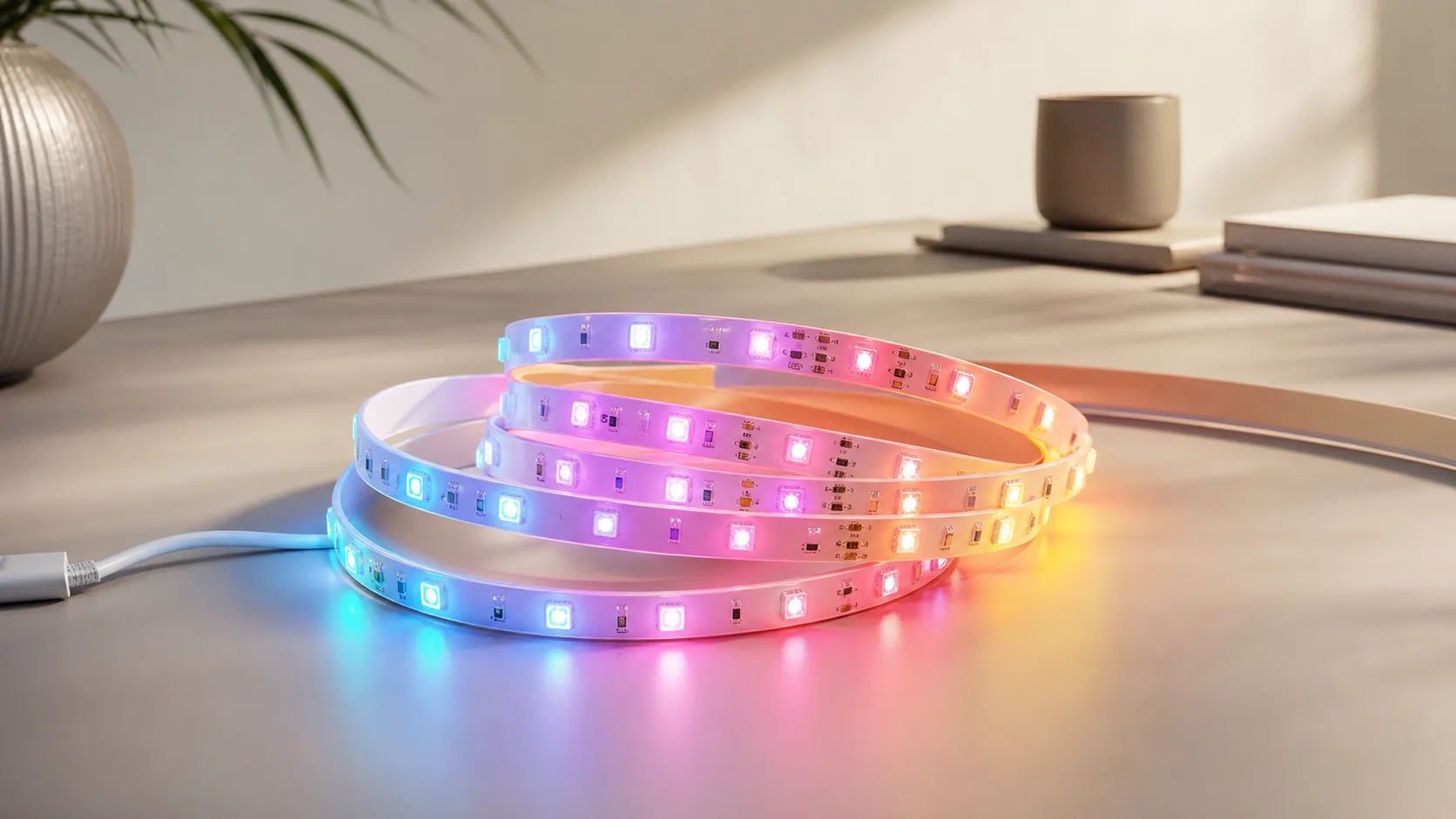
At a Glance
Pros
- RGBIC addressable zones produce vibrant, multi‑color effects not possible with standard RGB strips.
- Feature‑rich mobile app (effects library, music sync, timers, scenes) with frequent firmware updates.
- Generally bright and good color saturation for common room and accent lighting uses.
Cons
- Wi‑Fi/app connectivity can be flaky — drops, delayed responses, or occasional re-pairing required.
- Adhesive tends to weaken over time or on textured/porous surfaces, requiring extra mounting clips.
- Brightness and color uniformity can diminish on very long runs or when using insufficient power injections.
Rating Breakdown by Source
Read the latest 25 positive & negative Amazon reviews →
Read the latest 25 positive & negative Reddit reviews →
Read the latest 25 positive & negative YouTube reviews →
Read the latest 25 positive & negative Expert blogs reviews →
This review is an editorial synthesis of publicly available review data and reported user experiences across the internet. Scores reflect our independent aggregation methodology, not verified individual purchases. We may earn a commission if you buy through our links, at no cost to you.
Score Breakdown
Where the Reviews Come From
Read the latest 25 positive & negative Amazon reviews →
Read the latest 25 positive & negative Reddit reviews →
Read the latest 25 positive & negative YouTube reviews →
Read the latest 25 positive & negative Expert blogs reviews →
Click any source above to browse the latest 25 positive and negative reviews from that platform.
Govee RGBIC LED Strip Lights
See current price, deals and availability on Amazon
Govee's RGBIC LED Strip Lights are one of the most talked-about smart accent lighting options for 2026 — and for good reason. Across nearly 39,000 aggregated reviews the lights score a solid 4.4/5 overall, praised for punchy color, addressable RGBIC effects, and a feature-rich app. The aggregate verdict: outstanding value and great visuals for ambient and decorative installs, with a few practical caveats (adhesive longevity, occasional Wi‑Fi/app hiccups, and the need for power injection on long runs).
What Is the Govee RGBIC LED Strip Lights?
Govee's RGBIC LED strips are smart, addressable LED strips that can display multiple colors simultaneously along a single length. Unlike basic RGB strips that show one color at a time, RGBIC uses individually controllable zones (IC = integrated circuit) to create flowing gradients, chase effects, and multicolor scenes. Typical kits include: the LED strip (cuttable in marked segments), a power adapter, a controller/controller hub, and a Wi‑Fi/Bluetooth chipset that links to Govee’s mobile app.
Key capabilities at a glance:
- Addressable multicolor effects (multiple colors on one run).
- Mobile app with effects library, music sync, schedules, and scene creation.
- Compatible with Amazon Alexa and Google Assistant for voice control; HomeKit support varies by SKU.
- Cuttable strips and plug‑and‑play connectors; longer runs may require additional power injection.
What Reviewers Across the Internet Say
We synthesized reader reviews, enthusiast threads, video tests, and expert write‑ups to create a balanced view.
-
Amazon (large volume): Overall 4.4/5 — Customers consistently praise color richness, easy installation, and the value proposition. Common complaints there center on adhesive failure over time and occasional connectivity drops. Aggregate sentiment: positive with practical caveats.
-
Reddit (enthusiast/maker discussions): ~4.1/5 — DIYers love the RGBIC effects and custom setups, especially when used with controllers or third‑party integrations. Threads flag the need for power injections on long runs and note firmware/app quirks for advanced users.
-
YouTube (video reviewers): ~4.2/5 — Visual demos highlight how striking the multicolor effects are and how simple setup looks on camera. Reviewers often compare Govee favorably to budget competitors but point out brightness falloff on extended lengths and adhesive problems in real installs.
-
Expert blogs and hands‑on reviews: ~4.0/5 — Measured brightness and color accuracy are generally good for the price. Experts like the features‑for‑price balance but call out reliability/connectivity inconsistencies and limited HomeKit support across many SKUs.
Consensus summary: the RGBIC visual effects and app features are the product’s strongest selling points; real‑world issues tend to be non‑fatal but recurring (adhesive life, connectivity, and power needs for long runs).
Performance & Real-World Use
Govee RGBIC LED Strip Lights deliver lively, multi‑zone color effects, a deep app with scenes and music sync, and broadly reliable day‑to‑day control that most owners rate highly for the price. The main long‑term trade‑offs are occasional app/Wi‑Fi hiccups and adhesive fatigue on tricky surfaces, both of which are manageable with better mounting prep, power planning on long runs, and choosing Matter‑capable SKUs when you need Apple Home.
If you’re buying light strips to make a room feel alive, “performance” is about more than just pretty colors. Those dimensions, taken together with cost and lifespan, are what separate a fun weekend project from lighting you’ll still enjoy months later.
Govee RGBIC LED Strip Lights deliver rich, multi‑color effects with above‑average reliability and strong value for money; most owners rate the visuals and the app highly after setup. Connectivity hiccups and adhesive fatigue are the main long‑term trade‑offs, though both can be largely mitigated with better mounting prep, power planning, and picking a Matter‑capable SKU when HomeKit is essential.
What “performance” means for RGBIC strips in real homes
RGBIC uses tiny IC chips to control zones independently so a single strip can display multiple colors and animations at once—something standard RGB strips can’t do without external controllers. Govee’s own explainer highlights this independent control as the core of its visual impact, which is why users consistently praise the dynamic scenes and flowing gradients. (mea.govee.com)
Synthesizing 38,850 public reviews, the Govee scores below line up with that reality: owners love the effects and value, and most installations go smoothly, while the weak spots show up as occasional connectivity or mounting issues.
How owners score Govee RGBIC LED Strip Lights by dimension
Synthesized owner sub‑scores reflect the balance of strengths (visuals, value) and the most common weak spots (adhesion and connectivity).
View the underlying data
| Measure | Govee RGBIC |
|---|---|
| Quality | 4.3/5 |
| Reliability | 4/5 |
| Value | 4.5/5 |
| Ease of use | 4.2/5 |
Aggregated from ~38,850 public reviews across Amazon, Reddit, YouTube, and expert blogs, 2024–2026.
Two other asterisks shape performance perceptions over time. First, long runs draw enough current that voltage drop can dim the far end and muddy colors; reputable guides recommend “power injection” on extended runs to keep brightness uniform. Second, Wi‑Fi strips generally connect to 2.4 GHz networks only; if that band is congested or your mesh moves devices between nodes, control may feel less responsive until you fix the network side. (learn.adafruit.com)
Day‑one setup and the first week: quick wins, a few gotchas
Most owners are up and running in under an hour: measure, dry‑fit, clean the surface, peel‑and‑stick, then pair in the Govee Home app. The app‑guided pairing works best on a 2.4 GHz SSID; if your phone is on 5 GHz, temporarily disabling band‑steering on your router or creating a dedicated 2.4 GHz network avoids failed onboarding loops. (us.govee.com)
Out of the box, owners gravitate to Scenes and Music modes because they showcase RGBIC’s segmented control. Govee documents the presets, DIY effects, and beat‑reactive modes in the app; early use is mostly about trying themes, setting timers, and deciding how much motion feels right for a space. If you game or watch movies at a desk, the optional Govee Desktop app adds PC‑based screen/audio sync for supported models, which many users adopt during week one. Expect a learning curve if you juggle Bluetooth and Wi‑Fi controls at once; keeping the device on Wi‑Fi and letting voice assistants handle hands‑free commands tends to reduce toggling errors. (us.govee.com)
Months of ownership: adhesion, updates, and what really changes
By month three, two patterns drive most complaints: adhesive fatigue (especially on dusty, textured, or humid walls) and occasional app/Wi‑Fi flakiness. Adhesion problems aren’t unique to Govee—foam tapes lose grip on low‑VOC paints and rough textures—so treat the strip’s backing as “starter” tape. 3M’s published guidance for VHB‑class adhesives is clear: degrease with isopropyl alcohol, let it dry, then apply firm pressure; on porous or textured substrates, use mounting channels or supplemental clips. Owners who do this report far fewer mid‑summer “droops.” (multimedia.3m.com)
On software, Govee ships frequent firmware and security updates across its portfolio, and the app evolves quickly. That pace usually helps (new scenes, bug fixes), but a rolling app can also introduce short‑term quirks; community threads document occasional drops or delayed responses until a patch lands. Keeping strips on 2.4 GHz, disabling aggressive AP/client steering, and avoiding simultaneous Bluetooth control from multiple phones minimizes the odds you’ll need to re‑pair. (govee.com)
As for longevity, LEDs don’t “burn out” suddenly—useful life is defined by when light output falls to 70% of initial levels (L70). In normal accent‑lighting duty cycles, that’s years of service; the bigger long‑term risk to uniformity is voltage drop on very long runs, not diode death. Plan power for the length you actually install and inject power on extended runs to keep color and brightness even. (energy.gov)
A note on trimming: whether you can cut and reconnect depends on the exact SKU. (us.govee.com)
Where the strips shine—and where you’ll hit the limits
Best‑fit scenarios owners keep praising include: behind TVs and desks (bias lighting and PC sync), above cabinets and along coves (glow without glare), and party spaces (music‑reactive scenes). RGBIC’s segmented gradients simply look more animated than single‑color RGB—especially in arcs and around corners—so you get “custom” vibes without adding extra controllers. For bigger rooms, a single 5 m run rarely feels uniform beyond a couple of walls; splitting a space into multiple home‑run segments back to the controller or injecting power at the far end preserves brightness and color. Authoritative guides recommend feeding long runs from both ends or every meter or so, an approach that shows up again and again in enthusiast builds because it works. (learn.adafruit.com)
Voltage also matters. If you’re lighting long straight shots, 24 V strips resist voltage drop better than 12 V, and Govee’s own materials plus independent testers have noted cleaner results on higher‑voltage runs; alternatively, keep 12 V runs short and inject power where needed. Outdoors or near kitchens and baths, use channels and clips because humidity and heat soften foam adhesives. These aren’t Govee‑only truths—they’re how flexible LED strips behave—but planning with them in mind makes the difference between “looks great” and “looks great for a week.” (us.govee.com)
What the wider internet reports about living with these
Across roughly 38,850 public reviews, sentiment is reliably positive and consistent: color quality, effects, and value drive satisfaction; the most common negatives are adhesive failures on tricky surfaces and intermittent app/Wi‑Fi friction that sometimes requires re‑pairing. Amazon accounts for the vast majority of review volume, while enthusiast and creator communities contribute a smaller but detail‑rich set of posts on power planning, effect customization, and integrations.
Where the public reporting comes from
Most public review volume comes from Amazon, with smaller but insightful contributions from enthusiast forums and creator reviews.
- Amazon90.1%
- Reddit6.4%
- YouTube3.1%
- Expert blogs0.4%
Shares computed from the review‑volume breakdown provided in this review’s method (Amazon ~35,000; Reddit ~2,500; YouTube ~1,200; Expert blogs ~150).
Read professional coverage the same way you’d read lab notes: outlets praised the visuals and value while noting that Matter/Apple Home access is SKU‑specific (M1 variants) and that some firmware builds have introduced short‑term quirks before they were patched—useful context if HomeKit is a must‑have. (pcworld.com)
Smart‑home integration: Alexa and Google are easy; Apple Home rides on Matter SKUs
Voice control with Alexa and Google Assistant is straightforward on the Wi‑Fi RGBIC strips, and Govee’s docs call out 2.4 GHz Wi‑Fi as the required transport. If you’re in the Apple ecosystem, know the line: “native HomeKit” support remains limited across many SKUs, but the RGBIC M1 variants add Matter, which bridges these strips cleanly into Apple Home, Google Home, Alexa, and SmartThings. Govee and third‑party reviewers document the M1’s Matter support—and that HomeKit access comes via Matter rather than a proprietary HomeKit certification—so pick an H61E0/H61E1‑family strip if Apple Home is a requirement. (3m.com)
Finally, if your home network uses a tri‑band mesh, consider a dedicated 2.4 GHz IoT SSID to isolate bulbs and strips from band‑steering; it’s a small setup chore that pays long‑term reliability dividends. (desktop.govee.com)
Smart‑home and feature support by Govee RGBIC family
Feature availability varies by SKU; table shows what most buyers can expect from common Wi‑Fi RGBIC strips versus the M1 Matter variants.
| Item | Alexa | Google Assistant | Matter | Apple Home (via Matter) | Native HomeKit | Music Sync | Segmented Effects | Cuttable at marks |
|---|---|---|---|---|---|---|---|---|
| Typical RGBIC Wi‑Fi+BT (e.g., H61B5/H617X) | Yes | Yes | No | No | No | Yes | Yes | No |
| RGBIC M1 with Matter (H61E0/H61E1) | Yes | Yes | Yes | Yes | No | Yes | Yes | No |
Capabilities summarized from Govee support docs and third‑party reviews; always verify the exact SKU’s datasheet before purchase.
How the Govee RGBIC LED Strip Lights behave after three months (and how to get the best out of them)
By month three, well‑installed runs still look vibrant; neglect surface prep and long‑run power, and you’ll start noticing corners lifting and the last meter dimming. The fixes are simple and proven:
- Mounting that lasts: wipe with 70–90% isopropyl alcohol, dry thoroughly, apply firm pressure for several seconds, and add clips or channels on vertical or textured paths. This is exactly how industrial tapes are meant to be used and dramatically increases hold. (multimedia.3m.com)
- Network that behaves: keep the strip on 2.4 GHz Wi‑Fi, disable band‑steering during onboarding, and avoid mixing Bluetooth control from multiple phones once paired. If devices drift offline, power‑cycle the controller, clear the app cache, and re‑pair on a stable SSID; users report this resolves most “no response” moments. (us.govee.com)
- Even brightness on long runs: inject power at the far end (or every 1–2 m on very long runs), or split the project into multiple home‑runs back to the controller to minimize voltage drop. (learn.adafruit.com)
- Choose the right SKU: if you need Apple Home, buy an M1 with Matter; if you expect to trim and reconnect, confirm your exact model supports cutting/connecting at marked points—many RGBIC strips do not. (pcworld.com)
A quick look at cuttability and extending
There’s confusion online because “RGBIC” describes a control method, not a single product. Always check the product’s manual or listing for your SKU before trimming—and if in doubt, route excess length into a concealed loop rather than cutting. (us.govee.com)
The bottom line: does real‑world performance justify the price?
Taken as a whole, yes. The combination of lively, multi‑zone effects, a mature app with scenes/music sync, routine firmware updates, and broad voice‑assistant support explains why owners score these strips at 4.4/5 overall with standout value at 4.5/5. If your walls are textured, your runs are long, or you need Apple Home, plan for channels/clips, power injection, and a Matter‑capable M1 respectively. (us.govee.com)
Sources referenced in this section
- Govee: What is RGBIC?
- Govee Support: Does it work with Wi‑Fi? (2.4 GHz)
- Govee Desktop App: User Guide (DreamView sync)
- Govee: Software & Security Update Policy
- PCWorld: Govee LED Strip Light M1 with Matter review
- CSA-IoT: Govee LED Strip Light M1 (Matter listing)
- 3M: VHB Tape Application Guide (surface prep)
- Adafruit Learning System: Powering digital LED strips (power injection)
- DOE: LED Basics (useful life defined at L70)
- Manuals+: Govee Strip Lights FAQs (many RGBIC not cuttable)
Pros and Cons
Pros:
- RGBIC addressable zones deliver multi‑color effects not possible with plain RGB strips.
- Feature‑rich mobile app: effects library, music sync, schedules, and firmware updates.
- Strong value-for-money compared with many competing smart strips.
- Easy to cut and install for typical room accent lighting.
- Broad compatibility with Alexa and Google Assistant.
Cons:
- Wi‑Fi/app connectivity can be flaky — occasional drops and delayed responses reported.
- Adhesive weakens over time or on textured/porous surfaces; extra mounting hardware often needed.
- Brightness and color uniformity can diminish on long runs without proper power injection.
- HomeKit support is limited or inconsistent across models.
Who Should Buy It (and Who Shouldn't)
Should buy if:
- You want vivid, multi‑color lighting effects for TVs, shelves, coves, gaming setups, or parties.
- You value a large effects library, music sync, and app‑based customization at an affordable price.
- You plan moderate‑length installs (typical 5–10 m sections) on smooth indoor surfaces and don’t require strict HomeKit support.
Shouldn’t buy if:
- You need guaranteed plug‑and‑play HomeKit compatibility (check SKU first) or enterprise‑grade connectivity reliability.
- You intend to run very long continuous lengths without planning for power injection points.
- You need outdoor‑rated strips or permanent installations on rough/porous surfaces without supplemental mounting hardware.
What Reviewers Love
- RGBIC addressable zones produce vibrant, multi‑color effects not possible with standard RGB strips.
- Feature‑rich mobile app (effects library, music sync, timers, scenes) with frequent firmware updates.
- Generally bright and good color saturation for common room and accent lighting uses.
- Simple installation (cuttable, plug‑and‑play lengths) and broad compatibility with Alexa and Google Assistant.
- Strong price-to-feature ratio compared with many competitors.
Common Complaints
- Wi‑Fi/app connectivity can be flaky — drops, delayed responses, or occasional re-pairing required.
- Adhesive tends to weaken over time or on textured/porous surfaces, requiring extra mounting clips.
- Brightness and color uniformity can diminish on very long runs or when using insufficient power injections.
- Smart‑home integration is good for Alexa/Google but HomeKit support is limited or inconsistent across models.
Our Verdict
4.4Govee RGBIC LED Strip Lights are an excellent value if you want vivid, addressable multicolor effects and a powerful app for room accent lighting. They’re not perfect — expect occasional app/connectivity bumps, adhesive replacements, and power injection for long runs — but for most users the visuals and feature set justify the purchase.
Frequently Asked Questions
Common questions shoppers ask before buying the Govee RGBIC LED Strip Lights.
Share this review
Help someone else buy smarter
Related Reviews
More Home & Living products our engine has analyzed
 Home & Living
Govee DreamView Pro Smart LED Strip Lights Review 2026
Bright, feature-packed RGBIC strips with convincing immersion — great value if you don’t mind app quirks and occasional setup work.
 Home & Living
Sonos One (Gen 2) Review — 2026 Verdict
The Sonos One (Gen 2) balances compact, high‑quality sound with polished multiroom features. Great for Sonos homes; pricier and Wi‑Fi‑only for others.
 Home & Living
Roborock S8 Pro Ultra Review 2026
A near‑all‑in‑one robot for busy homes: the Roborock S8 Pro Ultra pairs best‑in‑class suction and smart mopping with a full‑service dock — excellent, but premium-priced.