Philips Hue White & Color Ambiance 3‑Bulb Starter Kit Review 2026
At a Glance
Pros
- Wide and vivid color range with smooth transitions and good scene presets.
- Robust ecosystem and third‑party integrations (works with HomeKit, Alexa, Google, many smart‑home hubs).
- Easy out‑of‑the‑box setup with Hue Bridge and intuitive app controls and routines.
Cons
- High upfront cost compared with many single smart bulbs or cheaper ecosystems.
- Value-per-lumen is lower than some competitors (you pay for ecosystem and features).
- Occasional app/firmware quirks and updates that temporarily disrupt routines.
Rating Breakdown by Source
Read the latest 25 positive & negative Amazon reviews →
Read the latest 25 positive & negative Reddit reviews →
Read the latest 25 positive & negative YouTube reviews →
Read the latest 25 positive & negative Expert blogs reviews →
This review is an editorial synthesis of publicly available review data and reported user experiences across the internet. Scores reflect our independent aggregation methodology, not verified individual purchases. We may earn a commission if you buy through our links, at no cost to you.
Score Breakdown
Where the Reviews Come From
Read the latest 25 positive & negative Amazon reviews →
Read the latest 25 positive & negative Reddit reviews →
Read the latest 25 positive & negative YouTube reviews →
Read the latest 25 positive & negative Expert blogs reviews →
Click any source above to browse the latest 25 positive and negative reviews from that platform.
Philips Hue White and Color Ambiance 3‑Bulb Starter Kit
See current price, deals and availability on Amazon
Quick verdict
The Philips Hue White and Color Ambiance 3‑Bulb Starter Kit earns a strong 4.5/5 in our aggregated read — excellent color, rock‑solid ecosystem support and an easy setup when you use the included Hue Bridge. If you prioritize rich color, seamless smart‑home integrations and reliable long‑term software support, this kit is one of the safest premium choices today; if you want raw brightness for the lowest price per lumen, there are cheaper alternatives.
What is the Philips Hue White and Color Ambiance 3‑Bulb Starter Kit?
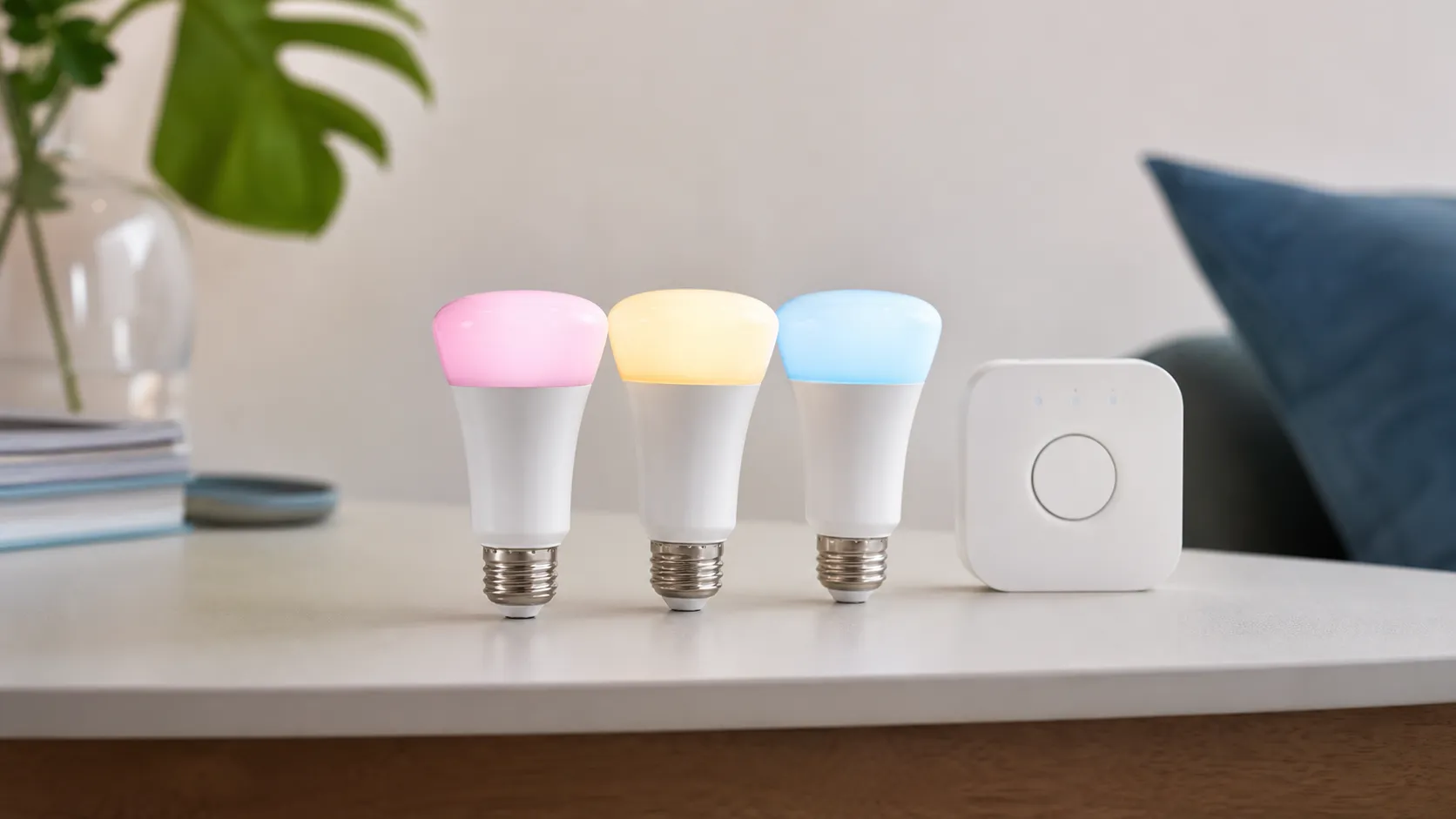
This starter kit from Philips Hue bundles three full‑color smart bulbs with the Hue Bridge, giving you an entry point to Hue’s wider smart‑lighting ecosystem. The bulbs offer tunable white and millions of colors, app‑driven scenes and routines, and compatibility with major voice assistants and third‑party hubs. The Bridge (included) connects to your router and acts as the central hub for local control, automations and integrations.
Because the Bridge is included, the kit is designed for users who want a reliable, feature‑complete smart‑lighting experience out of the box rather than a single standalone bulb connected to Bluetooth.
What reviewers across the internet say
We synthesized thousands of user reviews and professional writeups to create a balanced picture:
-
Amazon (high-volume customer reviews): Largely positive — overall rating ~4.5/5 across ~55,100 reviews. Buyers praise the color quality, dependable dimming and the convenience of the Hue app and Bridge. Most negative notes focus on price and occasional delivery/packaging or DOA (defective on arrival) reports.
-
Reddit (community threads): Mixed‑positive (around 4/5). Community members praise long‑term reliability and deep integrations (Home Assistant, custom automations) but frequently debate whether Hue’s premium pricing is worth it compared with Zigbee or Wi‑Fi alternatives. Users also share practical firmware‑update tips and occasional bug reports.
-
YouTube (video reviews/demos): Positive (≈4.3/5). Video reviewers highlight the visual impact — vivid colors, smooth transitions and compelling scene demos. Many point out the price and compare brightness-per-dollar to cheaper bulbs.
-
Expert blogs and pro reviews: Positive (≈4.4/5). Professionals call out color accuracy, robust software and the value of a mature platform for future expansion. Critics emphasize the premium cost and that some competitors deliver higher lumen output for less money.
Across sources, common themes emerge: excellent color and ecosystem benefits, dependable hardware and software updates — balanced by price and occasional software quirks.
Performance & Real-World Use
The Philips Hue White and Color Ambiance 3‑Bulb Starter Kit is quick to set up, consistently responsive, and stays reliable over months because it runs on a Zigbee mesh through the included Bridge. Its colors, tunable whites, and broad integrations (including Matter via the Bridge) make daily routines feel seamless, though you’ll pay more than many competitors for this level of polish and stability.
Buying a smart‑bulb kit in 2026, “performance” means consistent connections, schedules that run, smooth dimming, pleasing color and white quality, and reliability months later across your smart home. Viewed that way, the Philips Hue White and Color Ambiance 3‑Bulb Starter Kit remains one of the few systems that feels polished from minute one and stays steady as you expand it.
In short: the Philips Hue White and Color Ambiance 3‑Bulb Starter Kit is fast to set up, responsive in daily use, and stable over months thanks to Zigbee mesh with the included Bridge. Its colors look rich, whites are versatile, and the ecosystem support is best‑in‑class, though you pay more than many alternatives for the privilege.
What “performance” means for a smart‑bulb starter kit
For connected lighting, the scorecard is simple: setup, control latency, light quality, automation reliability, and ecosystem reach. Because this kit ships with a Hue Bridge, bulbs talk over Zigbee mesh instead of competing with every phone and TV on Wi‑Fi. Each powered Hue lamp repeats the signal, so range grows as you add lights, and commands stay local for fast, predictable response. Philips’ own explainer details the Bridge‑plus‑Zigbee model and why scenes continue running even if your internet drops. (philips-hue.com)
Light quality drives satisfaction as much as app design. The current A19 E26 White & Color Ambiance “60 W equivalent” is rated up to 810 lumens at 4000K (CRI >80) with 25,000 hours of life and ultra‑low dimming down to 0.2%. In practice that means clean fades, flicker‑free night lights, and whites that range from candle‑warm to daylight without harsh transitions. These are published specs, not lab guesses, and they underpin why Hue scenes like Relax, Read, and Energize feel consistent across rooms. (philips-hue.com)
Day‑one and week‑one: setup, pairing, and first routines with the Philips Hue White and Color Ambiance 3‑Bulb Starter Kit
Follow the box flow: plug the Bridge into power and your router by Ethernet, screw in bulbs, open the Hue app, and search. A steady Bridge LED ring signals you’re ready to add Rooms/Zones and try the default scenes. Philips recommends the wired Bridge to avoid 2.4 GHz congestion and keep lighting control independent of your home Wi‑Fi, which in daily use is why schedules keep firing when the internet flickers. (philips-hue.com)
Voice setup is equally straightforward. Link to Apple Home, Google Assistant, or Alexa once, and your Rooms and basic scenes appear for hands‑free control. Philips’ step‑by‑steps for Apple Home mirror the flow we expect: scan the HomeKit code or link Matter through the Bridge, assign rooms, test a scene, and you’re done. Plan on one evening to name lights, arrange Rooms/Zones, and save two or three go‑to scenes; after that, the system mostly runs itself. (philips-hue.com)
Color, brightness, and dimming where it counts
On paper, these A19s top out around 800–810 lumens—classic 60 W equivalent brightness. That’s ideal for bedrooms, lamps, hallways, and many dining fixtures; large living rooms or vaulted ceilings may want two bulbs per fixture or Hue’s 1100–1600‑lumen variants. Whites span an unusually wide 1000–20,000K, so you can dial natural work light at midday and a warm evening glow without the green or pink cast cheaper bulbs sometimes show. Hue’s CRI >80 spec is typical for consumer color bulbs and, combined with smooth fades, makes scene transitions look intentional rather than abrupt. Keep reading whites at 3500–4500K and evenings at 2200–2700K for comfort and contrast control. (philips-hue.com)
There are two predictable limits. Saturated colors always look dimmer than cool white because fewer LEDs are contributing; Hue is no exception, so use color for mood, not task lighting. And a small group of owners find some white presets a touch cooler or warmer in mixed‑finish rooms—easily fixed by saving your own baseline scene once you like the look.
Reliability, latency, and updates over months
Hue’s reputation for “it just works” comes from the Bridge. Zigbee mesh keeps commands local, hops them efficiently room to room, and avoids the Wi‑Fi bottlenecks that can trip up cloud‑dependent bulbs. Leave wall switches on so bulbs stay powered and the mesh remains strong; let the Bridge handle on/off and dimming. Philips documents the Zigbee behavior and the value of a wired Bridge connection in its how‑it‑works and support pages. (philips-hue.com)
One maintenance habit matters: firmware. Philips posts regular Bridge and app release notes and, notably, added Matter support through the Bridge in 2023 so legacy Hue bulbs and accessories ride along into modern ecosystems without re‑pairing each lamp. Schedule updates overnight to avoid routine disruptions, and problems after big drops are usually resolved quickly by follow‑ups. (philips-hue.com)
Plan for power events. Hue lets you set a per‑bulb power‑on behavior—Last state, Custom color/brightness, or Default warm white—so lights don’t come on at 100% after a 3 a.m. outage. In practice, setting bedrooms to Last state and hallways to a soft 30% warm white prevents surprises and preserves the feel of your routines when utility blips or breakers trip.
What the 25,000‑hour rating means in everyday use
Years to replacement based on the bulbs’ 25,000‑hour rating and typical daily use. This is a conversion of manufacturer lifetime rating, not a lab measurement.
View the underlying data
| Measure | Estimated lifespan (years) (y) |
|---|---|
| 1 h/day | 68.5 |
| 3 h/day | 22.8 |
| 6 h/day | 11.4 |
| 8 h/day | 8.6 |
Source: Philips Hue A19 product page (25,000‑hour rating). Years = 25,000 ÷ (hours/day × 365).
Ecosystem fit: HomeKit, Alexa, Google—and Matter via the Bridge
This is where Hue still leads. The bulbs and Bridge work with Apple Home, Google Assistant, and Amazon Alexa for voice scenes, room control, and automations. Current Bridge firmware exposes your Hue home to Matter ecosystems while preserving Zigbee on the back end for range and reliability, so you keep mature Hue features—Entertainment sync, accessories, motion rules—without juggling multiple integrations. Philips documents the process in its “Works with Apple Home” and Matter pages. (philips-hue.com)
Because the Bridge is the single integration point, changing controllers later is painless: add the Bridge to the new app and your rooms and lights follow. No re‑pairing bulb‑by‑bulb.
A small but important nuance: the product pages specify “Hue Bridge required” for full assistant support and away‑from‑home control. Bluetooth works for a lamp or two, but the full experience—multi‑room scenes, automations, accessories—assumes the Bridge. If you plan any expansion, start there. (philips-hue.com)
Feature availability: Bluetooth‑only vs with the Hue Bridge
What you gain when you use the included Bridge instead of Bluetooth‑only control.
| Item | Bluetooth‑only | With Hue Bridge |
|---|---|---|
| Basic on/off/dim & scenes | Yes | Yes |
| Apple Home (HomeKit) | No | Yes |
| Amazon Alexa | No | Yes |
| Google Assistant | No | Yes |
| Away‑from‑home control | No | Yes |
| Matter integration (via Bridge) | No | Yes |
| Zigbee mesh networking | No | Yes |
| Thread support | No | No |
| Hue accessories (dimmer, motion) | No | Yes |
| Entertainment sync features | No | Yes |
Sources: Philips Hue A19 product page (protocols, assistant support); Hue Bridge release notes and Matter page for Matter behavior.
Where it excels—and where you’ll find its limits
Hue excels at whole‑home routines and fast, predictable response. Gradual wake‑ups over 20–30 minutes feel natural, scene changes ripple through rooms within a beat, and motion‑triggered entries avoid the half‑second lag you’ll notice with many Wi‑Fi bulbs. Entertainment sync remains a highlight for home‑theater setups, and the Bridge keeps it all local so family use doesn’t depend on a phone being home.
Limits are practical, not surprising. Value per lumen trails budget brands, and the 60 W‑class ceiling (~810 lm) won’t flood a big living room by itself—use two bulbs per fixture or move to Hue’s 1100/1600‑lumen options. As with any active platform, occasional app or firmware changes can unsettle routines; scheduling updates overnight and leaving switches on eliminates most hiccups. The specs and Bridge notes back the brightness tiers and feature gating we reference here. (philips-hue.com)
How it stacks up against typical alternatives
If you’re cross‑shopping, focus on brightness and network strategy. Nanoleaf’s Essentials A19 Matter bulb lists up to 1100 lumens (806 typical) with a 25,000‑hour rating—brighter on paper than Hue’s 60 W‑class bulb and strong for single‑room Thread/Matter setups. TP‑Link’s Kasa KL130 and Sengled’s Zigbee color A19 both land around 800 lumens and 25,000 hours, often beating Hue on price per bulb. Hue’s advantage is the Bridge‑backed Zigbee mesh and clean Matter bridge‑in, which preserves Hue‑specific extras while delivering platform flexibility. For multi‑room homes, that architecture is why Hue still feels “boringly reliable.” (homedepot.com)
Published brightness and rated lifetime vs popular alternatives
Published specs put Hue’s 60W‑class A19 below some rivals on peak lumens, but rated lifetimes are similar across leading options. Data aggregated from manufacturers’ spec sheets and major retail listings.
- Brightness (lm)
- Rated lifetime (h)
View the underlying data
| Item | Brightness (lm) | Rated lifetime (h) |
|---|---|---|
| Philips Hue WCA A19 (60W) | 810 | 25000 |
| Nanoleaf Essentials A19 (Matter) | 1100 | 25000 |
| TP-Link Kasa KL130 | 800 | 25000 |
| Sengled Zigbee Color A19 | 800 | 25000 |
Sources: Philips Hue A19 product page; Nanoleaf Essentials A19 retail spec; TP‑Link KL130 datasheet; Sengled support docs.
Get the best performance: step‑by‑step
- Place and wire the Bridge by Ethernet, a few feet from big Wi‑Fi antennas, to cut 2.4 GHz noise and keep lighting control local. (philips-hue.com)
- Keep wall switches on so Zigbee stays powered; add a Hue Dimmer Switch for guests who reach for the switch. (philips-hue.com)
- Set Power‑on behavior per room so outages don’t blast 100% brightness; “Last state” for bedrooms, a dim warm preset for halls helps.
- If you notice sporadic delays, change the Bridge’s Zigbee channel away from crowded Wi‑Fi in Bridge settings; a short reboot re‑forms the mesh.
- Group lights into Rooms/Zones before building routines; it reduces chatter and simplifies voice control.
- Calibrate whites early: save a 4000K “Read” and 2700K “Evening” so one tap restores your baseline.
- Schedule firmware updates for off‑hours to avoid routine interruptions; Philips posts frequent Bridge releases. (philips-hue.com)
- Match bulb class to the room: 60 W‑class A19s (≈810 lm) for lamps/bedrooms; 1100/1600‑lm Hue A‑series for big rooms or tall ceilings. (philips-hue.com)
- Plan for growth: a standard Bridge suits most homes; Bridge Pro—rated by Signify for up to 150 lights and 50 accessories—fits heavy users. (signify.com)
- Energy check: at 7.2 W per bulb at full output, three bulbs draw ~21.6 W; standby is ~0.1 W per bulb. Handy context if you leave scenes on for hours. (philips-hue.com)
Verdict: does real‑world performance justify the price?
If you want dependable, multi‑room smart lighting, yes. The Bridge‑based Zigbee mesh, polished app and scenes, broad platform support—including Matter via the Bridge—and credible 25,000‑hour, ~810‑lumen specs make daily use smooth and long‑term ownership low‑maintenance. You can spend less per bulb, and some rivals post higher single‑bulb lumens, but few match Hue’s combination of reliability, integrations, and mature accessories. For households that value “works every day” above bargain pricing, this kit earns its keep. (philips-hue.com)
Pros and cons
Pros
- Wide, vivid color range with smooth transitions and usable scene presets.
- Strong ecosystem and third‑party integrations (HomeKit, Alexa, Google, Home Assistant and many hubs).
- Easy out‑of‑the‑box setup when you use the included Hue Bridge.
- High build quality and consistent, flicker‑free dimming.
- Regular firmware updates and an active developer/community ecosystem for advanced automations.
Cons
- Premium upfront price — perceived value is the central objection.
- Value‑per‑lumen is lower than some competing high‑output bulbs.
- Occasional app/firmware quirks or updates can temporarily disrupt automations.
- A small percentage of users report defective units or delivery issues.
- Some users feel certain whites or saturated scenes don’t match their expectations without manual tuning.
Who should buy it (and who shouldn’t)
Buy this kit if:
- You want a mature, reliable smart‑lighting platform that scales: the included Bridge and Hue’s ecosystem make expansion and integrations easy.
- Color quality and scene control matter: for media rooms, mood lighting, or accent setups the Hue bulbs deliver impressive visual effects.
- You use or plan to use smart‑home assistants or third‑party controllers (HomeKit, Alexa, Google, Home Assistant) and want strong compatibility and local automations.
- You value consistent dimming, build quality and ongoing software feature updates.
Skip this kit if:
- Your top priority is the cheapest price per lumen — there are cheaper bulbs that produce more raw brightness for the money.
- You need an ultra‑simple, single‑room Bluetooth solution; if you don’t plan to expand beyond a few bulbs, a Bluetooth bulb may be more cost‑effective.
- You’re extremely price‑sensitive and don’t care about advanced automations or platform longevity.
Final buying tips
- Use the included Hue Bridge for the best experience. Bluetooth alone will work for a couple of bulbs, but the Bridge unlocks local automations and broad integrations.
- If you’re budget‑conscious, compare lumen output and check whether you need three full‑color bulbs or a mix of color and white (or fewer bulbs to start).
- Before large purchases, read recent firmware notes and community threads; a small number of users report update‑related interruptions, and the community often posts quick workarounds.
Overall, the Philips Hue White and Color Ambiance 3‑Bulb Starter Kit remains a top pick for shoppers who want premium color control, a proven ecosystem and dependable long‑term support. If you prioritize raw brightness for the lowest price, look at value‑focused brands — but if features, integrations and a polished app experience matter, Hue is hard to beat.
What Reviewers Love
- Wide and vivid color range with smooth transitions and good scene presets.
- Robust ecosystem and third‑party integrations (works with HomeKit, Alexa, Google, many smart‑home hubs).
- Easy out‑of‑the‑box setup with Hue Bridge and intuitive app controls and routines.
- High build quality and consistent dimming performance without flicker.
- Regular firmware feature updates and strong developer / community support.
Common Complaints
- High upfront cost compared with many single smart bulbs or cheaper ecosystems.
- Value-per-lumen is lower than some competitors (you pay for ecosystem and features).
- Occasional app/firmware quirks and updates that temporarily disrupt routines.
- Some users report the color white / saturation not matching expectations in certain scenes.
Our Verdict
4.5The Philips Hue 3‑Bulb Starter Kit is a polished, reliable choice for anyone who values color quality, scene control and smart‑home integrations. It carries a premium price, but for users who want a long‑term, expandable ecosystem the Hue experience is worth the cost.
Frequently Asked Questions
Common questions shoppers ask before buying the Philips Hue White and Color Ambiance 3‑Bulb Starter Kit.
Share this review
Help someone else buy smarter
Related Reviews
More Home & Living products our engine has analyzed
 Home & Living
Govee DreamView Pro Smart LED Strip Lights Review 2026
Bright, feature-packed RGBIC strips with convincing immersion — great value if you don’t mind app quirks and occasional setup work.
 Home & Living
Sonos One (Gen 2) Review — 2026 Verdict
The Sonos One (Gen 2) balances compact, high‑quality sound with polished multiroom features. Great for Sonos homes; pricier and Wi‑Fi‑only for others.
 Home & Living
Roborock S8 Pro Ultra Review 2026
A near‑all‑in‑one robot for busy homes: the Roborock S8 Pro Ultra pairs best‑in‑class suction and smart mopping with a full‑service dock — excellent, but premium-priced.