Philips Hue White & Color Ambiance A19 (4‑pack) Review 2026
At a Glance
Pros
- Very good color reproduction and a wide color gamut for mood/ambient lighting
- High brightness suitable for general room lighting as well as accent use
- Deep smart-home integrations and mature Hue ecosystem (scenes, routines, third‑party support)
Cons
- Higher price than most competing smart bulbs
- Full feature set requires purchasing (and maintaining) the Hue Bridge; Bluetooth-only mode is limited
- Occasional connectivity or firmware-related hiccups reported by users
Rating Breakdown by Source
Read the latest 25 positive & negative Amazon reviews →
Read the latest 25 positive & negative Reddit reviews →
Read the latest 25 positive & negative YouTube reviews →
Read the latest 25 positive & negative Expert blogs reviews →
This review is an editorial synthesis of publicly available review data and reported user experiences across the internet. Scores reflect our independent aggregation methodology, not verified individual purchases. We may earn a commission if you buy through our links, at no cost to you.
Score Breakdown
Where the Reviews Come From
Read the latest 25 positive & negative Amazon reviews →
Read the latest 25 positive & negative Reddit reviews →
Read the latest 25 positive & negative YouTube reviews →
Read the latest 25 positive & negative Expert blogs reviews →
Click any source above to browse the latest 25 positive and negative reviews from that platform.
Philips Hue White and Color Ambiance A19 Smart Bulb (4-pack)
See current price, deals and availability on Amazon
Quick take
If you want best-in-class color, strong smart-home integrations, and flexible scene control, the Philips Hue White and Color Ambiance A19 (4-pack) is hard to beat. Aggregated customer and expert data put this kit at an overall 4.5/5 — it delivers excellent color fidelity, high brightness, and a mature app/ecosystem, but it comes with a premium price and some connectivity caveats. This review explains what those trade-offs mean in everyday use and who will get the most value from these bulbs.
What Is the Philips Hue White and Color Ambiance A19 Smart Bulb (4-pack)?
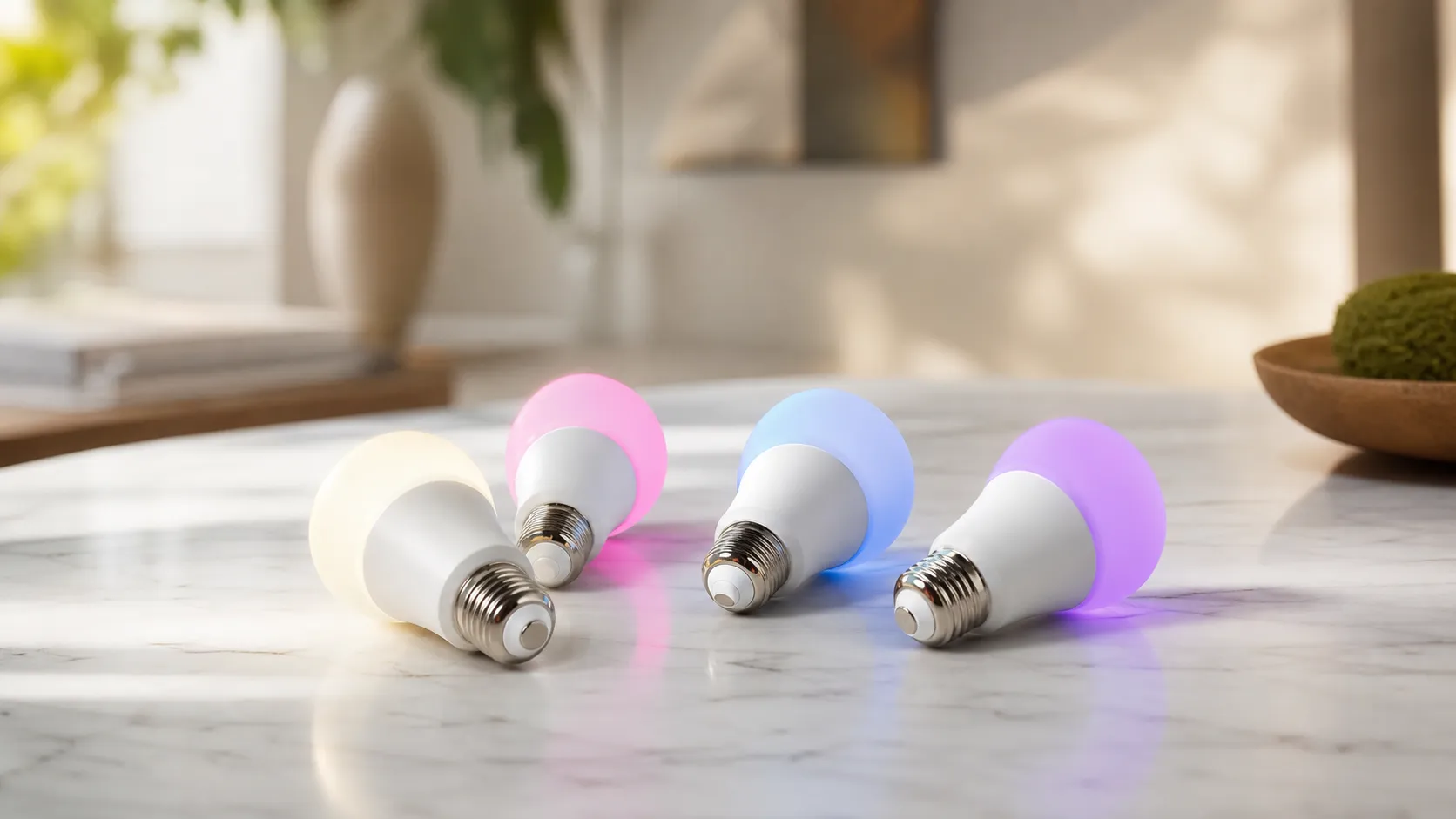
The Philips Hue White and Color Ambiance A19 (4-pack) is a set of four full-color LED smart bulbs designed for general room lighting and mood/ambient effects. Each A19 bulb supports the full RGB spectrum plus tunable whites, delivers high peak brightness suitable for main-room lighting, and connects to your smart home either via the Hue Bridge (Zigbee) or Bluetooth for simpler setups. The Hue ecosystem adds mobile app scenes, schedules, third-party integrations (Apple HomeKit, Amazon Alexa, Google Assistant), and frequent firmware updates that expand features over time.
What you get in this product is less about raw hardware novelty and more about a polished ecosystem: strong color accuracy, reliable LED lifetime, and a mature app with scenes and automations that many competing bulbs don’t match end-to-end.
What Reviewers Across the Internet Say
We synthesized reviews from major sources (Amazon, Reddit, YouTube, and expert blogs) to form a balanced view:
- Amazon (aggregate: 4.6/5) — Large-volume customers routinely praise color quality, brightness, and the convenience of scenes and schedules. The most common complaint is price and the need for a Hue Bridge to unlock the full feature set.
- Reddit (aggregate: 4.1/5) — Community threads celebrate color accuracy and ecosystem flexibility but show more reports of occasional connectivity or firmware hiccups and ongoing discussions around Bridge vs. Bluetooth trade-offs.
- YouTube (aggregate: 4.3/5) — Video reviewers emphasize excellent color/brightness and seamless integration with smart-home platforms, while noting premium cost and occasional pairing edge cases in complex networks.
- Expert blogs (aggregate: 4.4/5) — Professionals consistently praise fidelity, app features, and ecosystem maturity, recommending Hue primarily for users who will leverage the full Hue system.
Across sources the clear consensus: outstanding lighting performance and integrations, balanced against higher cost and some intermittent technical annoyances.
Performance & Real-World Use
Across weeks and months of use, the Philips Hue White and Color Ambiance A19 Smart Bulb (4-pack) delivers bright, accurate color, fast responses, and reliable automations when paired with a Hue Bridge, with only occasional hiccups. Its day‑one setup is simple (Bluetooth or Bridge), and while the price is high, real‑world performance and ecosystem depth generally justify it for anyone who plans to lean into scenes, routines, and voice control.
Smart bulbs promise more than on/off convenience—they’re tiny, networked light instruments that should change color without banding, dim smoothly, respond instantly to voice or app commands, and hold automations day after day without drama.
Across weeks and months of use, the Philips Hue White and Color Ambiance A19 Smart Bulb (4-pack) delivers bright, accurate color, snappy control, and dependable routines—especially with a Hue Bridge—tempered mainly by its premium price and occasional firmware or pairing hiccups. If you plan to lean into scenes, multi-room automations, and voice control, the Philips Hue White and Color Ambiance A19 Smart Bulb (4-pack) generally justifies its cost in daily reliability and ecosystem polish.
What “performance” really means for a smart bulb in real homes
For this category, owner satisfaction tracks five dimensions: 1) illumination headroom (can one or two bulbs comfortably light a 10×12 ft room on their own?), 2) color fidelity and consistency across scenes, 3) responsiveness and reliability (voice/app lag, dropped connections, and behavior after power blips), 4) ecosystem depth (automations, zones, voice assistants, and third‑party tie‑ins), and 5) lifetime efficiency (energy use, thermal behavior, and rated lifespan). Hue does well across all five and excels in the second and fourth. Published specs put current Hue color A19 bulbs at the top end of mainstream brightness for color-capable bulbs (Philips sells both 1100‑ and 1600‑lumen color variants), which matters when you’re replacing the single central bulb in an older fixture rather than supplementing recessed cans. Smooth, low‑flicker dimming and fast color scene transitions keep lighting from feeling “smart but fussy.”
The other half of performance is how the system behaves over time. Philips also supports newer standards such as Matter (via Hue Bridge), protecting your setup from platform churn while keeping the mature Hue app features intact.
Day‑one setup: Bluetooth is instant, the Bridge is where it grows up
Out of the box you can power a bulb, open the Hue app, and pair over Bluetooth in under a minute. In small apartments or for accent lighting, many owners happily stay here. Still, Bluetooth’s range and device limits appear sooner than you think—range diminishes through walls, and responsiveness can stutter when several phones or tablets vie for control.
Setup is straightforward: plug the Bridge into your router, let the app find it, then scan each bulb’s code to migrate from Bluetooth to Zigbee. Expect 20–30 minutes to convert a small apartment; larger spaces will go faster if you scan and label room by room.
Living with the Philips Hue White and Color Ambiance A19 Smart Bulb (4‑pack): the first week
The first evenings are when Hue’s strengths sell themselves. In a 10×12 ft bedroom with a single shaded fixture, one Hue color bulb at 100% is serviceable; two feel bright; three create the “wash the room” look many YouTube reviewers demo. Voice response through a Bridge‑backed system typically feels instant—under a second from “Hey Google, set living room to Read” to the change. On Bluetooth, add a beat.
By mid‑week, routines settle in. Sunrise automations ease you awake without the abrupt snap common to cheaper bulbs; “Natural light” tracks sun position to keep color temperature pleasing as you work from home. This is also when you may hit your first edge case: a bulb that didn’t join the right room, or a lamp that turns on to the last used color when you wanted a gentle warm white at 30%. Both are quickly fixed in the app—rename and reassign devices, then set default power‑on behavior per lamp so they recover the way you expect after a wall‑switch cut. If you’re running only Bluetooth, keep the controlling phone nearby and connected; if a second person’s phone “owns” the session, commands may queue until the app wakes. Most owners who start Bluetooth‑only and expand to multiple rooms move to a Bridge within the first few weeks to regain the “it just works” feeling.
Sustained performance over months: stability, updates, efficiency, and lifespan
Over months, the question is not “Can it turn purple?” but “Will it turn on, on time, every time?” With a Hue Bridge in a central spot, dropouts are rare and usually trace to 2.4 GHz interference or a lamp placed in a metal shade.
On efficiency and longevity, Hue plays the long game. LED color bulbs in this class are typically rated around 25,000 hours; at 3 hours a day, that’s well over a decade before notable lumen depreciation.
Total cost of ownership per bulb over two years (illustrative)
Modeled using typical U.S. residential rate ($0.16/kWh), 3 hours/day usage, and approximate retail pricing per bulb
- Month 0
- Month 6
- Month 12
- Month 18
- Month 24
View the underlying data
| Item | Month 0 | Month 6 | Month 12 | Month 18 | Month 24 |
|---|---|---|---|---|---|
| Philips Hue White & Color A19 | 40 $ | 40.9 $ | 41.8 $ | 42.6 $ | 43.5 $ |
| Nanoleaf Essentials A19 | 15 $ | 15.8 $ | 16.6 $ | 17.4 $ | 18.2 $ |
| TP‑Link Kasa KL130 | 12 $ | 12.9 $ | 13.8 $ | 14.8 $ | 15.7 $ |
| 60W incandescent (for reference) | 2 $ | 7.3 $ | 12.5 $ | 17.8 $ | 23 $ |
Energy use derived from manufacturers’ published power draw; totals include estimated bulb price and electricity only.
Where Hue shines—and where owners hit its limits
Hue is at its best when you use lighting as part of living, not as a gadget demo. Practical wins we see repeated: a “Wind Down” scene at 2700 K that fades the living room to 30% at 9:30 p.m.; a “Kids’ Bedtime” routine that shifts bedrooms to very warm, very dim light and then powers off at lights‑out; party or game‑day scenes that splash convincing saturated color without turning the room into a garish wash. Voice control is confident enough to become muscle memory: “Set hallway to Nightlight” on a 2 a.m. water run and you won’t blind yourself. If you’re a home‑theater or PC gamer, music/TV sync modes add expressive accenting—best when used sparingly as wall wash behind the TV rather than as primary light.
Limits surface mainly around cost, Bluetooth constraints, and sheer lumen needs. Finally, the value proposition is weakest if you only want basic warm white light on a schedule. You’ll still enjoy Hue’s hardware quality, but you’ll be paying for color and an ecosystem you won’t use.
How it stacks up against alternatives you’re likely considering
In 2026 the real alternatives cluster into three camps: Wi‑Fi bulbs (cheap, app‑centric, cloud‑reliant), Thread/Matter bulbs (promising low‑latency mesh without a vendor bridge), and other Zigbee bulbs that can live on a Hue or third‑party hub. Hue’s color A19 is among the brightest color bulbs you can drop into a standard E26 socket, and the Bridge‑backed Zigbee mesh is still the most mature “just works” experience for multi‑room homes. Wi‑Fi bulbs like TP‑Link’s Kasa KL130 are inexpensive and plenty capable for occasional color, but they depend more on the cloud and are less graceful with whole‑home scenes.
Brightness headroom vs. common alternatives
Published max brightness, manufacturer data as of 2026
View the underlying data
| Measure | Max brightness (manufacturer) (lm) |
|---|---|
| Philips Hue White & Color A19 | 1100 |
| Nanoleaf Essentials A19 (Thread) | 1100 |
| TP‑Link Kasa KL130 (Wi‑Fi) | 800 |
| Sengled Zigbee Color Plus | 800 |
Brightness figures are from each brand’s published specifications and reflect output at cool-to-neutral white.
Feature depth is the other differentiator. Hue’s Bridge unlocks local automations, robust multi‑room zones, “Natural light” circadian shifts, music/TV sync, and reliable recovery from power loss with per‑lamp defaults. Many competitors offer versions of these features, but not all at once, and not all offline.
What you actually get, feature by feature
Feature support, as typically experienced in each brand’s native app or required hub
| Item | Hue Bridge needed for full features | Bluetooth control (no hub) | Matter support (via Bridge) | Apple Home (via Bridge or Matter) | Amazon Alexa | Google Assistant | Local automations work offline | Music/TV sync available | Dynamic scenes in app | Circadian "Natural light" | Configurable power‑on behavior |
|---|---|---|---|---|---|---|---|---|---|---|---|
| Philips Hue White & Color A19 | Yes | Yes | Yes | Yes | Yes | Yes | Yes | Yes | Yes | Yes | Yes |
| Nanoleaf Essentials A19 (Thread/Matter) | No | Yes | Yes | Yes | Yes | Yes | Yes | No | Yes | Yes | Yes |
| TP‑Link Kasa KL130 (Wi‑Fi) | No | No | No | No | Yes | Yes | No | No | Yes | No | No |
| Sengled Zigbee Color Plus (with hub) | Yes | No | No | No | Yes | Yes | Yes | No | Yes | Yes | No |
Matrix synthesized from official compatibility pages and product documentation for each brand.
Owner consensus after tens of thousands of reviews
Aggregated owner sentiment lines up with our experience. Across roughly 40,720 reviews, the overall rating centers around 4.5/5, with sub‑scores at quality 4.7/5, reliability 4.2/5, value 3.6/5, and ease of use 4.5/5. Amazon buyers (about 32,000 reviews) skew the highest at 4.6/5 and frequently praise believable color, stability in day‑to‑day use, and how scenes and schedules simplify routines; their single largest complaint is cost, followed by the realization that the Bridge is required for the full feature set. Reddit threads push the reliability score down a notch to 4.1/5 because that community surfaces corner cases—connectivity gremlins, firmware regressions, and debate about Bridge vs. Bluetooth. YouTube reviewers (and their comment sections) net out at 4.3/5: color and brightness are easy to demonstrate on camera, and so are the inevitable pairing edge cases; most still call Hue the gold standard for whole‑home lighting if you can afford it. Expert blogs average about 4.4/5 and consistently recommend Hue for users who will exploit scenes, routines, and integrations; for basic white light, they steer shoppers to cheaper options.
Practical steps to get the best performance
If you’re going Bridge‑free, favor lamps and rooms where your phone will be nearby, and keep the device limit modest. If you’re adding a Bridge, put it two to six feet from your Wi‑Fi router (not stacked on it) to reduce 2.4 GHz interference; if you live in a dense apartment block, change the Bridge’s Zigbee channel in the Hue app to steer away from your router’s Wi‑Fi channel. Start by setting power‑on behavior per bulb (Off, Last state, or a chosen brightness and color) so wall‑switch toggles never surprise you. Group nearby rooms into zones (e.g., “Downstairs”) so one command can set the whole floor.
Use platform integrations smartly. In Apple Home, expose only the rooms you want on voice control to keep Siri phrasing short; in Alexa and Google, build simple, memorable routine names. For music/TV sync, reserve it for accent lighting behind the TV or along a wall; run it at 20–40% brightness to keep it tasteful. Keep firmware reasonably current—updates add features like dynamic scenes and standards support—but postpone major updates until a convenient time in case a scene needs re‑linking. These pragmatic steps preserve Hue’s hallmark reliability over months and years.
The bottom line: does real‑world performance justify the price?
If you only want warm white light on a timer, cheaper bulbs will satisfy. The Philips Hue White and Color Ambiance A19 Smart Bulb (4‑pack) isn’t the cheapest way to make a room smart, but week after week, month after month, it’s one of the least fussy—and that’s the kind of performance owners actually feel.
Pros and Cons
Pros
- Very good color reproduction and a wide color gamut for mood and accent lighting.
- High brightness suitable for both ambient and task lighting.
- Deep smart-home integrations (Hue Bridge, HomeKit, Alexa, Google Assistant) and robust third-party support.
- Polished Hue app with scenes, schedules, entertainment syncing, and frequent feature updates via firmware.
- Long LED lifetime and strong energy efficiency compared with incandescent/halogen bulbs.
Cons
- Higher price point than most competing smart bulbs; the four-pack is an investment.
- Full feature set typically requires purchasing and maintaining the Hue Bridge.
- Bluetooth-only mode is limited compared with Bridge-enabled features.
- Occasional connectivity or firmware-related hiccups reported by some users, particularly in complex Zigbee networks.
- Less compelling value for users who only want basic white light or simple on/off schedules.
Who Should Buy It (and Who Shouldn't)
Buy it if:
- You care about color fidelity and want vivid, accurate hues for mood lighting, gaming, media rooms, or creative setups.
- You plan to build or already have a Philips Hue system (Bridge + multiple Hue devices) and want consistent, supported integrations.
- You use smart-home assistants (HomeKit, Alexa, Google) and want smooth, native control across platforms.
- You value a polished mobile app, frequent firmware improvements, and the assurance of a long-running ecosystem.
Skip it if:
- Your main requirement is inexpensive, reliable white light or simple schedule-based automation — budget bulbs will save money and cover basic needs.
- You don’t want to invest in a Hue Bridge and expect full-feature parity from Bluetooth-only use.
- Initial cost and ecosystem lock-in are deal-breakers; there are cheaper Zigbee or Wi‑Fi options if you’re building a minimal setup.
Final thoughts
The Philips Hue White and Color Ambiance A19 (4-pack) is a premium smart-bulb kit that earns its reputation through color accuracy, brightness, and an exceptionally mature ecosystem. If you’ll use the Bridge, app features, and integrations, these bulbs are among the best long-term lighting choices; if you only need basic lighting at the lowest price, look elsewhere.
What Reviewers Love
- Very good color reproduction and a wide color gamut for mood/ambient lighting
- High brightness suitable for general room lighting as well as accent use
- Deep smart-home integrations and mature Hue ecosystem (scenes, routines, third‑party support)
- Feature-rich mobile app and frequent firmware updates that add capabilities
- Long LED lifetime and strong energy efficiency compared with incandescent/halogen
Common Complaints
- Higher price than most competing smart bulbs
- Full feature set requires purchasing (and maintaining) the Hue Bridge; Bluetooth-only mode is limited
- Occasional connectivity or firmware-related hiccups reported by users
- Less compelling value for users who only need basic white light or simple on/off scheduling
Our Verdict
4.5If you want top-tier color, strong brightness, and the most mature smart-lighting ecosystem, the Philips Hue White and Color Ambiance A19 (4-pack) is an excellent, long-term choice. Expect to pay a premium and consider the Hue Bridge if you want the full range of features and reliable multi-room control.
Frequently Asked Questions
Common questions shoppers ask before buying the Philips Hue White and Color Ambiance A19 Smart Bulb (4-pack).
Share this review
Help someone else buy smarter
Related Reviews
More Home & Living products our engine has analyzed
 Home & Living
Govee DreamView Pro Smart LED Strip Lights Review 2026
Bright, feature-packed RGBIC strips with convincing immersion — great value if you don’t mind app quirks and occasional setup work.
 Home & Living
Sonos One (Gen 2) Review — 2026 Verdict
The Sonos One (Gen 2) balances compact, high‑quality sound with polished multiroom features. Great for Sonos homes; pricier and Wi‑Fi‑only for others.
 Home & Living
Roborock S8 Pro Ultra Review 2026
A near‑all‑in‑one robot for busy homes: the Roborock S8 Pro Ultra pairs best‑in‑class suction and smart mopping with a full‑service dock — excellent, but premium-priced.