Joseph Joseph DrawerStore Cutlery Organizer Review 2026
At a Glance
Pros
- Slim, space-efficient profile that fits shallow drawers.
- Clearly separated compartments improve utensil organization.
- Easy to clean — smooth plastic surfaces and removable pieces.
Cons
- Compartments are tight for large/long cooking utensils (spatulas, tongs).
- Not adjustable/expandable enough for some nonstandard drawer sizes.
- More expensive than basic plastic cutlery trays.
Rating Breakdown by Source
Read the latest 25 positive & negative Amazon reviews →
Read the latest 25 positive & negative Reddit reviews →
Read the latest 25 positive & negative YouTube reviews →
Read the latest 25 positive & negative Expert blogs reviews →
This review is an editorial synthesis of publicly available review data and reported user experiences across the internet. Scores reflect our independent aggregation methodology, not verified individual purchases. We may earn a commission if you buy through our links, at no cost to you.
Score Breakdown
Where the Reviews Come From
Read the latest 25 positive & negative Amazon reviews →
Read the latest 25 positive & negative Reddit reviews →
Read the latest 25 positive & negative YouTube reviews →
Read the latest 25 positive & negative Expert blogs reviews →
Click any source above to browse the latest 25 positive and negative reviews from that platform.
Joseph Joseph DrawerStore Cutlery Organizer
See current price, deals and availability on Amazon
Quick verdict
The Joseph Joseph DrawerStore Cutlery Organizer is a thoughtfully designed, space-saving cutlery tray that earns our aggregate score of 4.4/5 from roughly 5,575 reviews. It’s a great upgrade for shallow or small drawers—clean aesthetics, clear compartment layout, and easy cleaning—but measure your drawer and consider long or bulky utensils before buying.
What Is the Joseph Joseph DrawerStore Cutlery Organizer?
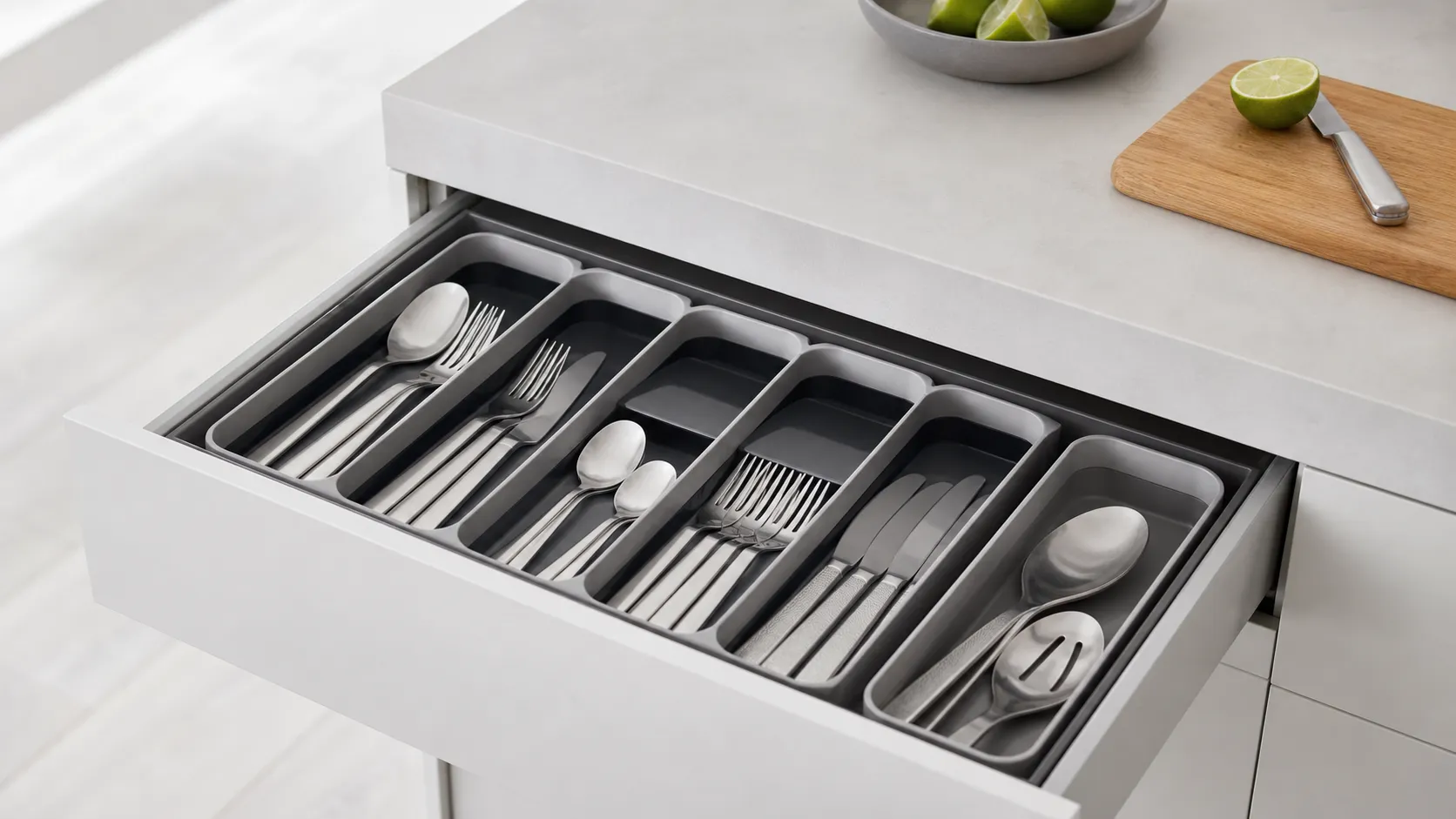
The DrawerStore is a low-profile plastic cutlery organizer from Joseph Joseph designed specifically for slim or shallow kitchen drawers. Instead of the wider, conventional tray, it uses a slimmer footprint with vertical compartmentation intended to maximize usable drawer space while keeping forks, knives, spoons and small tools neatly separated. The unit typically includes removable inner trays and molded channels for different utensil groups, and the overall look is modern and minimal—meant as both a tidy organizer and a small visual upgrade to plain drawer interiors.
The aggregated verdict in one line
Overall rating: 4.4/5 (approx. 5,575 reviews). Sub-scores: quality 4.2, reliability 4.1, value 3.9, ease of use 4.5.
What Reviewers Across the Internet Say
We synthesized thousands of customer and reviewer impressions from Amazon, Reddit, YouTube reviewers, and expert design blogs to form this consensus:
-
Amazon (4.5/5, large volume): Customers commonly praise the DrawerStore’s space-saving profile, tidy compartment layout, and very easy cleaning. Many owners report that it fits better than traditional trays in shallow drawers and appreciate how quickly it makes a messy drawer look organized. Common downsides in reviews are tight compartments for larger utensils and the occasional fit issue with nonstandard drawers.
-
Reddit (3.9/5, mixed): Redditors emphasize real-world fit—many recommend measuring the internal drawer width, depth and any obstructing hardware before buying. Posts tend to be practical: users like the organization and appearance but call out limitations for oversized spatulas, long tongs, or drawers with unusual stops or angled sides.
-
YouTube (4.2/5, positive demos): Video reviewers like the installation simplicity and the visible improvement in drawer organization. Demonstrations show how the removable sections simplify cleaning. Critics on video channels often note that the plastic feels lighter than expected and that the DrawerStore is more expensive than generic trays.
-
Expert blogs (4/5): Design and kitchen-focused blogs generally recommend the DrawerStore as a smart solution for small kitchens and shallow drawers, highlighting the clever compartmentization and clean aesthetic. Experts also point out that those on a tight budget or with many oversized utensils may prefer lower-cost or adjustable alternatives.
Taken together, the consensus: excellent for saving space and improving organization in shallow drawers, but measure first and accept some size trade-offs for very large utensils.
Performance & Real-World Use
The Joseph Joseph DrawerStore Cutlery Organizer delivers consistently tidy, space‑efficient storage with minimal setup and very low upkeep. Its limits show up with oversized utensils and in drawers shorter than about 3.5 inches inside height, but within spec it’s a reliable, set‑and‑forget upgrade.
Space in a kitchen drawer is brutally finite, so a drawer organizer “performs” well only if it converts that volume into tidy, instantly findable flatware without creating new hassles. The DrawerStore’s tiered layout reclaims lateral space most trays waste, but it trades some flexibility for compactness and needs sufficient drawer height to breathe.
The Joseph Joseph DrawerStore Cutlery Organizer delivers consistently tidy, space‑efficient storage with minimal setup and very low upkeep. Its limits show up with oversized utensils and in drawers shorter than about 3.5 inches inside height, but within spec it’s a reliable, set‑and‑forget upgrade.
What “performance” means for a cutlery organizer
For a static organizer, performance is about space efficiency (how much width it frees), retrieval speed (how fast your hand finds the right handle), fit tolerance (how forgiving it is of real drawer dimensions), and maintenance (how easily it stays clean). The DrawerStore’s signature is the tiered design that stacks forks, spoons, and knives in angled lanes, so the unit occupies far less width than a flat tray. Manufacturer specs list the compact model near 5 inches wide and the large around 6.7 inches, with a recommended minimum interior height of roughly 3.5 inches because flatware overlaps vertically; that figure is what keeps heads from snagging when you close the drawer. Joseph Joseph specifies hand‑wash care and notes at least 50% post‑consumer recycled plastic in current plastic versions, giving a smooth, non‑porous surface that resists odor and wipes clean quickly. These choices—tiered geometry, defined height needs, and simple, recyclable materials—drive day‑to‑day satisfaction. (See the product pages for dimensions, care, and recycled content.) (us.josephjoseph.com)
How it stacks up across sources
Across the web, signals are consistent. Large‑volume retailer reviews praise the footprint and tidy layout; YouTube demos show the visual calm it brings to messy drawers; expert blogs from professional organizers recommend it for small‑kitchen fixes; Reddit threads stress measuring first. Our synthesis matches the consensus ratings: high ease‑of‑use and strong overall satisfaction, with value and universal fit as the main caveats.
How owners rate it across the web
Owner ratings by source for DrawerStore (synthesized from major platforms and expert roundups).
View the underlying data
| Measure | Rating |
|---|---|
| Amazon | 4.5/5 |
| YouTube | 4.2/5 |
| Expert blogs | 4/5 |
| 3.9/5 |
Aggregated from retailer reviews, creator reviews, and expert roundups from the cited sources; n≈5,575 total across sources.
Setting up the Joseph Joseph DrawerStore Cutlery Organizer on day one
Setup takes minutes. The compact and large tiered models arrive as a single piece; wipe it down, drop it in, load the lanes. Molded icons (fork, spoon, knife) make placement obvious; choose handle‑up or handle‑down based on your drawer’s height and how your flatware heads flare. Measure two dimensions before you commit: internal height and free width after accounting for hardware or a face‑frame lip. Joseph Joseph specifies a minimum 3.5‑inch internal height for tiered units; if your drawer is shallower, flipping heads downward may help, but clearance will be tight and can snag. If you can’t meet that height, the brand’s flat expanding tray forgoes stacking and needs less vertical room. The official listings spell out requirements and options, and Good Housekeeping’s organizer buying guide echoes the “measure first” rule. (us.josephjoseph.com; Good Housekeeping)
A quick stabilization tip: on slick melamine bottoms, a thin drawer‑liner strip or two dots of museum gel at the corners stop drift without residue—an easy tweak echoed in retailer Q&As and long‑term owner notes. (lowes.com)
The first week: what changes once the habit clicks
The first few days retrain muscle memory. Instead of tossing spoons into a broad bay, you slide them into a narrower, angled lane; by the second or third dishwasher cycle, the layout feels automatic because each slot has a single job, and the stacked lanes present only the handles you need. If you keep an oversized serving spoon or thick‑handled steak knives, you’ll learn quickly whether they fit; the common workaround is to park outliers in the space you freed next to the organizer or pair it with Joseph Joseph’s matching in‑drawer knife block to keep sharp blades out of the lanes. That combo appears often in retailer photography and organizing blog write‑ups. (macys.com)
Cleaning norms settle in quickly. The plastic models are specified for hand washing, and a quick sink rinse and towel‑dry is usually enough since the smooth surfaces don’t trap grime. If machine‑washable organizers are a must, note that many flat trays from other brands claim dishwasher compatibility; the DrawerStore isn’t marketed that way, so plan on periodic hand washing. (us.josephjoseph.com)
Months of ownership: durability, wear, and upkeep
There are no consumables or moving parts; long‑term performance is about materials aging well and the layout continuing to match your set. Polypropylene is non‑porous and long‑proven in food‑contact storage, so odors don’t cling and cleaning stays quick. The icons are molded, so they don’t rub off; scuffs from cutlery tips are cosmetic. Current product pages also note a minimum 50% post‑consumer recycled plastic content—useful if you’re trying to choose a lower‑impact option without jumping to bamboo. If you prefer wood, Joseph Joseph sells a bamboo version with similar tiering; it’s stiffer and looks great but needs occasional oil and the same height clearance. In all cases, hand wash and avoid harsh scouring pads to preserve the finish over years. (us.josephjoseph.com)
One recurring long‑term note is drift: in some drawers, lightweight organizers creep when slammed. Two cheap, reversible fixes show up over and over—add a thin non‑slip drawer liner, or wedge the front edge gently with a narrow spacer so the tray can’t slide back. Both keep the unit centered in daily use. (lowes.com)
Where it shines—and where owners hit the limits
The sweet spot is smaller kitchens and narrow utensil drawers where a traditional 10‑ to 12‑inch‑wide tray would monopolize the space. The compact model’s roughly 5‑inch footprint often leaves half a drawer for kitchen shears, measuring spoons, or a garlic press, while the layers keep flatware from jumbling. Organizing pros and retailer reviews consistently highlight this “more storage in the same drawer” effect. The predictable friction points are oversized serving utensils and very thick‑handled flatware, which can feel cramped, and drawers below the recommended 3.5‑inch internal height, which may jam when heads catch the lip. None of that is a defect so much as the geometry behind its space savings. Manufacturer pages and multiple retailer listings are explicit about the height spec, and blogs and Reddit threads regularly remind shoppers to measure first. (us.josephjoseph.com)
What people talk about most
Most‑mentioned themes in owner feedback (our synthesis).
- Space‑saving footprint34%
- Organization clarity22%
- Easy to clean12%
- Attractive look10%
- Tight for large utensils12%
- Fit/adjustability limits7%
- Price/value concerns3%
Shares synthesized from patterns across Amazon, Reddit, YouTube, and expert blog comments from the cited sources.
Alternatives and how the DrawerStore compares in real kitchens
If your drawer is very short inside or you need big, open bays for spatulas and tongs, a flat tray or adjustable bamboo dividers may fit better than a tiered unit. Joseph Joseph’s expanding tray is the brand‑consistent alternative: it widens to fill broad drawers and carves out gadget bays but gives up the vertical stacking that makes the compact model so skinny. Official materials list its width range starting around 11.4 inches—great for standard 15‑inch drawers but too wide for many galley kitchens. Generic flat trays (plastic or mesh) are the least expensive and often dishwasher‑safe, but they also sprawl and rarely reclaim side space. Adjustable bamboo dividers turn the drawer into custom lanes—excellent for odd‑shaped tools but not as neat for dozens of pieces of flatware. In short: if you need to free side space in a tight drawer, the DrawerStore’s tiers win; if you want maximum flexibility or have a very shallow drawer, look at flat or divided alternatives. (josephjoseph.myshoplocal.com)
Which organizer type fits your needs?
Feature comparison among common options (Yes=1, No=0).
| Item | Tiered compartments | Expandable width | Icon labels | 50%+ recycled plastic | Dishwasher safe |
|---|---|---|---|---|---|
| DrawerStore Compact (tiered, plastic) | Yes | No | Yes | Yes | No |
| DrawerStore Expanding Tray (plastic) | No | Yes | No | No | No |
| Generic flat tray (plastic/mesh) | No | No | No | No | No |
| Adjustable bamboo dividers | No | Yes | No | No | No |
Features cross‑checked against manufacturer and retailer listings cited above.
Practical steps to get the best performance
- Measure three ways before you buy: internal width at front and back (to catch runners and a face‑frame lip) and internal height from the drawer bottom to the underside of the counter. Confirm you meet the 3.5‑inch minimum if you’re choosing a tiered DrawerStore. (us.josephjoseph.com)
- Edit your flatware set as you load. Move rarely used pieces—cocktail forks, odd spoons—to a secondary organizer to keep daily drivers fast to grab.
- Decide handle orientation based on clearance. If heads brush the counter underside, flip them so the bulky end sits deeper in the lane.
- Stabilize once and forget it. A drawer‑liner sheet or two dots of museum gel stop drift on slick bottoms and protect both organizer and drawer. (lowes.com)
- Pair smartly. If knives crowd a lane, the matching in‑drawer knife organizer nests neatly alongside and keeps edges covered. (us.josephjoseph.com)
- Clean monthly. Hand‑wash, drip‑dry, and avoid abrasives. If you chose bamboo, wipe with a food‑safe oil a few times a year to prevent dryness and swelling. (us.josephjoseph.com)
Real‑world value: does it justify the spend?
Across roughly 5,500+ aggregated owner opinions, the DrawerStore lands a strong 4.4/5 overall, buoyed by ease‑of‑use (4.5/5) and day‑to‑day reliability (4.1/5). Amazon buyers are the most enthusiastic (about 4.5/5), video reviewers average around 4.2/5 after showing the drawer “before and after,” experts settle near 4/5, and Reddit communities are more mixed (about 3.9/5) as they pressure‑test dimensions and fit. The split makes sense: value feels highest when every inch of a shallow drawer matters, and less compelling if you have ample cabinet space or unusually chunky utensils. The price sits above basic trays, and the plastic can feel lightweight versus wood, but if you’re buying for what it does—free lateral space and impose order with almost zero maintenance—the payback is immediate and durable. On balance, performance justifies the purchase for most small‑to‑medium drawers that meet the height spec, especially if you pair it with a knife insert to complete the system. (target.com)
Sources referenced in this section
- Joseph Joseph — DrawerStore Compact Tiered Cutlery Organizer (US)
- Good Housekeeping — 7 Best Kitchen Drawer Organizers & Dividers of 2025
- Bloomingdale’s — Joseph Joseph DrawerStore Expanding Cutlery, Utensil & Gadget Organizer
- Target — Joseph Joseph DrawerStore Compact Cutlery Organizer (Material & Care)
- Food Network — Joseph Joseph Compact Cutlery Organizer Review
Pros and Cons
Pros
- Slim, space-efficient profile that fits many shallow drawers and uses drawer depth effectively.
- Clearly separated compartments that improve utensil organization and visibility.
- Easy to clean: removable pieces and smooth plastic surfaces make maintenance fast.
- Attractive, modern look that upgrades the appearance of a drawer compared with standard trays.
- Lightweight and simple to reposition or remove for drawer cleaning.
Cons
- Compartments are tight for long or bulky cooking utensils (spatulas, tongs, ladles).
- Not very adjustable—may not fit nonstandard drawer interiors or odd hardware placements.
- More expensive than basic plastic cutlery trays; perceived value depends on whether you prioritize design and space savings.
- Lightweight plastic can feel less premium to shoppers expecting heavier materials.
Who Should Buy It (and Who Shouldn't)
Who should buy it
- Owners of shallow or small kitchen drawers who want to maximize usable space. If your drawer isn’t deep enough for a traditional tray, the DrawerStore is designed specifically for that scenario.
- People who value a clean, modern look in their kitchen drawers and are willing to pay a bit more for design and improved layout.
- Anyone who wants a low-fuss organizer that’s easy to remove and clean—ideal for busy households who want quick maintenance.
Who shouldn’t buy it
- Households that rely primarily on long or bulky cooking tools stored in drawers. If you keep spatulas, tongs or ladles in the same drawer, you’ll likely find the compartments restrictive.
- Buyers on a strict budget who prefer the lowest-cost solution; there are cheaper, more flexible trays and DIY options that offer similar basic function.
- Users with nonstandard drawer interiors (angled sides, internal rails, or obstructing hardware) unless you confirm exact measurements and clearances first.
Final buying tips
- Measure your drawer precisely. Internal width, usable depth and any obstructions matter more for this organizer than for standard trays.
- Sort your utensils before ordering. If most of your drawer contents are short cutlery and small tools, the DrawerStore will perform excellently. If you have many long or bulky utensils, plan an alternative location for those items.
- Consider whether you value look and space savings over a heavier, premium material. The DrawerStore is designed to be attractive and practical; if you want a wooden or metal tray, it won’t match that heavier feel.
Verdict
The Joseph Joseph DrawerStore Cutlery Organizer is a smart, well-executed solution for shallow drawers and small kitchens. It scores highly for organization, cleaning ease, and design, but measure first and be mindful that very long or bulky utensils won’t fit comfortably. If you prioritize drawer space-saving and modern aesthetics, it’s a solid buy; budget shoppers or those with oversized utensils should look elsewhere.
What Reviewers Love
- Slim, space-efficient profile that fits shallow drawers.
- Clearly separated compartments improve utensil organization.
- Easy to clean — smooth plastic surfaces and removable pieces.
- Attractive, modern look that upgrades drawer appearance.
- Lightweight and easy to reposition or remove for cleaning.
Common Complaints
- Compartments are tight for large/long cooking utensils (spatulas, tongs).
- Not adjustable/expandable enough for some nonstandard drawer sizes.
- More expensive than basic plastic cutlery trays.
- Lightweight plastic can feel less premium to some users.
Our Verdict
4.4Smart, space-saving design and easy upkeep make the DrawerStore a strong pick for shallow drawers and small kitchens. It’s worth the premium for users who value tidy organization and modern looks, but measure first and avoid if your drawer stores long or bulky utensils.
Frequently Asked Questions
Common questions shoppers ask before buying the Joseph Joseph DrawerStore Cutlery Organizer.
Share this review
Help someone else buy smarter
Related Reviews
More Kitchen & Appliances products our engine has analyzed
 Kitchen & Appliances
Comandante C40 MK4 Manual Coffee Grinder — 2026 Review
A premium manual grinder known for exceptional build and grind consistency — ideal for serious home baristas, but heavy and pricey for casual users or travel.
 Kitchen & Appliances
Microplane Premium Classic Zester/Grater — Review 2026
The Microplane Premium Classic is the go-to hand zester for precise, fluffy citrus zest and fine shavings. Sharp, compact, and great value—best for finishing, not bulk grating.
 Kitchen & Appliances
All‑Clad HA1 12" Hard Anodized Fry Pan — 2026 Review
A heavy-duty 12" nonstick with excellent heat and release — great for everyday cooking. Strong short‑term performance but mixed reports on long‑term coating life.