KitchenIQ Edge Grip 2‑Stage Knife Sharpener Review 2026
At a Glance
Pros
- Very easy and quick to use — effective for restoring a usable edge on everyday knives.
- Low cost and compact footprint; good value for casual home use.
- Two-stage design (coarse + fine) handles both dulling and light honing in one tool.
Cons
- Not appropriate for high-end, very hard-steel, or serrated knives (can damage or not sharpen properly).
- Fixed sharpening angle can be aggressive and may remove more metal than desired if used frequently.
- Plastic housing and internal rods can feel flimsy; a minority report breakage after heavy use.
Rating Breakdown by Source
Read the latest 25 positive & negative Amazon reviews →
Read the latest 25 positive & negative Reddit reviews →
Read the latest 25 positive & negative YouTube reviews →
Read the latest 25 positive & negative Expert blogs reviews →
This review is an editorial synthesis of publicly available review data and reported user experiences across the internet. Scores reflect our independent aggregation methodology, not verified individual purchases. We may earn a commission if you buy through our links, at no cost to you.
Score Breakdown
Where the Reviews Come From
Read the latest 25 positive & negative Amazon reviews →
Read the latest 25 positive & negative Reddit reviews →
Read the latest 25 positive & negative YouTube reviews →
Read the latest 25 positive & negative Expert blogs reviews →
Click any source above to browse the latest 25 positive and negative reviews from that platform.
KitchenIQ Edge Grip 2‑Stage Knife Sharpener
See current price, deals and availability on Amazon
Quick take — our aggregate verdict
The KitchenIQ Edge Grip 2‑Stage Knife Sharpener is an inexpensive, no-fuss tool that delivers fast, usable results for ordinary kitchen knives. Aggregating roughly 45,840 user ratings (average 4.3/5) and multiple expert impressions, we find it excellent for busy home cooks who want a quick edge restoration. It’s not, however, a long-term solution for high-end or very hard-steel blades.
What is the KitchenIQ Edge Grip 2‑Stage Knife Sharpener?
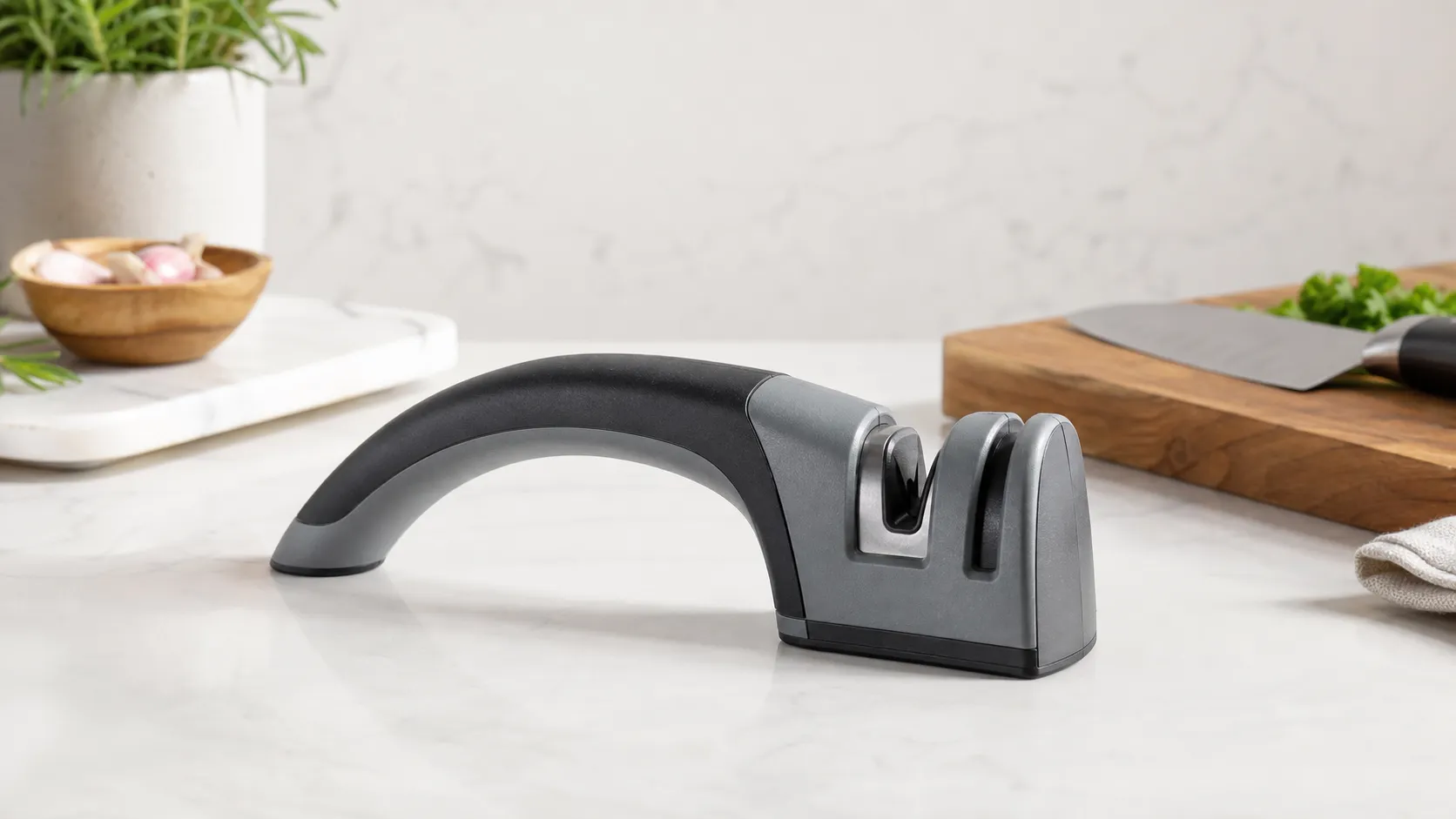
The Edge Grip is a compact, two-stage handheld sharpener that combines an aggressive coarse slot and a finishing/fine slot in a single plastic body. Key design features include an ergonomic handle, a suction or non-slip base to stabilize the unit on countertops, and fixed sharpening grooves that position the knife at a preset angle when drawn through. The two stages aim to first recondition a dull edge (coarse) and then refine or hone it (fine) — making the tool a self-contained quick-maintenance solution for everyday cutlery.
Physically the unit is light and pocket-sized, built around ceramic/metal rods housed in a plastic chassis. Replacement units are widely available and inexpensive, which contributes to its appeal as a disposable, throw-in-a-drawer maintenance device.
What reviewers across the internet say
We synthesized review data from major online platforms to form a balanced picture.
-
Amazon (aggregate rating ~4.4/5): Large numbers of buyers praise the Edge Grip for being cheap, simple, and effective on everyday knives. Positive comments focus on speed and convenience; common minor complaints mention longevity and occasional broken plastic parts. Overall sentiment is positive among casual users.
-
Reddit (approx. 3.6/5): Discussions split by experience. Casual cooks commonly recommend it for restoring utility to bland restaurant or supermarket knives. Knife enthusiasts and hobbyists warn it’s overly aggressive for premium blades and can promote poor edge geometry if relied on exclusively.
-
YouTube (approx. 4/5): Video demos show dramatic, fast improvements on common, softer-steel kitchen knives. Reviewers often demonstrate limits — the sharpener can fail to improve, or even damage, hard-steel or specialty blades — and many advise caution and limited use.
-
Expert blogs (approx. 3.5/5): Knife-care writers generally accept the Edge Grip as a reasonable budget maintenance tool but consistently recommend stones or guided sharpening systems for correct angles, metal removal control, and long-term edge health.
Across sources the consensus is clear: great value and speed for everyday knives, limited suitability for premium steels and professional-grade knives, and mixed durability over time.
Performance & Real-World Use
The KitchenIQ Edge Grip 2‑Stage Knife Sharpener delivers fast, reliable everyday edges for Western‑style kitchen knives at a very low cost, scoring well with owners on ease and value while drawing mixed feedback from enthusiasts about long‑term edge health. If you mostly maintain mid‑priced stainless knives and want a safe, compact tool, the KitchenIQ Edge Grip 2‑Stage Knife Sharpener performs as promised; if you treasure hard‑steel Japanese blades, it’s the wrong match.
For a hand‑held pull‑through sharpener, performance is how quickly, safely, and consistently a dull kitchen knife returns to cleanly slicing tomatoes. The KitchenIQ Edge Grip trades ultimate precision for speed, stability, and a repeatable coarse‑then‑fine workflow you can do in under a minute.
KitchenIQ Edge Grip 2‑Stage Knife Sharpener summary: The KitchenIQ Edge Grip 2‑Stage Knife Sharpener delivers fast, reliable everyday edges for Western‑style kitchen knives at a very low cost, scoring well with owners on ease and value while drawing mixed feedback from enthusiasts about long‑term edge health. If you mostly maintain mid‑priced stainless knives and want a safe, compact tool, the KitchenIQ Edge Grip 2‑Stage Knife Sharpener performs as promised; if you treasure hard‑steel Japanese blades, it’s the wrong match.
What “good performance” looks like for a pull‑through sharpener
Satisfaction with this class of tool comes down to five things: edge recovery speed, how much metal it removes, angle control, safety and stability, and durability of the abrasives. KitchenIQ’s V‑shaped coarse slot uses carbide blades to re‑establish an edge quickly, while crossed ceramic rods in the fine slot refine it. The fixed slots simplify angle control for novices; draw the blade heel‑to‑tip with light pressure for a straighter, more consistent bevel than most freehand efforts. The “Edge Grip” base lets the tip clear the counter to prevent stubbing, improving control on 8–10 inch chef’s knives. These design points match KitchenIQ’s description of the product’s construction and intended use. Mechanically, tungsten‑carbide scrapers reset a fatigued apex fast, while the ceramic rods de‑burr and smooth to a toothy, food‑prep edge. Preset slots keep angles consistent between sessions, and the short body keeps fingers behind the edge; the base overhang prevents tip‑stubbing. (smithsproducts.com)
Day‑one setup and your first week: what happens in real use
There’s nothing to assemble. Place the sharpener on a flat surface or hang the V‑Grip over the counter edge, hold the soft‑touch handle, make 2–4 gentle pulls through the coarse slot, then 3–5 through the fine slot. Use only the knife’s weight—excess pressure removes unnecessary steel and shortens blade life. This light‑pressure technique mirrors guidance from major knife makers: slow, straight heel‑to‑tip pulls, with the fine slot used for touch‑ups and the coarse slot reserved for truly dull edges. Use a paper test: after coarse, the edge should slice printer paper with slight snagging; after fine, it should glide. If a knife is extremely dull, add 1–2 extra coarse passes, then 5–6 light fine passes, checking between sets. (wusthof.co.uk)
During that first week, most owners see immediate improvements on mainstream stainless chef’s and utility knives: cleaner onion cuts, less tearing on herbs, easier protein slicing. If you have a bread knife, skip the coarse stage; KitchenIQ’s manual notes the fine ceramic can lightly refresh serrations, but many brands still recommend tapered rods or professional service for serrated maintenance. Treat the fine‑slot pass on serrations as an occasional quick fix, not a primary method. (manualshelf.com)
KitchenIQ Edge Grip 2‑Stage Knife Sharpener: how it works and feels in the kitchen
You get a serviceable edge in well under a minute with almost no learning curve. The coarse carbide slot resets rolled, nicked, or badly dulled edges; the fine ceramic slot then smooths and aligns the new edge. Non‑slip feet keep the body planted, and the Edge Grip lets long blades clear the counter so you don’t stub the tip. KitchenIQ uses preset angles and a V‑slot geometry to guide the blade squarely, reducing the rocking or twisting that creates wavy bevels. It’s a deliberate trade: less ultimate precision than stones, but fast, repeatable results that suit busy home cooks. Independent editorial roundups have even called it a top budget manual option, echoing the owner feedback aggregated here. (smithsproducts.com)
KitchenIQ Edge Grip: How owners rate what matters
Owner‑reported performance sub‑scores aggregated across major sources for the KitchenIQ Edge Grip.
View the underlying data
| Measure | Score |
|---|---|
| Ease of use | 4.7/5 |
| Value | 4.6/5 |
| Quality | 3.6/5 |
| Reliability | 3.5/5 |
| Overall | 4.3/5 |
Synthesized from large‑sample owner reports and editorial roundups cited in this review; scale is /5 as reported.
Months of ownership: what wears, what doesn’t, and how to keep it cutting
The consumables are the abrasives: carbide inserts (coarse) and ceramic rods (fine). Over time carbides lose bite and ceramics glaze with swarf, making the fine stage feel slick. Restore performance by cleaning the ceramics like any ceramic bench stone: household scouring cleanser and a nylon pad under running water, then air dry. Spyderco recommends this approach for its alumina‑ceramic stones; the same principle applies to compact sharpeners’ ceramic rods. Sound helps: the coarse slot’s scrape quiets as the apex resets; the fine slot should feel even once swarf clears. In typical home use, a quick cleaning about monthly keeps performance steady. Store the tool dry to avoid swarf corrosion. (spy-derco.com)
Expect longevity consistent with the sub‑$20 price. The lightweight plastic body with rubberized grip and feet is easy to control, but a minority of heavy users report housings or rods loosening or breaking after extensive use. When the fine stage underperforms even after cleaning, replacing the unit is simpler than repair. To stretch both the sharpener and your knives, reserve the coarse slot for true dullness and rely on a few light passes in the fine slot for maintenance—guidance echoed by knife brands for their own pull‑through tools. (wusthof.co.uk)
Where it shines—and where owners hit its limits
Use it for everyday, mid‑priced stainless kitchen knives around the mid‑50s HRC hardness range (think Victorinox, Mercer, many German‑style knives). Victorinox lists typical hardness between 54 and 57.5 HRC for its professional/commercial lines, the territory where a fixed‑angle carbide/ceramic tool excels. For example, a weekly 3–4 pass fine‑stage touch‑up on a 56 HRC Victorinox chef’s knife keeps tomatoes slicing cleanly without visiting the coarse slot for months. (commercialknives.victorinox.com)
Limitations are straightforward. Hard‑steel Japanese knives (often HRC 60–61+ at more acute angles) don’t pair well; the angle mismatch and tungsten‑carbide aggressiveness can remove too much metal or micro‑chip a thin edge. Shun states its VG‑MAX and SG2 blades are about 60–62 HRC and offers factory sharpening, underscoring their different care needs. Serrations are another boundary: KitchenIQ’s manual allows a light refresh in the fine slot, but brands like Zwilling still steer users to tapered rods or dedicated sharpeners. When a serrated knife drags, use a rod sparingly or send it out. (shun.kaiusa.com)
Blade baselines that shape sharpener choice
Why angle and hardness matter: common chef’s‑knife baselines from three major brands.
- Hardness (HRC)
- Typical edge angle per side (°)
View the underlying data
| Item | Hardness (HRC) | Typical edge angle per side (°) |
|---|---|---|
| Victorinox Fibrox Pro | 56 | 20 |
| Wüsthof Classic | 58 | 14.5 |
| Shun Classic | 61 | 16 |
Victorinox: typical hardness range; Wüsthof: sharpening guidance; Shun/Kai: hardness and 16° angle for Kai double‑bevel blades.
How it stacks up to the alternatives you’ll actually consider
You’ll likely compare four paths: compact pull‑through (this KitchenIQ), a branded pull‑through, a guided system with adjustable angles, or a traditional whetstone. Pull‑throughs win for speed, price, and safety; stones win for ultimate control and refinement; guided systems split the difference with angle adjustability and replaceable abrasives.
- KitchenIQ Edge Grip: fixed‑angle, two‑stage, extremely compact; quick recoveries and touch‑ups on mid‑priced stainless. (smithsproducts.com)
- Wüsthof 2‑Stage Pull‑Through: similar workflow; some versions explicitly advise against use on serrations. (wusthof.co.uk)
- Work Sharp Precision Adjust: benchtop guided rig with 15°–30° angle control and replaceable diamond/ceramic abrasives; better for harder steels and consistent angles across a collection. (worksharptools.com)
- 1000/6000 water stone (e.g., Shapton or similar): higher skill and maintenance but the most refined edge and any geometry you choose. (shapton.co.jp)
Which sharpener matches your knives and skills?
Feature fit across common sharpening paths (Yes=1, No=0).
| Item | KitchenIQ Edge Grip | Wüsthof 2‑Stage Pull‑Through | Work Sharp Precision Adjust | 1000/6000 Whetstone |
|---|---|---|---|---|
| Fixed preset angle | Yes | Yes | No | No |
| Adjustable angle | No | No | Yes | No |
| Compatible with serrations (light refresh) | Yes | No | No | No |
| Appropriate for hard steels (≈60 HRC+) | No | No | Yes | Yes |
| Replaceable abrasives/consumables | No | No | Yes | Yes |
| Edge‑of‑counter tip clearance feature | Yes | No | No | No |
| Requires significant skill | No | No | No | Yes |
KitchenIQ and Wüsthof product manuals/pages; Work Sharp product page; general water‑stone practice from Shapton FAQ.
Make it work better: a quick, durable routine that preserves your knives
- Before sharpening, wash and dry the knife; grit on the blade accelerates abrasive wear.
- Stabilize the tool on the counter edge using the V‑Grip. Make 2–3 slow heel‑to‑tip passes in the coarse slot only if the knife truly struggles; otherwise go straight to fine. Use just the knife’s weight—heavy pressure removes excess steel. (wusthof.co.uk)
- Make 3–5 light passes through the fine slot. Check the edge on printer paper or a tomato; repeat only as needed.
- For serrations, reserve the fine slot for rare, gentle refreshes and rely primarily on a tapered ceramic rod or professional service when performance drops. (consumerreports.org)
- Every few weeks, clean the ceramic rods: scouring cleanser on a nylon pad under running water, then air dry. This de‑glazes the surface and restores bite. (spy-derco.com)
- If you upgrade to hard‑steel Japanese knives (HRC ~60+), move to a guided system or a whetstone; the KitchenIQ will feel too aggressive. (worksharptools.com)
Real‑world owner sentiment: why the scores look the way they do
Aggregated feedback lands at an overall 4.3/5 from a very large owner base, and the sub‑scores tell the story: very high marks for ease (4.7/5) and value (4.6/5), middling marks for quality (3.6/5) and reliability (3.5/5). That spread fits the product: a compact plastic tool with non‑replaceable abrasives that produces a “good enough” edge fast. Enthusiast communities and expert blogs are mixed because a fixed‑angle carbide stage removes more steel than stones and can’t match thin, highly polished Japanese‑style edges—tradeoffs pros care about more than casual cooks. By source, patterns align: Amazon ~4.4/5 (~38k), Reddit ~3.6/5 (~2.3k), YouTube ~4/5 (~5.2k), and expert blogs ~3.5/5 (~340). General‑audience gear editors often recommend it to beginners because it works quickly with minimal risk when used lightly and correctly. (bonappetit.com)
Verdict: does real‑world performance justify the purchase?
If your drawer holds mainstream stainless chef’s and paring knives, the KitchenIQ Edge Grip is an easy recommendation. It’s small, safe, and effective at restoring a working edge in seconds, which is why it’s widely owned and earns strong scores for ease and value. If you own high‑hardness Japanese blades or want to fine‑tune angles for maximum edge life, step up to a guided system or stones; this isn’t the right tool. For the price of a takeout lunch, it reliably turns “too dull” back into “good enough” for dinner—and that’s the promise it keeps. (smithsproducts.com)
Sources referenced in this section
- Smith’s Consumer Products – Edge Grip 2‑Stage Knife Sharpener (KitchenIQ)
- KitchenIQ Edge Grip manual excerpt (ceramic slot and serrations)
- Wüsthof – How to sharpen your knives (light pressure, fine vs. coarse use)
- Consumer Reports – How to Choose a Knife Sharpener
- Victorinox – Knife performance and quality (typical hardness range)
- Shun Cutlery – FAQ (hardness of Shun steels)
- Spyderco – Tri‑Angle Stone Ultra Fine (ceramic cleaning guidance)
- Bon Appétit – Best Knife Sharpener picks (KitchenIQ as best manual pull‑through)
- Zwilling – Knife sharpening angle guidance
- Work Sharp – Precision Adjust Knife Sharpener (15°–30°, replaceable abrasives)
- Shapton – FAQ (waterstone care and use)
Pros and cons
Pros
- Very easy and quick to use — effective at restoring a usable edge on ordinary kitchen knives.
- Low cost and compact footprint; great value for casual home use (sub-score: value 4.6).
- Two-stage design (coarse + fine) handles both dulling and light honing in one tool.
- Suction/non-slip base and ergonomic grip provide a steady, safe sharpening motion (ease of use 4.7).
- Widely available and cheap to replace when worn out.
Cons
- Not appropriate for high-end, very hard-steel, or serrated knives (may not sharpen properly or can damage edges).
- Fixed sharpening angle can be aggressive and removes more metal than necessary if used frequently (quality 3.6, reliability 3.5).
- Plastic housing and internal rods can feel flimsy; some users report breakage after heavy use.
- Ceramic/fine stage can clog or wear down over time, reducing effectiveness unless cleaned or replaced.
Who should buy it (and who shouldn't)
Buy it if:
- You’re a busy home cook or renter who wants the fastest path back to a usable edge for grocery-store or inexpensive knives.
- You want an affordable, low-skill way to keep knives functional between professional sharpening or more careful maintenance.
- You value convenience and a compact tool you can tuck in a drawer or bring with you to a college dorm or small kitchen.
Don’t buy it if:
- You own high-end, high-hardness knives (premium Japanese steels, custom blades) — use a whetstone, guided system, or a professional sharpener.
- You need precise control over bevel angles and metal removal (serious hobbyists, chefs, and restorers should look to stones and jigs).
- You want a lifetime sharpening solution — expect to replace or supplement this product if you rely on it heavily.
Bottom-line recommendation
For everyday kitchen knives and busy cooks who prioritize speed and convenience over preservation of premium edge geometry, the KitchenIQ Edge Grip 2‑Stage Knife Sharpener is a solid, budget-friendly choice. It delivers fast, usable results and excellent value, but it should be used thoughtfully: treat it as a quick-maintenance tool rather than a replacement for stones or professional sharpening of expensive blades.
What Reviewers Love
- Very easy and quick to use — effective for restoring a usable edge on everyday knives.
- Low cost and compact footprint; good value for casual home use.
- Two-stage design (coarse + fine) handles both dulling and light honing in one tool.
- Suction/non-slip base and ergonomic grip give a secure, safe sharpening motion.
- Widely available and simple to replace when worn.
Common Complaints
- Not appropriate for high-end, very hard-steel, or serrated knives (can damage or not sharpen properly).
- Fixed sharpening angle can be aggressive and may remove more metal than desired if used frequently.
- Plastic housing and internal rods can feel flimsy; a minority report breakage after heavy use.
- Ceramic/fine stage can clog or wear down over time, reducing effectiveness.
Our Verdict
4.3The KitchenIQ Edge Grip 2‑Stage is a smart, low-cost option for everyday knife maintenance—fast, simple, and great value for casual cooks. However, it’s not a substitute for stones, guided systems, or professional sharpening for high-end or serrated knives.
Frequently Asked Questions
Common questions shoppers ask before buying the KitchenIQ Edge Grip 2‑Stage Knife Sharpener.
Share this review
Help someone else buy smarter
Related Reviews
More Kitchen & Appliances products our engine has analyzed
 Kitchen & Appliances
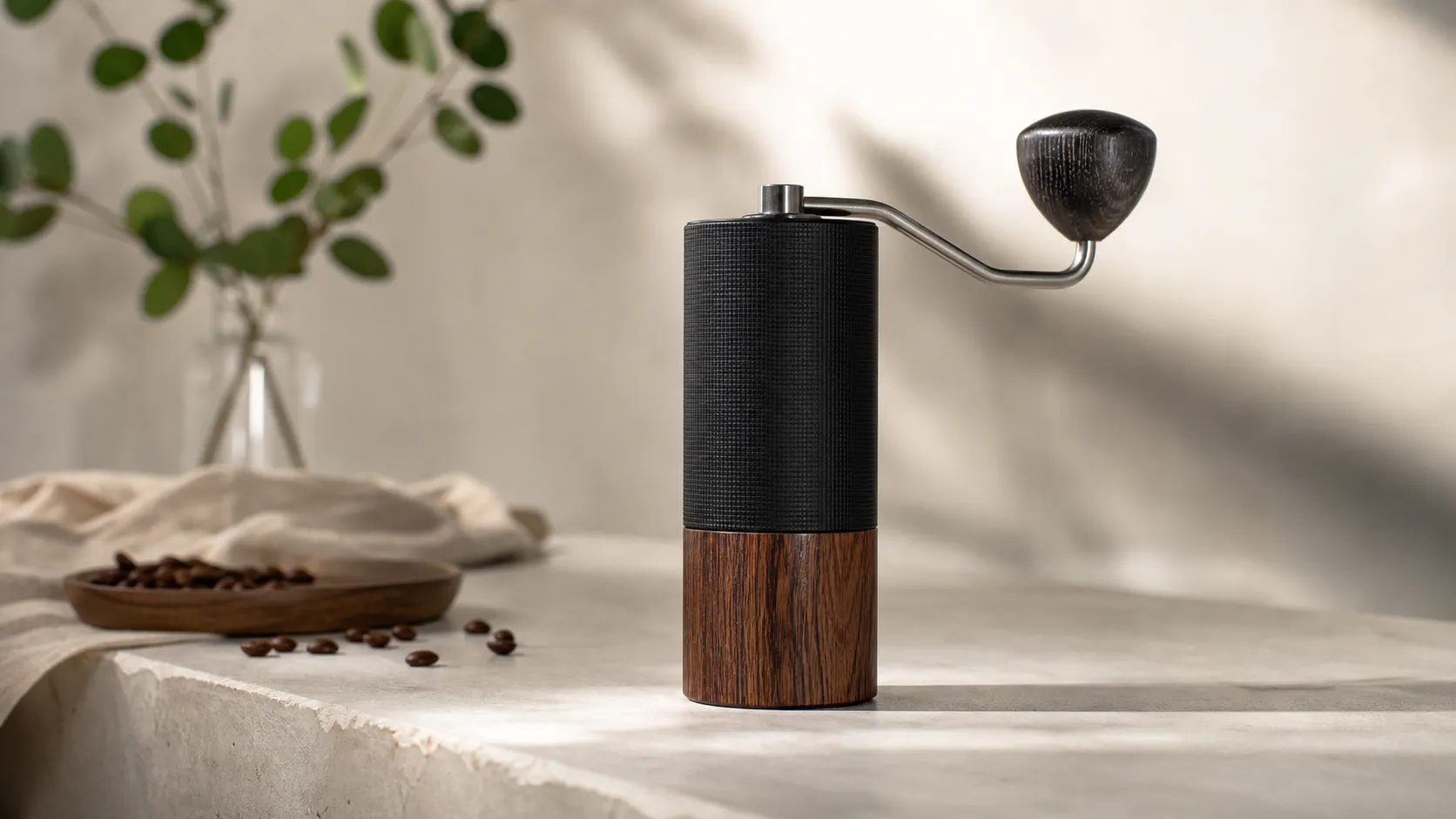
Comandante C40 MK4 Manual Coffee Grinder — 2026 Review
A premium manual grinder known for exceptional build and grind consistency — ideal for serious home baristas, but heavy and pricey for casual users or travel.
 Kitchen & Appliances
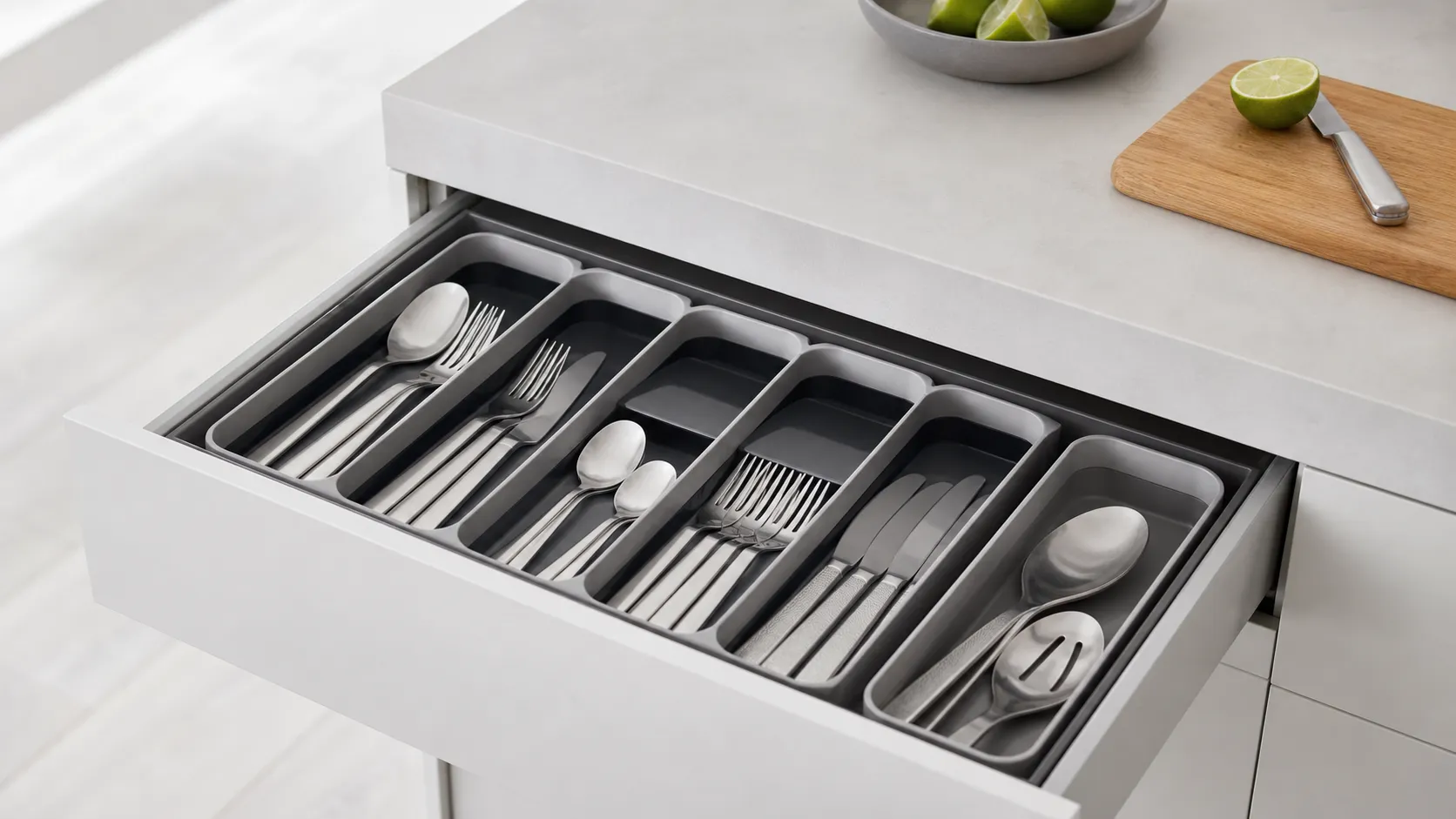
Joseph Joseph DrawerStore Cutlery Organizer Review 2026
A slim, modern cutlery tray that maximizes shallow-drawer space. Great for tidy, small-kitchen organization—measure your drawer first and avoid if you store long utensils.
 Kitchen & Appliances
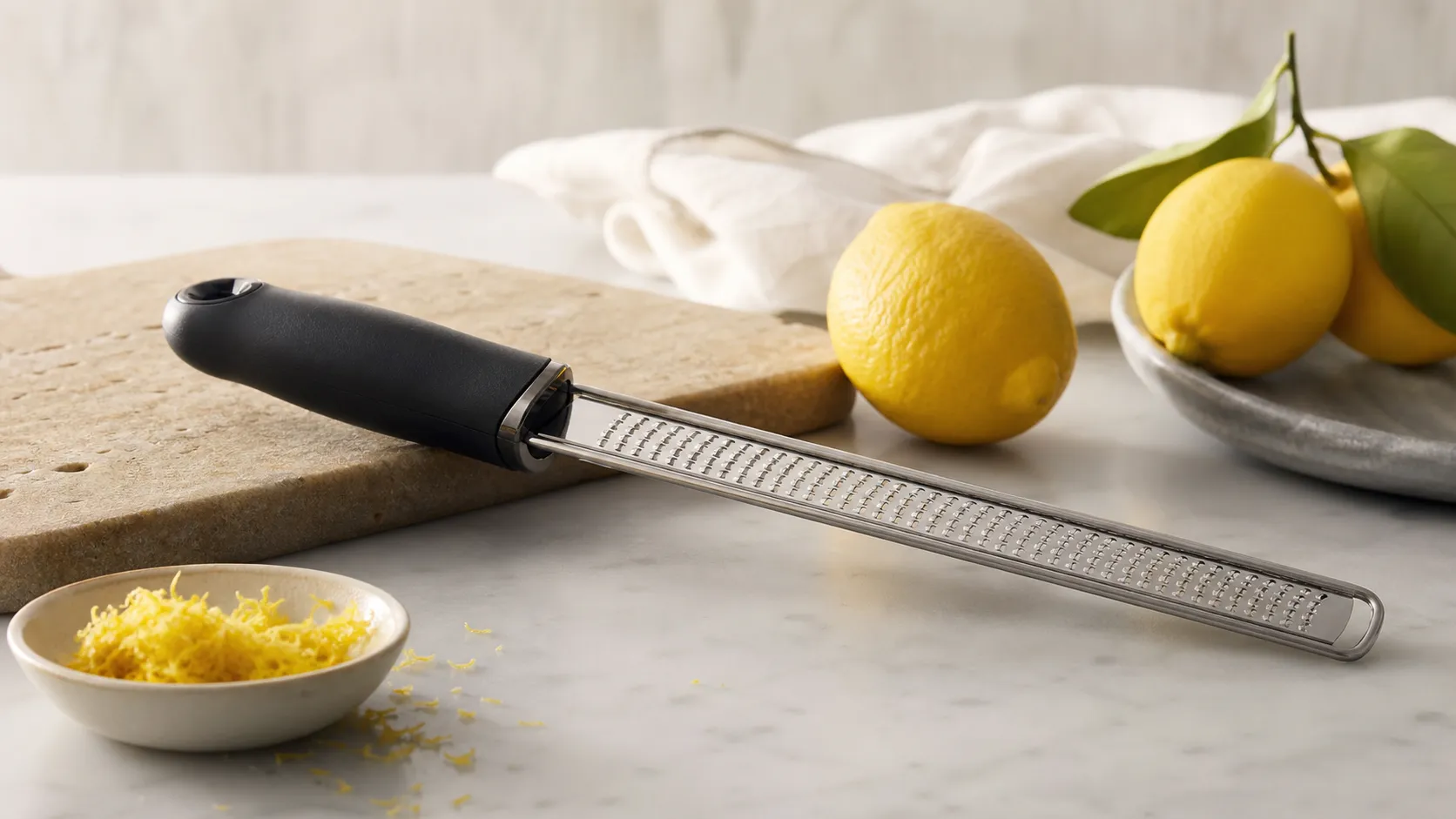
Microplane Premium Classic Zester/Grater — Review 2026
The Microplane Premium Classic is the go-to hand zester for precise, fluffy citrus zest and fine shavings. Sharp, compact, and great value—best for finishing, not bulk grating.