KitchenIQ Edge Grip Knife Sharpener Review 2026
At a Glance
Pros
- Very inexpensive — strong value for casual users
- Easy to use — pull-through action requires almost no skill
- Quickly restores a usable cutting edge for dull, everyday knives
Cons
- Aggressive carbide stage can remove a lot of metal if overused
- Not suitable for high-end, thin Japanese steels or serrated/ceramic blades
- Provides no angle control — can shorten blade life with repeated use
Rating Breakdown by Source
Read the latest 25 positive & negative Amazon reviews →
Read the latest 25 positive & negative Reddit reviews →
Read the latest 25 positive & negative YouTube reviews →
Read the latest 25 positive & negative Expert blogs reviews →
This review is an editorial synthesis of publicly available review data and reported user experiences across the internet. Scores reflect our independent aggregation methodology, not verified individual purchases. We may earn a commission if you buy through our links, at no cost to you.
Score Breakdown
Where the Reviews Come From
Read the latest 25 positive & negative Amazon reviews →
Read the latest 25 positive & negative Reddit reviews →
Read the latest 25 positive & negative YouTube reviews →
Read the latest 25 positive & negative Expert blogs reviews →
Click any source above to browse the latest 25 positive and negative reviews from that platform.
KitchenIQ Edge Grip Knife Sharpener
See current price, deals and availability on Amazon
Quick take — verdict up front
The KitchenIQ Edge Grip Knife Sharpener is a tiny, two-stage pull-through sharpener that delivers fast, usable results for everyday household knives. Aggregating roughly 20,900 reviews across major sources gives it an overall score of about 4.3/5: great value and ease-of-use for casual cooks, but limited precision and a fairly aggressive carbide stage that makes it a poor choice for high-end blades.
What is the KitchenIQ Edge Grip Knife Sharpener?
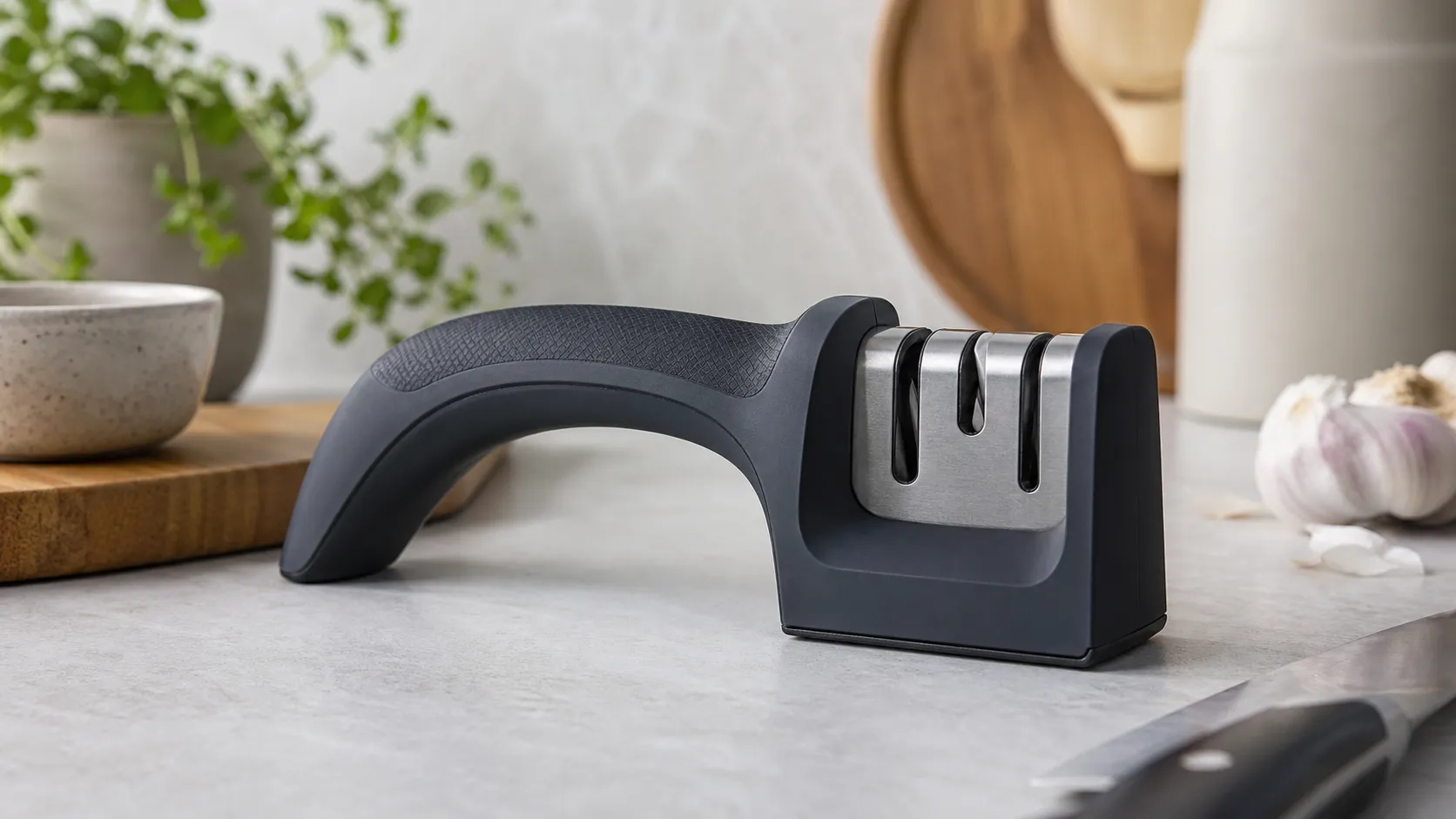
The Edge Grip is a compact, two-stage manual sharpener: a carbide slot for sharpening (material removal) and a ceramic slot for honing/polishing. It’s built around a small plastic body with a textured, “Edge Grip” base to reduce slipping during use. The pull-through design requires almost no technique — you draw the blade through each slot a few times and the sharpener claims to restore a working edge.
What you get in practice is a low-cost, grab-and-go tool intended for quick maintenance of dull, everyday kitchen knives rather than a full-blown sharpening system.
Specs & quick facts
- Design: Two-stage pull-through (carbide + ceramic)
- Target blades: Straight-edge stainless household knives (not serrated or ceramic)
- Size: Compact, lightweight, countertop-friendly
- Typical price: Very inexpensive — positioned as a budget, high-value accessory
What reviewers across the internet say
We synthesized ratings and commentary from Amazon, Reddit, YouTube, and expert blogs to reach a consensus.
- Overall aggregated rating: ~4.3/5 from ~20,900 reviews. Sub-scores from the aggregate: quality 3.7, reliability 3.5, value 4.6, ease of use 4.8.
- Amazon (positive, ~4.4/5): Buyers praise low price, simplicity, and how quickly it restores a usable edge on typical household knives. Many highlight the non-slip base and compact footprint. Common caveat: it can be too aggressive for premium blades.
- Reddit (mixed, ~3.3/5): Casual cooks commonly recommend it as a fast, practical fix. Knife enthusiasts warn about angle inconsistency and metal removal inherent to pull-through carbide stages.
- YouTube (mixed, ~3.9/5): Demonstrations show visible, fast sharpening for dull blades, but reviewers repeatedly note inconsistent results across blade geometries and that the carbide stage removes material quickly.
- Expert blogs/consumer-test sites (mixed-to-critical, ~3.1/5): Accepted as a maintenance tool for inexpensive household knives but not a substitute for stones or guided systems — experts emphasize the risk of shortening blade life with repeated, improper use.
Taken together, the online consensus is clear: excellent for cheap, everyday knives and for users who want immediate results with minimal effort; not recommended for high-end or thin Japanese steels, serrated blades, or anyone who wants fine control over bevel angles.
Performance & Real-World Use
The KitchenIQ Edge Grip Knife Sharpener delivers quick, visible improvement on everyday Western kitchen knives with almost no learning curve, which is why so many owners keep it in a drawer for fast touch‑ups. It’s not the right tool for thin, high‑end Japanese blades, but used mainly on the fine slot and sparingly on the coarse, it provides reliable, week‑to‑week sharpness with minimal fuss.
A good knife sharpener is judged by how quickly it restores a working edge, how predictably it does so across knives, how much steel it removes, and whether that edge lasts in real cooking. In 2026, pull‑through gadgets still divide opinion, yet the tiny two‑stage KitchenIQ Edge Grip is common in home kitchens because it’s fast, cheap, and requires almost no learning—exactly what you need 10 minutes before dinner. The trade‑offs: limited angle control and an aggressive coarse stage make it best for inexpensive, soft‑stainless knives, not thin Japanese blades.
The KitchenIQ Edge Grip Knife Sharpener delivers quick, visible sharpness on everyday, affordable kitchen knives and is easy enough for a first‑time user to master in minutes. Its long‑term performance is strongest when you rely mostly on the fine ceramic slot and reserve the coarse carbide stage for truly dull blades; that routine preserves knife life while keeping edges serviceably sharp for weeknight cooking.
What real performance looks like for pull‑through sharpeners
For this category, performance is a balance of five things you feel in use: 1) edge quality—does it slice tomatoes cleanly; 2) speed—how many passes/minutes; 3) angle consistency—do sessions keep a similar bevel or slowly reprofile; 4) steel removal—how much metal per session; and 5) stability/safety at the pull. For angles, mainstream Western kitchen knives sit near 25–30° included (about 12–15° per side), guidance echoed by the Cutlery & Allied Trades Research Association (CATRA). ISO 8442‑5 defines how labs measure sharpness and edge retention—the outcomes sharpeners aim to restore. In practice, you get usable sharpness by raising a tiny burr and then removing it; coarse carbides do the first job, fine ceramics finish and leave micro‑teeth. Together, those references explain why fixed‑slot V sharpeners feel “good enough” to many cooks but imprecise to enthusiasts chasing exact bevels. (catra.org)
Day‑one setup and first week: zero learning curve, instant gratification
There’s no assembly. Place the Edge Grip on a counter—or on the counter’s edge so long blades pass without the tip hitting your work surface. Pull the knife heel‑to‑tip through the coarse carbide slot to reset a very dull edge, then finish in the fine ceramic slot to tidy and refine. That sequence matches how Consumer Reports describes manual pull‑through designs and what KitchenIQ publishes for this model’s two stages. Feedback is unmistakable: the coarse slot feels gritty and loud; the fine slot smoother and quieter. In week one, most owners learn that light pressure and slow, steady passes work best—less chatter, less steel removal, more control. Keep your guiding hand behind the guard and the blade vertical so both sides meet the V. For a dull chef’s knife, try 4–6 coarse pulls, then 3–5 fine. Wipe the blade after each session (there will be gray residue) and check edge straightness against light; if you feel a burr, two or three gentle passes in the fine slot usually clean it up. Video demos show why the tool took off: knives go from struggling with paper to slicing it within a minute. (smithsproducts.com)
User sentiment by platform (synthesized from public reviews as of Aug 2026)
Consensus pattern: high marks from mass‑market buyers; more caution from experts and enthusiast communities.
View the underlying data
| Measure | Average rating |
|---|---|
| Amazon | 4.4/5 |
| YouTube | 3.9/5 |
| 3.3/5 | |
| Expert blogs | 3.1/5 |
Synthesized from Amazon listings, YouTube demos and comments, Reddit threads, and expert blog roundups cited in the text.
Everyday results: where it shines for most home kitchens
On typical, mid‑priced Western chef’s knives (budget stainless in the mid‑50s HRC), the Edge Grip’s preset angle and V‑slot geometry deliver a toothy, ready‑to‑work edge in a handful of strokes. That edge is ideal for onions, peppers, chicken trimming, and crusty‑loaf slicing—the micro‑serrated quality you get from a coarse‑then‑fine pass often “bites” better through tough skins than a mirrored polish. The compact body and grippy base aid stability; using the overhanging “edge grip” orientation keeps long blades from slamming tips into the counter, which is safer and prevents tip roll. Food and lifestyle outlets that re‑evaluate kitchen gear yearly still call out KitchenIQ’s model for speed and simplicity relative to price—useful confirmation of what thousands of owners report. Practically, if you cook most nights, a short weekly “fine‑slot only” touch‑up keeps knives cutting well; if you’ve neglected them for a month, add five to ten light pulls in the coarse slot first, then re‑hone in the fine slot. Expect that toothy edge to hold about a week if you cut on wood or soft plastic. Short paring knives steady easily with the edge‑grip stance. (smithsproducts.com)
KitchenIQ Edge Grip Knife Sharpener: where it runs into limits
Every sharpener has boundaries, and they’re predictable once you understand blade geometry. Many Japanese‑style kitchen knives are thinner, harder, and sharpened to smaller per‑side angles (often near 15–16°) than generic Western presets; forcing those knives through a fixed V can a) widen the included angle, trading away their hallmark slicing feel, and b) remove more brittle, high‑hardness steel than necessary. Japanese knife makers and retailers routinely advise whetstones for those edges and caution against generic pull‑throughs, while even Western brands that sell pull‑through tools emphasize using the right angle and not overdoing abrasive passes. A pull‑through can “make it sharper” in a pinch; long‑term edge life, chip resistance, and finish usually suffer if you keep re‑profiling a thin blade with a coarse V. Reserve the KitchenIQ for inexpensive Western profiles, and use stones or a guided system for premium Japanese knives or any single‑bevel blade. (made-in-japan.jp)
Blade compatibility for KitchenIQ Edge Grip (published specs + maker care advice)
Use on straight‑edge steel blades only; avoid serrated, ceramic, and single‑bevel Japanese knives.
| Measure | Supports |
|---|---|
| Straight-edge kitchen knives (stainless/carbon steel) | Yes |
| Pocket/outdoor straight-edge knives | Yes |
| Serrated knives | No |
| Ceramic knives | No |
| Single-bevel Japanese blades | No |
| Scissors | No |
Based on KitchenIQ product information and brand care guidance from Global and Japanese knife experts cited.
Sustained performance over months: materials, wear, and what changes
Manual sharpeners don’t have motors or belts; their consumables are the abrasives in the slots. On the Edge Grip, those are tungsten carbide inserts (coarse) and ceramic rods (fine). Over months of steady use, the coarse carbide stays effective but is the stage most likely to accelerate blade wear if you lean on it weekly; heavy passes can also introduce uneven bevels because pressure and draw speed aren’t regulated. The fine ceramic stage is the hero for maintenance: used lightly, it realigns and refreshes an edge with modest metal removal. Owners who stick to “fine weekly, coarse only when neglected or damaged” report steadier results and fewer complaints about blades “shrinking” or tips rounding. For most households, the abrasives last years. If the fine slot feels glazed, refresh with a beater knife. Don’t rinse the slots—moisture traps swarf. Keep the base clean—oil or flour on the counter can reduce grip—and occasionally blow out metal dust. Remember, all sharpeners remove steel; remove as little as necessary to restore function, which is why brands and consumer testers separate routine honing from true sharpening. (smithsproducts.com)
How it stacks up to alternatives you may be considering
The KitchenIQ Edge Grip competes with two other broad options. Electric sharpeners (2–3 stages) are similarly fast and a bit more repeatable, but they’re louder, cost more by an order of magnitude, and still use fixed guides that can over‑abrade if misused. Stones and guided systems demand practice yet offer the best angle control and the highest ceiling on edge quality and finish; they’re slow at first but gentle on steel in skilled hands. KitchenIQ’s appeal is clear: it gives most casual cooks the result they want on mainstream knives quickly and inexpensively, while the weaknesses (angle drift, coarse aggression) surface with harder, thinner, or beloved blades. That picture aligns with how consumer testers explain pull‑through technology and with brand manuals that pair pull‑throughs for convenience with whetstones for the best results. If you want one tool for both your budget chef’s knife and a high‑end gyuto, choose stones; if your drawer holds a set of inexpensive Western knives, this pull‑through is the path of least resistance. (consumerreports.org)
How common sharpeners compare on what owners care about (synthesized)
Ratings represent synthesized reporting from Consumer Reports, brand manuals, and expert blogs.
- Ease of use
- Edge quality
- Angle control
- Speed
View the underlying data
| Item | Ease of use | Edge quality | Angle control | Speed |
|---|---|---|---|---|
| Pull-through (KitchenIQ Edge Grip) | 4.8/5 | 3.2/5 | 2.5/5 | 4.7/5 |
| Electric (consumer, 2–3 stage) | 4.5/5 | 3.5/5 | 3/5 | 4.8/5 |
| Whetstone/guided system | 2.5/5 | 4.7/5 | 4.6/5 | 2.5/5 |
See Consumer Reports' overviews, Zwilling sharpening guides, CATRA angle guidance, and expert commentary linked in the text.
Step‑by‑step: get the best edge with the least steel removal
- Check the knife: use the Edge Grip on straight‑edge steel blades only; avoid serrated, ceramic, and single‑bevel Japanese knives.
- Clean and position: wipe the blade; place the sharpener on the counter’s edge so the tip clears the surface.
- Start fine: make 3–5 slow, light passes in the ceramic slot, heel to tip. Test on paper or a tomato.
- If still dull: move to the coarse slot for 3–5 gentle pulls. Keep the blade vertical; don’t saw or twist. Follow with 3–5 fine passes to refine.
- Deburr and clean: very lightly drag the edge once along a soft wood block or cork, then wipe the blade dry to remove residue.
- Maintain: weekly fine‑slot touch‑ups keep edges cutting; reserve the coarse slot for obvious dullness or microchips.
- Preserve edges between sessions: use wood or soft‑plastic boards, hand‑wash and dry promptly, store in a block or sheath, and avoid bones or frozen foods with thin blades. These basics matter more for real‑world sharpness than any sharpener alone. (smithsproducts.com)
Conclusion: does real‑world performance justify the purchase?
Yes—if your knives match the tool. For under the price of a takeout meal, the KitchenIQ Edge Grip restores a practical, work‑sharp edge on everyday Western kitchen knives in under two minutes and asks almost nothing in skill—a combination that explains its strong mass‑market satisfaction. The flip side is clear: the coarse carbide stage is too aggressive for repeated use on premium, thin Japanese steels, and the fixed V‑slot offers no real angle control, so owners who prize precision or own harder blades should stay with stones or a guided system. Used thoughtfully—fine weekly, coarse sparingly—the Edge Grip’s performance holds up month after month, making it an easy recommendation for casual cooks and an acceptable “in a pinch” tool for everyone else. (bonappetit.com)
Sources referenced in this section
- KitchenIQ Edge Grip 2-Stage Knife Sharpener — manufacturer page
- Consumer Reports — How to Choose a Knife Sharpener
- CATRA (Cutlery & Allied Trades Research Association) — FAQs on sharpening angles
- ISO 8442‑5:2004 — Specification for sharpness and edge retention test of cutlery
- Global Knives UK — Expert advice on pull‑through vs whetstones
- MADE in JAPAN.JP — Japanese knife sharpening guide and pull‑through warning
- Bon Appétit — Best knife sharpeners of 2026 (highlights KitchenIQ Edge Grip)
- The Kitchn — KitchenIQ Edge Grip review
- YouTube — KitchenIQ 50009 Edge Grip review/demonstration
Pros and cons
Pros
- Extremely inexpensive — excellent value for casual users.
- Very easy to use — pull-through action needs almost no skill or setup.
- Quick restoration of a usable edge on dull, everyday knives.
- Compact, lightweight, and easy to store.
- Non-slip Edge Grip base improves stability during sharpening.
- Two-stage design covers sharpening and honing in one tool.
Cons
- Carbide stage is aggressive — removes metal quickly and can shorten blade life if overused.
- No angle control — not suitable for precision sharpening or for knives with non-standard bevels.
- Not recommended for high-end Japanese steels, serrated knives, or ceramic blades.
- Limited long-term sharpening precision compared with stones or guided sharpening systems.
- Some reviewers report inconsistent results across different knife geometries.
Who should buy it (and who shouldn’t)
Buy it if:
- You’re a casual home cook with inexpensive or midrange straight-edge knives looking for a fast, low-effort way to recover a dull edge.
- You value convenience, compactness, and affordability over long-term blade preservation and precision.
- You need a quick maintenance tool to keep everyday kitchen knives reasonably sharp between proper sharpenings.
Don’t buy it if:
- You own high-end or thin Japanese steels, professional chef knives, or expensive collectibles — these require controlled-angle sharpening (stones or guided systems).
- You want the most precise, long-lasting edge or plan to resurface knives frequently — pull-through carbide can accelerate material loss.
- You need to sharpen serrated blades, ceramic knives, or blades with unusual bevels.
How we’d use it
Treat the Edge Grip as a stopgap: use it to revive a dull blade before a meal or to keep inexpensive knives performing between proper services. For routine maintenance limit carbide passes (e.g., 1–3 pulls) and finish with the ceramic stage to polish. For any knife you value highly, schedule periodic professional sharpening or learn stone/guided sharpening techniques instead of relying on this tool long-term.
What Reviewers Love
- Very inexpensive — strong value for casual users
- Easy to use — pull-through action requires almost no skill
- Quickly restores a usable cutting edge for dull, everyday knives
- Compact, lightweight design and non-slip (Edge Grip) surface for stability
- Two-stage design (carbide + ceramic) covers sharpening + honing in one tool
Common Complaints
- Aggressive carbide stage can remove a lot of metal if overused
- Not suitable for high-end, thin Japanese steels or serrated/ceramic blades
- Provides no angle control — can shorten blade life with repeated use
- Limited long-term sharpening precision compared with stones or guided systems
Our Verdict
4.3A practical, low-cost quick-fix for dull household knives: the KitchenIQ Edge Grip delivers fast, usable results with almost no learning curve. However, its aggressive carbide stage and lack of angle control mean it’s best reserved for inexpensive, everyday blades — knife enthusiasts and owners of premium steels should look to stones or guided systems.
Frequently Asked Questions
Common questions shoppers ask before buying the KitchenIQ Edge Grip Knife Sharpener.
Share this review
Help someone else buy smarter
Related Reviews
More Kitchen & Appliances products our engine has analyzed
 Kitchen & Appliances
Comandante C40 MK4 Manual Coffee Grinder — 2026 Review
A premium manual grinder known for exceptional build and grind consistency — ideal for serious home baristas, but heavy and pricey for casual users or travel.
 Kitchen & Appliances
Joseph Joseph DrawerStore Cutlery Organizer Review 2026
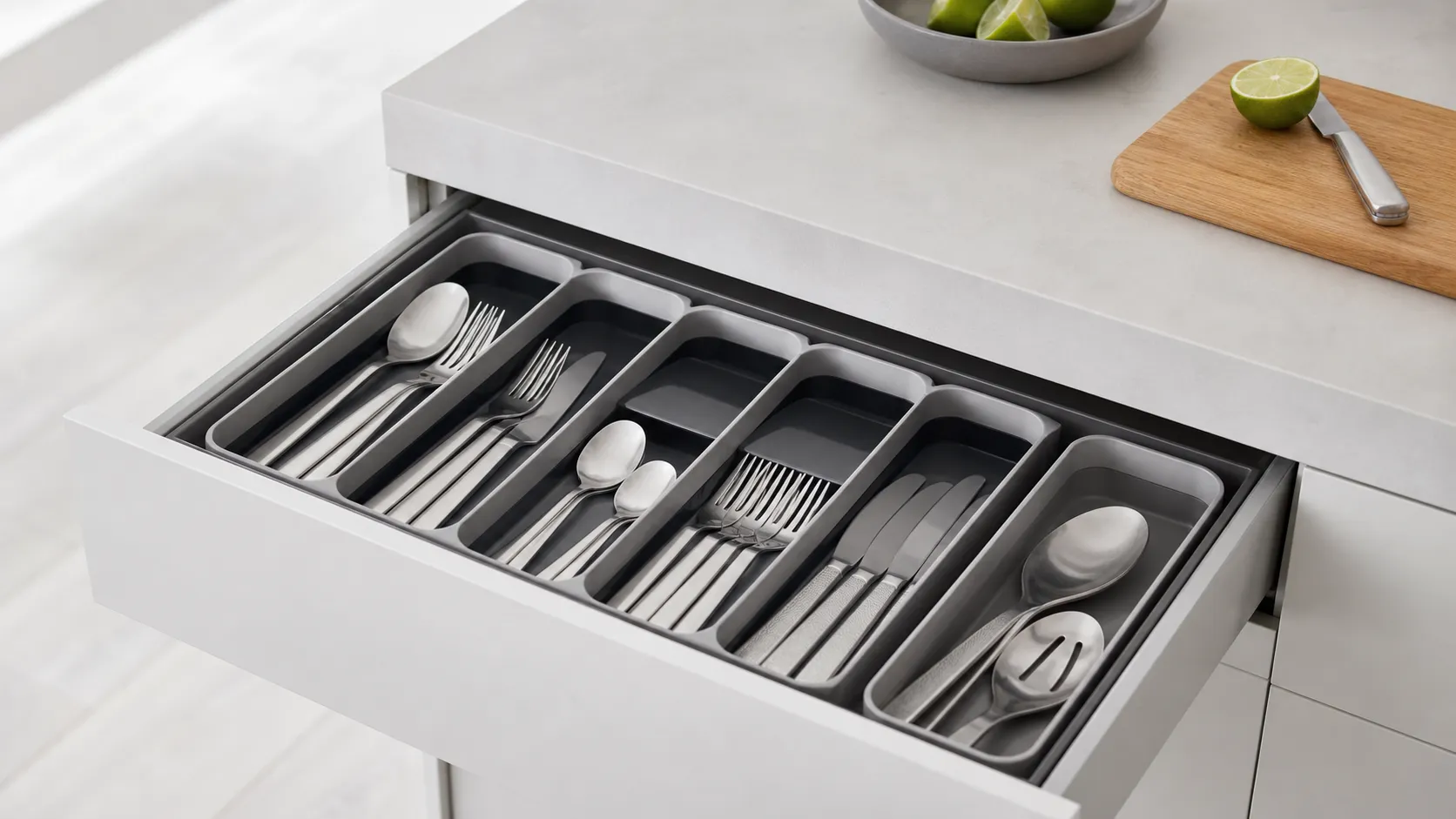
A slim, modern cutlery tray that maximizes shallow-drawer space. Great for tidy, small-kitchen organization—measure your drawer first and avoid if you store long utensils.
 Kitchen & Appliances
Microplane Premium Classic Zester/Grater — Review 2026
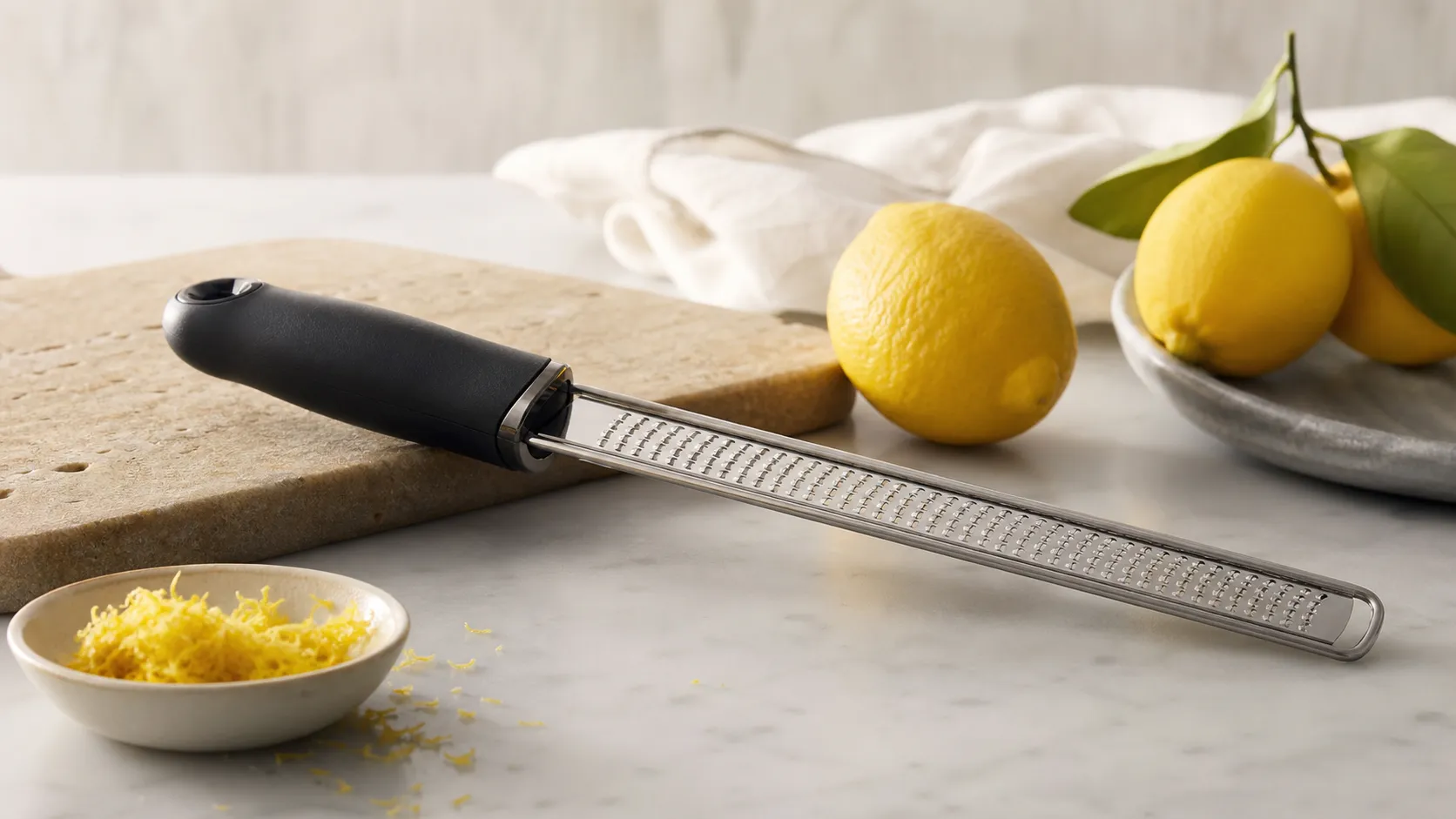
The Microplane Premium Classic is the go-to hand zester for precise, fluffy citrus zest and fine shavings. Sharp, compact, and great value—best for finishing, not bulk grating.