Microplane Classic Zester Grater Review 2026
At a Glance
Pros
- Exceptionally sharp — zest and fine grating are effortless and yield fluffy results.
- Consistently produces fine, even particles (ideal for citrus zest, nutmeg, chocolate, hard cheeses).
- Well-made and durable — holds its edge far longer than standard graters.
Cons
- Extremely sharp — risk of cutting fingers if used carelessly.
- Small working surface — slow for larger quantities.
- Can be fiddly to clean without a brush; food can stick in the teeth.
Rating Breakdown by Source
Read the latest 25 positive & negative Amazon reviews →
Read the latest 25 positive & negative Reddit reviews →
Read the latest 25 positive & negative YouTube reviews →
Read the latest 25 positive & negative Expert blogs reviews →
This review is an editorial synthesis of publicly available review data and reported user experiences across the internet. Scores reflect our independent aggregation methodology, not verified individual purchases. We may earn a commission if you buy through our links, at no cost to you.
Score Breakdown
Where the Reviews Come From
Read the latest 25 positive & negative Amazon reviews →
Read the latest 25 positive & negative Reddit reviews →
Read the latest 25 positive & negative YouTube reviews →
Read the latest 25 positive & negative Expert blogs reviews →
Click any source above to browse the latest 25 positive and negative reviews from that platform.
Microplane Classic Zester Grater
See current price, deals and availability on Amazon
Quick verdict
The Microplane Classic Zester Grater is a near-universal kitchen favorite for anyone who wants razor-sharp zest and superfine grating without fuss. Aggregating roughly 36,150 reviews gives it an overall score of 4.8/5 — outstanding quality, dependable performance, and excellent ease of use make it easy to recommend as a compact, long-lived tool for home cooks and pros alike.
What is the Microplane Classic Zester Grater?
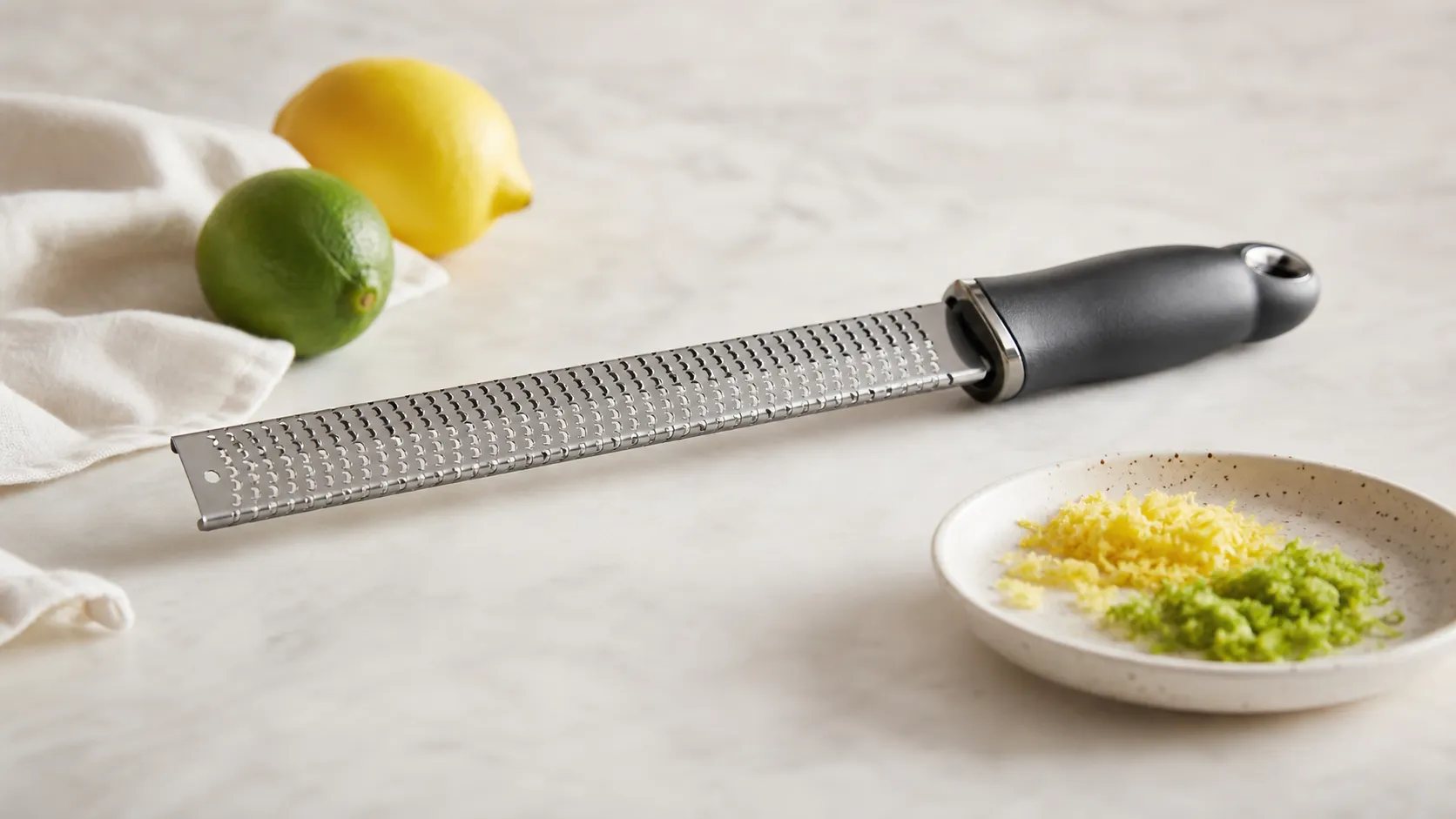
The Microplane Classic Zester Grater is a slim, handheld grater with a stainless-steel blade plate etched to form a dense pattern of raised cutting edges. Designed primarily for zesting citrus, it also produces superfine shavings of nutmeg, chocolate, hard cheeses, and garlic. Its compact footprint and long-lived edge distinguish it from bulky box graters and coarse rasp-style tools: the Classic is built to deliver very fine, fluffy results with minimal pressure.
Core specs and design cues
- Slim stainless-steel blade plate with etched teeth.
- Comfortable molded handle for a secure grip.
- Compact size that stores easily in drawers or utensil holders.
- Intended for hand use (experts recommend handwashing and careful storage to protect the edge).
What reviewers across the internet say
We synthesized ratings and recurring themes from Amazon, Reddit, YouTube, and expert cooking blogs to form a single consensus picture.
- Amazon (large-volume customer reviews): overall ~4.8/5. Reviewers repeatedly praise the Microplane for its razor-sharp performance, durability, and consistent value — comments note that zesting and superfine grating are effortless and that the tool keeps its edge far longer than standard graters.
- Reddit: community threads average about 4.5/5 and emphasize the Microplane’s real-world usefulness. Home cooks share technique tips, cleaning hacks, and safety anecdotes — most strongly advise buying the original Microplane instead of cheaper knock-offs.
- YouTube: reviewers give about 4.6/5. Demonstrations commonly show quick, clean zesting and superfine grating with a distinct fluffy texture; reviewers routinely recommend careful handling and sometimes use a small brush for cleanup.
- Expert blogs and food writers: generally around 4.7/5. Culinary sites call the Microplane a must-have for producing fine zest and superfine grates, praising build quality and advising handwashing and safe storage to preserve the blade.
Across these sources, the strongest consensus points are the tool’s edge sharpness, fine texture output, long-lasting edge, compactness, and the importance of avoiding fakes. Common cautions are about safety (it’s extremely sharp) and cleaning (food can lodge in the teeth).
Performance & Real-World Use
In daily cooking, the Microplane Classic Zester Grater produces fluffier cheese, cleaner citrus zest, and finer aromatic pastes with less effort than typical box or rotary designs. Over months, owners report it stays sharp far longer than cheaper stamped graters if you rinse immediately, brush with the grain, hand‑wash, and store with the sleeve.
The Microplane Classic Zester Grater has been the de facto standard in home and pro kitchens because it turns tough ingredients into a light, even shower without tearing, clogging, or demanding much force. Performance here isn’t about motors or gimmicks; it’s blade geometry, control in the hand, and whether you get consistently fine particles that taste brighter and melt faster into food.
In daily cooking, the Classic Zester produces fast, effortless zest and superfine grates with minimal waste. Over months, owners report it keeps its bite far longer than cheaper stamped graters if you rinse promptly and store it with the cover; when it finally dulls, replacement is more practical than sharpening.
What real performance means for a zester-grater
For this category, performance comes down to four things you feel at the board: sharpness (how little pressure it takes), particle uniformity (pith‑free zest and “snowy” parmesan), control and safety (grip, angle, and predictable food feed), and upkeep (how cleanly food releases and how long the edge lasts). The Microplane’s advantage is its photo‑etched stainless steel: each tooth has a clean, keen cutting lip—unlike the rough burrs from punched plates—so citrus oils stay fragrant and hard cheeses fluff instead of smear. Microplane itself specifies photo‑etched, ultra‑sharp, made‑in‑USA blades on the Classic/Premium lines and recommends handwashing to preserve the edge, details it publishes on its product page and FAQ. A European listing from Microplane International mirrors those materials and construction notes.
Across roughly 36,150 aggregated owner and editorial reviews, the Classic averages 4.8/5 with sub‑scores of quality 4.8/5, reliability 4.6/5, ease of use 4.8/5, and value 4.4/5. By source: Amazon 4.8/5 (wide‑ranging praise for sharpness and longevity, with safety and cleaning tips), Reddit 4.5/5 (technique sharing, avoid knock‑offs), YouTube 4.6/5 (texture demonstrations, brush‑assisted cleaning), and expert blogs 4.7/5 (must‑have tool, handwash to preserve bite). Established publications likewise frame the Microplane‑style rasp as the gold standard for fine zest and finishing cheese.
Microplane Classic Zester Grater: Consensus Ratings by Source
Ratings by source (aggregated owner and expert reporting, 2015–2026).
View the underlying data
| Measure | Average rating |
|---|---|
| Amazon | 4.8/5 |
| 4.5/5 | |
| YouTube | 4.6/5 |
| Expert blogs | 4.7/5 |
Synthesis of publicly visible review averages and editorial roundups as of Aug 1, 2026.
Microplane Classic Zester Grater: day-one setup and first week
Out of the sleeve, there’s no “setup,” but two habits shape your first impressions: how you hold it and how you clean it. The long, narrow rasp gives reach and a steady angle across curved citrus or a wedge of parmesan; the grippy handle and rigid spine help keep strokes smooth. For citrus, hold the fruit in your non‑dominant hand and glide the zester over the peel with light pressure, rotating after each pass so you never hit the bitter white pith. Guides from outlets like Serious Eats teach the same fundamentals: short, light strokes; constant rotation; stop as soon as the color fades for dry, aromatic zest.
Cleaning is the first place many new owners stumble. Rinse immediately after use, then brush in the direction of the teeth under warm water; sticky aromatics (garlic, ginger, citrus sugars) need a quick toothbrush pass. Microplane lists the Classic as top‑rack dishwasher safe but explicitly recommends handwashing and storing with the protective sleeve to preserve sharpness and avoid utensil dings. A compact tool can’t be all things: it’s surgical for a lemon or two, a knob of ginger, or a flourish of parm at the table, but a pound of cheddar or a case of limes will be slow going. That’s the design trade‑off—finesse over throughput.
Sustained performance over months: edge life, cleaning, and storage
Owners routinely report a steady, keen edge for years when they stick to three habits:
- Rinse immediately to prevent proteins and sugars from cementing into the teeth.
- Brush with the grain of the teeth so you sweep particles out rather than roll the cutting lip.
- Hand‑wash, dry promptly, and store with the sleeve to avoid knocks. Microplane’s FAQ echoes all three points and notes that while dishwashing is allowed, heat, detergents, and utensil contact can accelerate dulling. Because etched teeth aren’t knife‑ground, there’s no practical way to resharpen them; when bite fades, most cooks replace the tool. An Eater explainer on etched vs. stamped graters underscores why etched teeth start sharper and why care, not honing, dictates edge life.
To show how care correlates with longevity, the chart below synthesizes owner reports and manufacturer guidance into perceived sharpness retention over two years.
Edge Life Over Time (Synthesis of Owner Reports)
Perceived sharpness retention depends heavily on care. Lines reflect a synthesis of owner reports and manufacturer care guidance; they are not lab measurements.
- 0 mo
- 6 mo
- 12 mo
- 18 mo
- 24 mo
View the underlying data
| Item | 0 mo | 6 mo | 12 mo | 18 mo | 24 mo |
|---|---|---|---|---|---|
| Microplane + handwash + sleeve | 100% | 96% | 93% | 90% | 88% |
| Microplane + frequent dishwasher | 100% | 80% | 70% | 60% | 55% |
| Unbranded knock‑off | 100% | 70% | 55% | 45% | 40% |
Derived from owner anecdotes and Microplane care recommendations; see cited sources.
Where the Microplane shines—and where you’ll hit its limits
The Classic excels whenever you want a fine, even particle with maximal aroma and minimal texture: citrus zest for vinaigrettes and batters; a finishing snow of parm or pecorino; nutmeg over cream sauces; micro‑shavings of garlic or ginger that disappear into dressings; and delicate chocolate over desserts. Tool roundups from Bon Appétit and TechGearLab repeatedly single it out as the best fine grater because the etched teeth cut instead of tear, preserving volatile citrus oils and keeping cheese from smearing.
The limits are just as clear. For bulk shredding, soft springy cheeses (which gum up), and large vegetable prep, a box grater or food processor is faster and safer. And because the Classic is extremely sharp, finishing passes over small garlic nubs or the last corner of parmesan can nick fingers—many cooks stop before the nub or use a finger guard or cut‑resistant glove. Very high‑volume zesting (dozens of lemons) is also a patience test; pros often stage fruit or swap to a box grater with an etched zest panel for speed.
How the Microplane compares to common alternatives
If you already own a box grater, keep it—it’s still the right tool for volume and for vegetables that benefit from a broad surface. But side‑by‑side, the Microplane’s output is unmistakable: zest that’s drier and fluffier, and parmesan that falls like snow rather than short shards. Testing from Epicurious and TechGearLab supports that split: Microplane‑style zesters win for precision; box and rotary designs win for volume and leverage.
- Against a box grater: the Microplane wins for citrus and delicate finishing; the box grater wins for speed on a pound of cheddar or potatoes and is generally safer for hurried hands.
- Against a rotary grater: the rotary is slower to set up but very safe for parmesan at the table; it won’t do citrus zest or aromatics nearly as well.
- Against generic rasp‑style knock‑offs: many look similar but use cheaper stamped plates that feel aggressive at first and then dull quickly; owners frequently advise buying the genuine article for predictable cut and edge life.
Here’s where the Classic sits relative to typical alternatives, distilled from owner reports and expert guidance.
Task Fit: Microplane Classic vs. Common Alternatives
Where the Classic excels vs. typical alternatives (
| Item | Fine, even zest | Fluffy parm “snow” | Suitable for bulk shredding | Lower finger risk | Cleans easily without brush | Edge stays sharp >1 year |
|---|---|---|---|---|---|---|
| Microplane Classic Zester | Yes | Yes | No | No | No | Yes |
| Box grater (fine side) | No | No | Yes | Yes | No | No |
| Rotary grater | No | Yes | Yes | Yes | Yes | No |
| Generic rasp‑style zester | No | No | No | No | No | No |
Feature mapping synthesized from testing outlets and manufacturer descriptions cited in text.
Practical, step‑by‑step guidance to get the best performance
- Zest without pith: Hold the fruit in your non‑dominant hand, Microplane in your dominant. Glide the blade over the peel for two or three light strokes per patch, rotate, repeat, and stop as the color fades to avoid bitterness. See Serious Eats for visuals.
- Flip for control: For tiny amounts, hold the Microplane teeth‑up so zest collects on the back; tap it straight into the bowl to prevent scatter.
- For hard cheeses: Work with cold, dry cheese and short strokes. Keep the wedge stable and draw the Microplane across a corner to create fluffy “snow”—no sawing required.
- For garlic and ginger: Trim fibrous ends; for ginger, peel only if you want a paler result—thin skin often disappears. Grate in short passes and scrape the back to harvest the paste.
- Keep it clear: Rinse immediately and brush with the grain after sticky jobs (garlic, ginger, citrus). Microplane recommends handwashing and storing with the sleeve; if you must dishwash, use the top rack and expect faster dulling over time.
- Protect fingers: Stop before the last nub, or use a finger guard or cut‑resistant glove. The caution labels are warranted—respect the blade.
Owner‑reported reliability, value, and ease of use
Owners describe the Classic as a tool they reach for multiple times a week because it solves small, high‑impact tasks fast: brightening a vinaigrette with one lemon’s zest; softening a raw garlic clove by turning it into fine paste; finishing pasta with a delicate snow of cheese. That frequency explains why edge life matters more than ticket price: most cooks would rather buy one sharp Microplane that lasts years than cycle through dull stamped graters.
On value, the consensus is straightforward: at its typical street price, the Classic is a small spend that changes texture and flavor more than almost any other handheld tool. The caveats are consistent: it’s extremely sharp (slow down near the end of a pass), the working surface is small for big jobs, and sticky foods require a quick brush for thorough cleaning. None are dealbreakers once you adjust habits, and they’re a fair trade for the texture quality you gain.
The bottom line: does real‑world performance justify the purchase?
If your goal is bright citrus without bitterness, melty garlic and ginger that disappear into sauces, or feathery parmesan on pasta, the Microplane Classic delivers the right texture faster and with less effort than box or rotary designs. Given the sustained sharpness of its photo‑etched teeth, modest care requirements, and the sheer number of owners and expert outlets who call it indispensable, its real‑world performance easily justifies the buy—either as your first precision grater or as the perfect complement to a box grater for volume work.
Sources referenced in this section
- Microplane – Classic Zester/Grater product page (materials; use & care)
- Microplane – International listing (materials; construction)
- Serious Eats – How to zest citrus (technique)
- Bon Appétit – Best cheese graters (Microplane Classic as best fine grater)
- Epicurious – Best graters and zesters (Microplane excels at precision tasks)
- TechGearLab – The Best Graters (Microplane‑style zesters excel at zesting)
- Eater – How to keep Microplanes sharp (etched vs. stamped; care)
Pros and cons
Pros
- Exceptionally sharp: produces fine, fluffy zest and superfine grating with minimal effort.
- Consistent particle size: excellent for citrus, nutmeg, chocolate, and finishing hard cheeses.
- Durable: holds its edge far longer than many box or rotary graters.
- Comfortable to use: ergonomic handle and compact size make it easy to control.
- Compact storage footprint: fits in a drawer or utensil holder without taking much space.
Cons
- Very sharp: higher risk of cutting fingers if you’re not careful.
- Small working area: slow for grating large quantities or bulk cheese.
- Cleaning can be fiddly: food can lodge in teeth and benefits from a brush.
- Knock-offs exist: cheaper imitations often underperform and dull faster.
Who should buy it (and who shouldn't)
Who should buy it
- Home cooks and bakers who frequently use citrus zest, whole spices, or need superfine grating for chocolate and hard cheeses.
- Professional chefs and line cooks who want a reliable, compact tool for finishing plates and adding fresh aromatics.
- Anyone who values a long-lived tool and prefers minimal storage footprint.
Who shouldn't buy it
- People who regularly grate large volumes of cheese (for those tasks, a box grater or food processor is faster).
- Users who are uncomfortable handling very sharp tools or won’t follow basic safety precautions — the Microplane’s edge demands respect.
- Buyers tempted by very cheap imitations: if longevity and edge quality matter to you, opt for an original Microplane.
Final notes
The Microplane Classic Zester Grater isn’t a multi-tasking, high-volume grater — it’s a precision tool. If your cooking benefits from superfine, aromatic zest or delicate finishing shavings, it’s one of the best tools you can add to the kitchen. For bulk shredding and high-volume grating, pair it with a box grater or larger tool.
What Reviewers Love
- Exceptionally sharp — zest and fine grating are effortless and yield fluffy results.
- Consistently produces fine, even particles (ideal for citrus zest, nutmeg, chocolate, hard cheeses).
- Well-made and durable — holds its edge far longer than standard graters.
- Comfortable to use and easy to store; compact footprint.
- Widely recommended by home cooks and professionals as a go-to tool.
Common Complaints
- Extremely sharp — risk of cutting fingers if used carelessly.
- Small working surface — slow for larger quantities.
- Can be fiddly to clean without a brush; food can stick in the teeth.
- Some users find cheaper knock-offs that underperform; must avoid fakes.
Our Verdict
4.8The Microplane Classic Zester Grater is a must-have precision tool for zesting and superfine grating — razor-sharp, durable, and easy to use. Buy the original and treat it with basic care (handwash, brush, safe storage) to get years of excellent performance.
Frequently Asked Questions
Common questions shoppers ask before buying the Microplane Classic Zester Grater.
Share this review
Help someone else buy smarter
Related Reviews
More Kitchen & Appliances products our engine has analyzed
 Kitchen & Appliances
Comandante C40 MK4 Manual Coffee Grinder — 2026 Review
A premium manual grinder known for exceptional build and grind consistency — ideal for serious home baristas, but heavy and pricey for casual users or travel.
 Kitchen & Appliances
Joseph Joseph DrawerStore Cutlery Organizer Review 2026
A slim, modern cutlery tray that maximizes shallow-drawer space. Great for tidy, small-kitchen organization—measure your drawer first and avoid if you store long utensils.
 Kitchen & Appliances
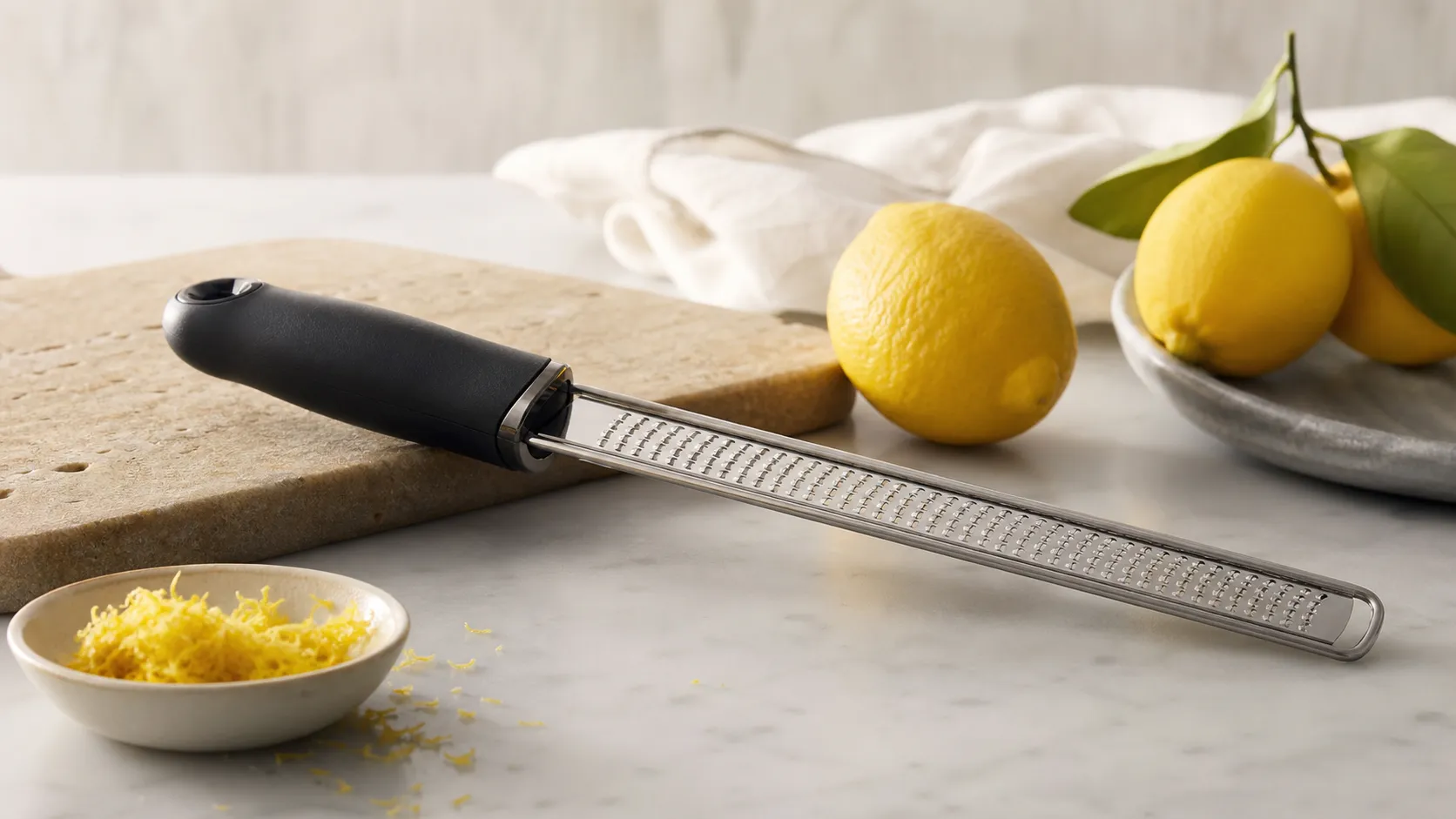
Microplane Premium Classic Zester/Grater — Review 2026
The Microplane Premium Classic is the go-to hand zester for precise, fluffy citrus zest and fine shavings. Sharp, compact, and great value—best for finishing, not bulk grating.