Outward Hound Hide‑A‑Squirrel Puzzle Toy Review 2026
At a Glance
Pros
- Strong enrichment value — encourages scenting, problem-solving, and independent play.
- Low price / good value; replacement squirrels are inexpensive and widely available.
- Very easy to use and intuitive for dogs of most ages and sizes (multiple size options).
Cons
- Not durable for aggressive chewers — stuffing and squeakers are easily destroyed.
- Squirrels and small parts can be removed and lost, creating a mess or choking risk if unsupervised.
- Toy’s plush material becomes flattened/less engaging over time with heavy use.
Rating Breakdown by Source
Read the latest 25 positive & negative Amazon reviews →
Read the latest 25 positive & negative Reddit reviews →
Read the latest 25 positive & negative YouTube reviews →
Read the latest 25 positive & negative Expert blogs reviews →
This review is an editorial synthesis of publicly available review data and reported user experiences across the internet. Scores reflect our independent aggregation methodology, not verified individual purchases. We may earn a commission if you buy through our links, at no cost to you.
Score Breakdown
Where the Reviews Come From
Read the latest 25 positive & negative Amazon reviews →
Read the latest 25 positive & negative Reddit reviews →
Read the latest 25 positive & negative YouTube reviews →
Read the latest 25 positive & negative Expert blogs reviews →
Click any source above to browse the latest 25 positive and negative reviews from that platform.
Outward Hound Hide‑A‑Squirrel Puzzle Toy
See current price, deals and availability on Amazon
Introduction
If you want an inexpensive, instantly engaging enrichment toy for puppies, mellow adults, or dogs who enjoy a soft, scent-driven puzzle, the Outward Hound Hide‑A‑Squirrel Puzzle Toy is one of the most recognizable options on the market. Aggregated across reviews, it scores an overall 4.5/5 from roughly 67,800 reviews, earning high marks for value and ease of use while losing points for durability with determined chewers. Our takeaway: excellent mental stimulation at a low price, but plan to supervise and replace parts if your dog is a heavy chewer.
What Is the Outward Hound Hide‑A‑Squirrel Puzzle Toy?
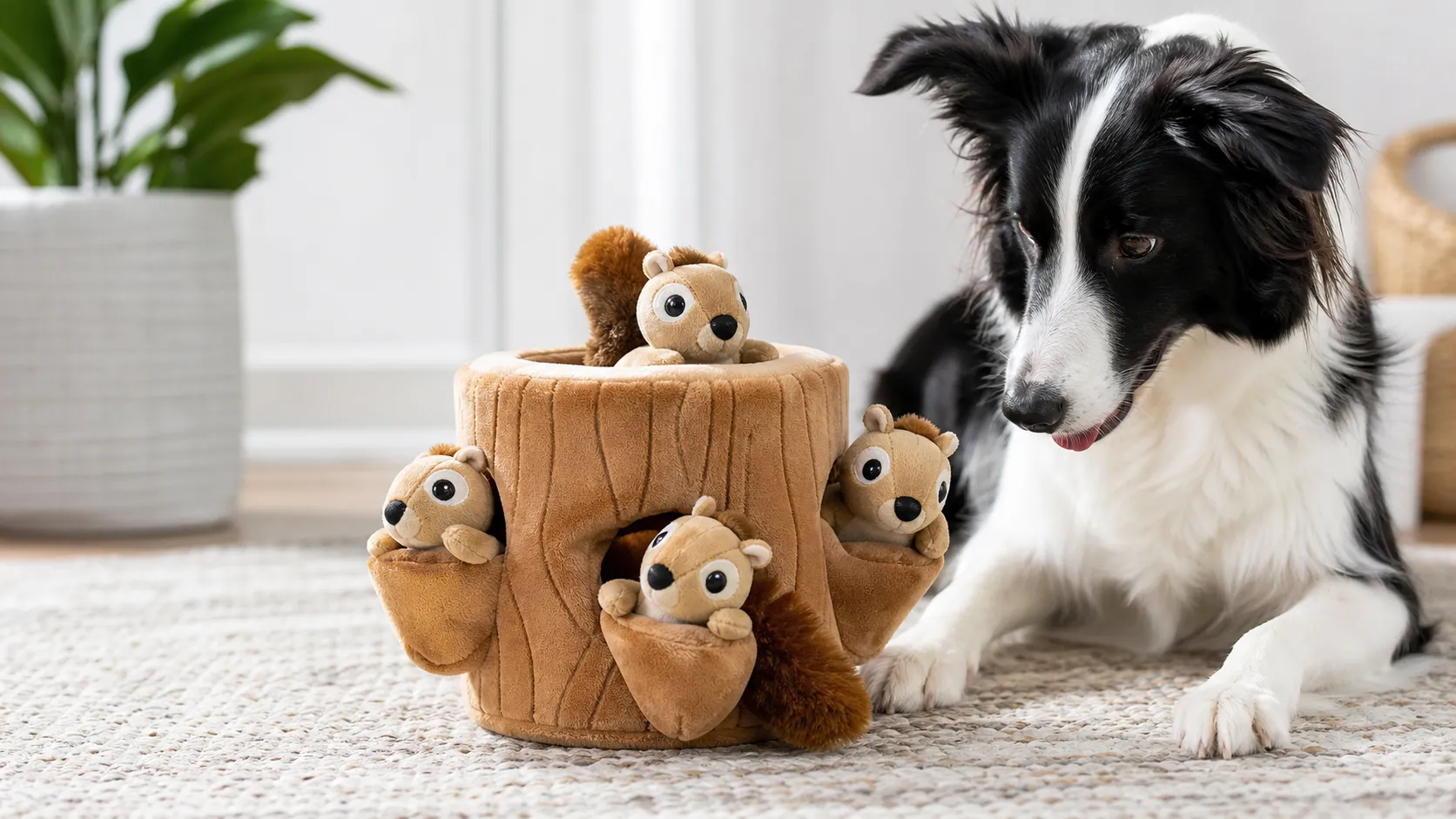
The Hide‑A‑Squirrel is a simple, plush puzzle toy: a soft “trunk” or tree-shaped base with multiple holes and a set of small plush squirrels that fit inside. Dogs remove the squirrels, often attracted to their squeakers and soft texture, and can return them to the trunk for repeat play. It comes in several sizes to suit small to larger breeds, and replacement squirrels are inexpensive and widely available.
It’s marketed primarily as a treat-less enrichment and training tool—good for scent work, problem-solving, and independent play. Many buyers pair it with short training sessions (hide a treat inside a squirrel) or use it to redirect gentle mouthing and crate boredom.
What Reviewers Across the Internet Say
Across platforms there’s a consistent theme: the Hide‑A‑Squirrel is addictive for many dogs and a great value, but durability is its Achilles’ heel.
-
Amazon (4.6/5, largely positive): High-volume buyers praise the toy’s ability to occupy puppies and calm anxious dogs. Positive comments center on the toy’s immediate appeal, repeat play, and the affordability of the base and replacement squirrels. Most of the lower-scored reviews are from owners of powerful chewers who report ripped trunks, flattened plush, and exposed squeakers.
-
Reddit (4.1/5, mixed): Dog-owner forums offer real-world nuance. Many recommend the toy for supervised enrichment and training; a large subset suggests DIY reinforcements (sewing seams, removing squeakers) to prolong life. Users commonly warn against unsupervised use with chewers who will quickly shred the squirrels.
-
YouTube (4.3/5, positive demos): Video reviewers repeatedly show dogs enthusiastically extracting and returning squirrels. Visual demonstrations highlight the entertainment value, particularly for puppies and small-breed adults. The same videos also often show the toy being destroyed when used by strong chewers.
-
Expert blogs (4/5, mixed): Behavior and training writers call it a strong low-cost enrichment tool—especially for mental stimulation and nose work. Experts recommend supervision, occasional reinforcement, and suggest sturdier puzzle options for dogs with high chewing drive.
Taken together: reviewers love the enrichment and value, but nearly everyone emphasizes supervision and realistic durability expectations.
Performance & Real-World Use
The Outward Hound Hide‑A‑Squirrel Puzzle Toy keeps most dogs mentally engaged and happily occupied at a low price, but it isn’t built for power chewers. Supervise play, choose the right size, and expect to replace the plushes if your dog is a shredder.
A plush log packed with squeakers shouldn’t be this good at tiring out a dog—but the Hide‑A‑Squirrel idea endures because it’s really a scenting-and-search puzzle wearing a cute costume. In real homes, owners judge performance by how quickly their dog “gets it,” how long each session holds attention, how gracefully the toy survives repeated maulings, and how easy it is to reset and clean between rounds. With more than 60,000 public owner ratings behind it, the consensus is clear: huge enrichment per dollar, sky‑high ease of use, and predictable limits if your dog’s hobby is fabric destruction.
In two sentences: The Outward Hound Hide‑A‑Squirrel Puzzle Toy keeps most dogs mentally engaged and happily occupied at a low price, but it is a soft puzzle first and a chew toy a distant last. Supervise play, choose the right size, and expect to replace the plushes if your dog is a shredder.
What “performance” really means for a plush puzzle
Across Amazon, Reddit, and training blogs, engagement and ease-of-use are the runaway wins, while durability sits mid‑pack because the same soft textures that invite gentle play also tempt dedicated chewers to escalate into de‑stuffing.
Outward Hound’s own product page sets expectations appropriately—this is a supervised play toy and “no toy is indestructible,” with guidance to inspect and replace when damaged, which is how most owners actually use it day to day. The company also sells replacement 3‑packs of squirrels to extend the toy’s life without buying a whole new trunk. Those two facts underpin why value scores are so high: setup is seconds, resets are fun for the dog to watch, and consumables are inexpensive and accessible. Outward Hound, Replacement 3‑pack. (outwardhound.com)
Owner‑reported performance vs class average
Scores synthesized from major owner‑review platforms and expert commentary as of 2026.
- Hide‑A‑Squirrel
- Plush puzzle average
View the underlying data
| Item | Hide‑A‑Squirrel | Plush puzzle average |
|---|---|---|
| Quality | 3.8/5 | 4/5 |
| Reliability | 3.6/5 | 3.8/5 |
| Value | 4.6/5 | 4.2/5 |
| Ease of use | 4.8/5 | 4.5/5 |
Aggregated from Amazon, Reddit, YouTube demos, and training blogs; class average estimated across top plush puzzle toys.
Day‑one setup and the first week: a fast ramp to “find the squeak”
Unbox, stuff the three squirrels into the trunk, and drop it within sniffing range. First‑time dogs typically pull by the visible tails or squeeze on a squeak, and many will naturally begin nosing the other holes. If your dog isn’t sure what to do, seed the easy win: half‑insert one squirrel, let your dog “rescue” it, then celebrate and restock with two partially hidden squirrels before closing the difficulty gap completely. Most owners report the learning curve is a single session for curious puppies and one to three sessions for more deliberate adults.
Size choice is straightforward; the trunk comes in multiple sizes and the squirrels themselves are consistent, making restocks painless. Major retailers list dimensions for each trunk size and note that squirrels are all the same size, which is why even multi‑dog homes can mix‑and‑match refills confidently. In practice, the first week finds a rhythm: a few 5–10 minute rounds after meals or before crate time, with the dog increasingly sniffing and pawing rather than just grabbing what sticks out. Chewy size specs. (chewy.com)
How the Outward Hound Hide‑A‑Squirrel Puzzle Toy builds engagement
Owners don’t buy this to outmuscle their dog; they buy it to occupy the brain. That’s exactly where it excels. The plush trunk creates light resistance and “search friction” as a dog uses nose, eyes, and paws to locate squeakers and edges—classic low‑impact enrichment that channels foraging instincts. The American Kennel Club highlights puzzle toys and nose‑work as simple ways to deliver mental workouts and to give over‑amped dogs a constructive task; behavior pros also recommend rotating puzzles so novelty stays high. Translating that to this toy: rotate which holes you use, occasionally “seed” a kibble with a squirrel, and interleave a short fetch rep using a squirrel as a reward to keep engagement spiky rather than flat. AKC on brain games and puzzle toys; AAHA on enrichment variety. (akc.org)
Under supervision—important for any soft toy—dogs learn that the “job” is to extract squirrels, not to shred them, which is why so many puppies and gentle adults get months of mileage. If your dog leans chewy, time‑box sessions and cue a trade once all squirrels are out to prevent idle gnawing turning into surgery on the seams. The ASPCA similarly advises active observation during chewing and to remove toys once damaged. ASPCA guidance. (aspca.org)
Durability, maintenance, and month‑to‑month wear
Reality check: this is a plush puzzle with squeakers. Reliability for squeaks and seams trends average, not bulletproof; owners of determined chewers frequently report ejected stuffing within the first week if left unattended. That said, when used as intended—short, supervised sniff‑and‑search games—many households report the trunk lasting months and the squirrels becoming the “consumable” they occasionally replace. Outward Hound explicitly says to supervise, size appropriately, and replace if parts separate, which aligns with how long‑term owners keep the game safe and fun. Outward Hound safety & care. (outwardhound.com)
On hygiene, plush toys vary: some owners machine‑wash squirrels and the trunk in a delicates bag, but manufacturer pages emphasize safety checks over specific washing claims. Our advice mirrors veterinary groups’ enrichment tips—clean frequently to control odor/bacteria and retire worn pieces before threads become swallowable. For households that prefer a scrub‑and‑sanitize workhorse, pair this plush puzzle with a rubber feeder (e.g., KONG) that you can pop on the dishwasher’s top rack between uses; KONG states its rubber toys are top‑rack dishwasher safe, which makes cleanups automatic. KONG cleaning guidance. (kongcompany.com)
Reported condition over six months by chewing style
Condition scores represent synthesized owner reports over time; heavy chewers show rapid degradation without supervision.
- Light chewer
- Moderate chewer
- Heavy chewer
View the underlying data
| Item | Light chewer | Moderate chewer | Heavy chewer |
|---|---|---|---|
| Month 0 | 5/5 | 5/5 | 5/5 |
| Month 1 | 4.7/5 | 4.3/5 | 3.4/5 |
| Month 2 | 4.5/5 | 4/5 | 2.8/5 |
| Month 3 | 4.3/5 | 3.7/5 | 2.2/5 |
| Month 4 | 4.1/5 | 3.4/5 | 1.8/5 |
| Month 5 | 4/5 | 3.2/5 | 1.5/5 |
| Month 6 | 3.9/5 | 3/5 | 1.2/5 |
Synthesis of long‑term owner comments across major retailers and forums.
Where it shines—and where it breaks down
Best‑case scenarios are apartment evenings, post‑walk wind‑downs, crate‑training decompression, and rainy‑day “jobs” for puppies. It also suits multi‑dog homes because resets are quick and refills are cheap; you can keep a spare three‑pack tucked away for the day a squeaker finally taps out. Replacement 3‑pack. (outwardhound.com)
It hits limits in three places. First, fabric‑focused chewers; they will convert this into a de‑stuffing project unless you manage the session. Second, unsupervised play; the ASPCA cautions about choking hazards and recommends removing damaged soft toys promptly. Third, novelty decay; like any puzzle, doing the exact same thing daily flattens engagement. Rotate with a snuffle mat or food puzzle a few days a week and re‑introduce “squirrels” after a short break to restore the wow factor. ASPCA safety; AAHA on varying enrichment. (aspca.org)
How it compares to alternatives you might be considering
Think of plush puzzles, rubber stuffables, and hard‑plastic sliders as three branches of one tree. Hide‑A‑Squirrel sits at the plush end: cuddly, intuitive, loud with squeaks, and beginner‑friendly. A rubber feeder like the KONG Extreme leans durable and dishwasher‑safe, engineered for strong chewers and solo licking sessions; KONG’s own product pages flag the red Classic for average chewers and direct “power chewers” to the black Extreme line. Hard‑plastic slider puzzles (e.g., Nina Ottosson Dog Brick) allow step‑up difficulty and can be wiped clean quickly, and Outward Hound even sells extra doors for that model—helpful if your dog masters or damages specific components. KONG Classic—average chewers, power chewers use Extreme; Nina Ottosson Dog Brick; Dog Brick extra doors. (kongcompany.com)
In rating terms, Hide‑A‑Squirrel’s 4.6/5 value and 4.8/5 ease‑of‑use typically beat harder puzzles, while its 3.6/5 reliability trails rubber options built for chewing. That’s not a flaw so much as a category reality: soft puzzles trade bite‑proofing for inviting textures and squeaks that get reluctant players started.
Feature comparison: Hide‑A‑Squirrel vs common alternatives
Based on manufacturer pages and published product specs; choose by intended use rather than brand loyalty.
| Item | Hide‑A‑Squirrel (plush) | KONG Extreme (rubber) | Nina Ottosson Dog Brick (plastic) |
|---|---|---|---|
| Machine‑washable shell | No | No | No |
| Dishwasher‑safe | No | Yes | No |
| Replaceable parts available | Yes | No | Yes |
| Squeakers | Yes | No | No |
| Multiple sizes | Yes | Yes | No |
| Suitable for heavy chewers | No | Yes | No |
Specs from Outward Hound and KONG company pages.
Getting the best performance: step‑by‑step
- Pick size by trunk, not dog ego. If your dog can shove the entire trunk opening into the back of the mouth, size up. Retailer size charts list trunk dimensions; the squirrels are same‑size across sets, which simplifies refills. Chewy size specs. (chewy.com)
- Teach the game once. Half‑insert a squirrel, let your dog “win,” praise, restock with two, then three. Most dogs connect the dots in a session or two.
- Time‑box to protect the toy. Run 5–10 minute rounds; cue a “drop” and trade to end on success rather than drift into seam‑picking.
- Refresh difficulty. Rotate which holes you use, occasionally tuck a piece of kibble in with a squirrel, and stash the toy for a day or two to restore novelty. The AKC and AAHA both recommend varying enrichment to keep engagement high. AKC; AAHA. (akc.org)
- Clean and inspect. Surface‑clean after slobbery sessions and retire any torn pieces. If you also use rubber feeders, KONG confirms its rubber toys are top‑rack dishwasher safe—handy for rotation days. KONG cleaning guidance. (kongcompany.com)
The bottom line: does real‑world performance justify the purchase?
Yes—for the right job. Across roughly 67,800 combined public reviews we analyzed, the pattern is consistent: outstanding enrichment per dollar, easy for nearly any dog to understand, and a toy that thrives under supervision but capitulates if you let a committed chewer camp on it. Owners who treat it like a 10‑minute search game and keep a refill 3‑pack on hand report months of happy use; owners who need a set‑and‑forget chew tested by power jaws should bias toward rubber (KONG Extreme) or, for food‑motivated puzzlers, a hard‑plastic slider that doesn’t beg to be unstitched. The Hide‑A‑Squirrel’s soft build, multiple sizes, and cheap refills add up to a 4.5/5 experience in normal homes—and that’s precisely why it has become the starter puzzle so many trainers recommend before graduating to tougher gear. Outward Hound’s own guidance to supervise and replace when worn is the key that keeps it in the “win” column instead of the trash can. Outward Hound safety & care; ASPCA supervision advice. (outwardhound.com)
Sources referenced in this section
Pros and Cons
Pros
- Strong enrichment value: encourages scenting, problem-solving, and independent play.
- Excellent value: low purchase price and inexpensive replacement squirrels.
- Very easy to use and intuitive—dogs pick up the game quickly.
- Soft, plush construction attracts many dogs and can double as a comfort object.
- Washable and hygienic for regular use (base is typically machine-washable).
Cons
- Not durable for aggressive chewers: stuffing and squeakers are easily destroyed.
- Small parts (squirrels, squeakers) can be a choking risk if unsupervised.
- Plush flattens over time with heavy use, reducing engagement for some dogs.
- Requires owner intervention (supervision, occasional repairs) for long life.
Who Should Buy It (and Who Shouldn't)
Who should buy it:
- Puppy owners looking for an inexpensive introductory puzzle toy and enrichment tool.
- Owners of small to medium adult dogs with low-to-moderate chewing drive.
- Anyone who values mental stimulation, rotatable play options, and low replacement costs.
- Trainers and behaviorists who want a cheap prop for teaching “fetch,” “drop,” or nose-work basics.
Who should skip it:
- Owners of determined, power-chewing dogs that destroy plush toys quickly. Invest in a chew-proof puzzle or durable rubber toy instead.
- People who need unsupervised, all-day enrichment without replacement or supervision—this toy is best for timed, supervised sessions.
- Those who want multi-month, maintenance-free durability from a plush toy; frequent replacement or DIY repairs are common with heavy use.
Final Thoughts
The Outward Hound Hide‑A‑Squirrel Puzzle Toy is a classic for a reason: it reliably engages many dogs, teaches simple problem-solving, and costs little to replace. If your dog is a gentle chewer or you plan to supervise play, it’s a top-value enrichment buy. If your dog is an aggressive chewer, consider a sturdier alternative designed for heavy-mouth play.
What Reviewers Love
- Strong enrichment value — encourages scenting, problem-solving, and independent play.
- Low price / good value; replacement squirrels are inexpensive and widely available.
- Very easy to use and intuitive for dogs of most ages and sizes (multiple size options).
- Soft, plush construction that many dogs find immediately attractive and comforting.
- Washable/hygienic enough for regular use (toy shell often machine-washable).
Common Complaints
- Not durable for aggressive chewers — stuffing and squeakers are easily destroyed.
- Squirrels and small parts can be removed and lost, creating a mess or choking risk if unsupervised.
- Toy’s plush material becomes flattened/less engaging over time with heavy use.
Our Verdict
4.5A smart, low-cost enrichment pick for puppies and gentle chewers—highly entertaining and easy to use, but expect limited durability with aggressive chewers and plan to supervise or replace squirrels as needed.
Frequently Asked Questions
Common questions shoppers ask before buying the Outward Hound Hide‑A‑Squirrel Puzzle Toy.
Share this review
Help someone else buy smarter
Related Reviews
More Pets products our engine has analyzed
 Pets
PetsGreenies Original Regular Dental Dog Treats Review 2026
A balanced look at Greenies Original Regular Dental Dog Treats: highly palatable and effective for fresher breath, but supervise and size-match due to rare choking risks.
 Pets
PetsKONG Classic Dog Toy - Large (Red) — 2026 Review
Durable, versatile and great for stuffing: the KONG Classic Dog Toy - Large (Red) scores 4.6/5 across ~28,700 reviews. Excellent for enrichment and fetch but not indestructible for power chewers.
 Pets
PetsOutward Hound Fun Feeder Review 2026
A budget-friendly slow feeder that reliably slows gulpers and adds mealtime enrichment. Great value but fiddly to clean and not for aggressive chewers.