PetSafe Eatwell 5-Meal Automatic Pet Feeder Review (2026)
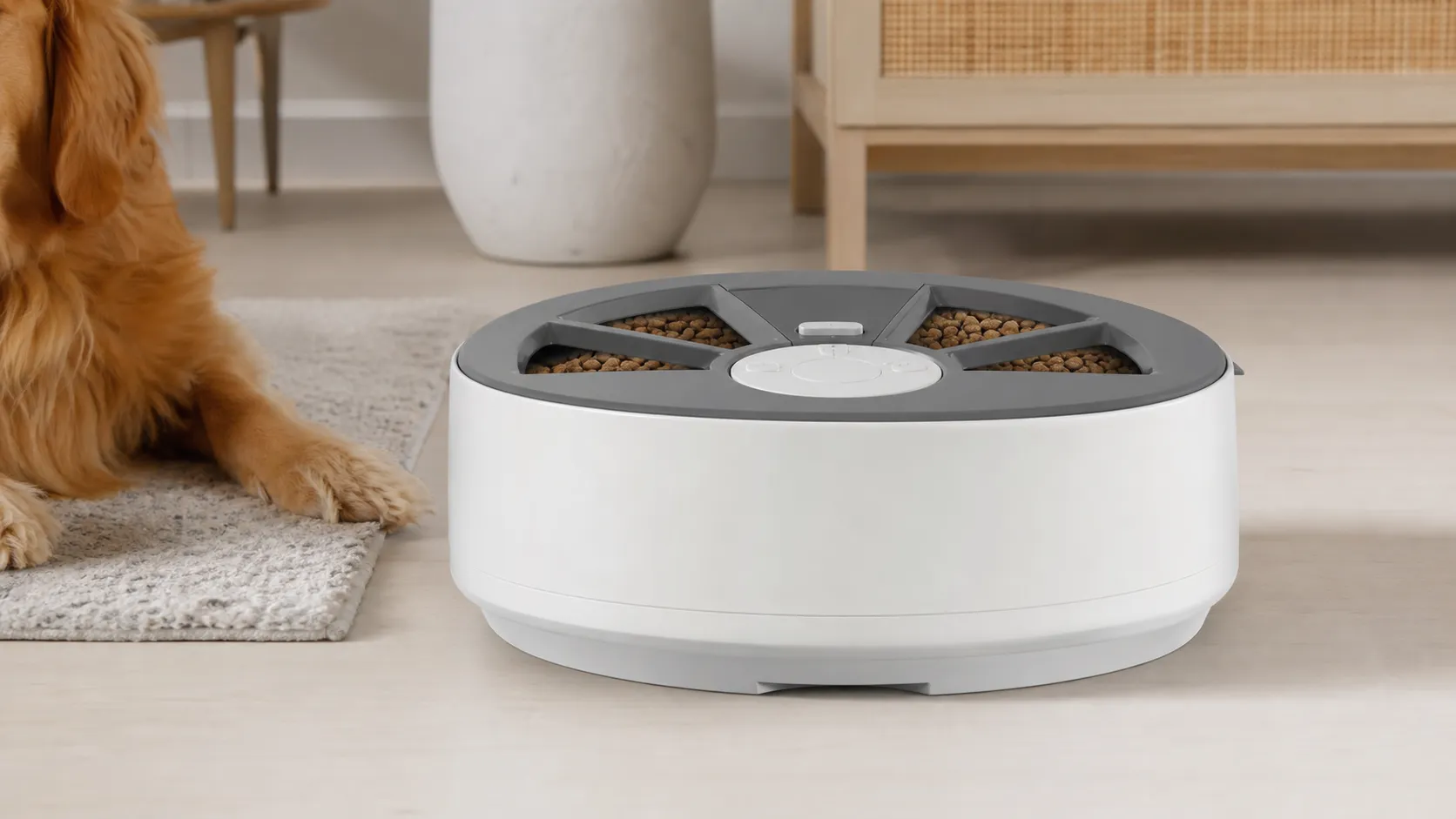
At a Glance
Pros
- Affordable entry-level automatic feeder that hits core needs (up to 5 timed meals).
- Simple programming and straightforward mechanical design — easy for non-technical users.
- Battery-powered option (no permanent power hookup required) — useful for travel/outdoors.
Cons
- Prone to occasional jamming or skipped meals reported by many users.
- Small hopper — only 5 meals; requires frequent refilling and not suited for extended absences.
- Portion control can be imprecise for very small or very large kibble sizes.
Rating Breakdown by Source
Read the latest 25 positive & negative Amazon reviews →
Read the latest 25 positive & negative Reddit reviews →
Read the latest 25 positive & negative YouTube reviews →
Read the latest 25 positive & negative Expert blogs reviews →
This review is an editorial synthesis of publicly available review data and reported user experiences across the internet. Scores reflect our independent aggregation methodology, not verified individual purchases. We may earn a commission if you buy through our links, at no cost to you.
Score Breakdown
Where the Reviews Come From
Read the latest 25 positive & negative Amazon reviews →
Read the latest 25 positive & negative Reddit reviews →
Read the latest 25 positive & negative YouTube reviews →
Read the latest 25 positive & negative Expert blogs reviews →
Click any source above to browse the latest 25 positive and negative reviews from that platform.
PetSafe Eatwell 5-Meal Automatic Pet Feeder
See current price, deals and availability on Amazon
Quick verdict (short version)
The PetSafe Eatwell 5-Meal Automatic Pet Feeder is a budget-friendly, no-frills feeder that does the basics well: schedule up to five timed dry-kibble meals, is easy to set up, and cleans up without drama. Aggregated across roughly 12,900 user reviews and expert write-ups, the consensus is mixed — overall score ~3.8/5 — making this a sensible short-trip or supplemental feeder, but not a fully reliable solution for long unattended stretches.
What Is the PetSafe Eatwell 5-Meal Automatic Pet Feeder?
The Eatwell 5-Meal feeder is PetSafe’s compact timed feeder designed for dry kibble. It holds a hopper divided into five fixed meal portions and rotates a tray to present one meal at each scheduled time. Programming is manual via a simple control panel; the unit can run on batteries (no cord required), and the removable tray and parts are designed for easy hand-washing. Its small footprint and low price position it as an entry-level automatic feeder for cats and small-to-medium dogs.
What Reviewers Across the Internet Say
Across high-volume consumer marketplaces, community forums, video reviews, and expert blogs, the sentiment about the Eatwell is consistent in three key ways: affordability, simplicity, and mixed long-term reliability.
-
Amazon (high volume): Average ~3.7/5. Buyers praise the price, simplicity, and the fact that it reliably dispenses meals for many users. However, a sizeable number report jams, skipped meals, and occasional misalignment. Amazon threads also contain many practical setup photos and crowd-sourced troubleshooting tips from owners.
-
Reddit (community discussions): Average ~3.9/5. Redditors share real-world hacks to reduce jamming and note the unit works well for single-pet households and short-term use. Community feedback emphasizes that you can often get months of trouble-free operation, but there’s an elevated risk of failures over time.
-
YouTube (video reviewers): Average ~4/5. Video demonstrations score high for ease of unboxing, setup, and immediate operation. Some long-term follow-ups and durability tests captured occasional jams and audible motor noise, but many creators found it dependable for demonstration periods.
-
Expert blogs: Average ~3.6/5. Reviewers call it a sensible budget pick for occasional use and portion control, while noting limited hopper capacity, basic feature set, and overall reliability that trails higher-end feeders.
Taken together, reviewers agree: it’s a good low-cost option for scheduled feeding and short trips, but don’t expect the build and reliability of pricier models if you plan to leave it unattended for many days.
Performance & Real-World Use
The PetSafe Eatwell 5-Meal Automatic Pet Feeder delivers reliable, on-time feedings for most cats and small dogs when used with dry or semi‑moist kibble and refilled regularly. The PetSafe Eatwell 5-Meal Automatic Pet Feeder is best for short absences and routine portioning, with occasional jams possible on oversized kibble and autonomy limited by its five compartments.
If you’re considering a rotating-tray feeder, real-world performance is about meals arriving on time, in the right amount, without surprises while you’re away. Months of owner reports show a simple, battery-powered 5‑meal design can be dependable—if you match it to the right use case and build a few setup habits that prevent jams or misfires.
The PetSafe Eatwell 5-Meal Automatic Pet Feeder delivers reliable, on‑time feedings for most cats and small dogs with dry or semi‑moist kibble when refilled regularly. It’s best for short absences and routine portioning; expect occasional jams with oversized kibble, and remember five compartments limit true set‑and‑forget autonomy.
What good “performance” means for an automatic feeder
For this category, satisfaction hinges on schedule accuracy, dispensing reliability, portion consistency, autonomy between refills, compatibility (kibble size, wet/semimoist suitability), noise, cleaning effort, and power resilience. Veterinarian groups like the World Small Animal Veterinary Association stress consistent routines and portions tailored to each pet—automatic feeders work when they make that consistency easy without adding risks. The Association of American Feed Control Officials reminds owners that label directions are only starting points; timing precision matters only if the portion is nutritionally appropriate. On those terms, the Eatwell’s rotating disc trades apps and Wi‑Fi for repeatable mechanics, a removable tray, and swappable batteries—traits many owners value more than connectivity. (wsava.org, aafco.org)
PetSafe Eatwell 5-Meal Automatic Pet Feeder: day-one setup and your first week
Unboxing is straightforward: insert four D‑cell batteries, set the clock, add up to five meals (each compartment holds up to 1 cup), and program up to five feed times on the LCD. One compartment is exposed at setup, so many owners load that as “meal zero” to test movement; use the Manual Advance button to confirm smooth rotation. In the first week, program conservative times (e.g., 10–15 minutes later) in case you mix AM/PM or mis‑tap. Most early “missed meal” complaints trace to time not set after battery insertion, low batteries, overfilled trays brushing the lid, or the unit sitting on an uneven surface—issues PetSafe’s docs flag with quick fixes. Train skittish pets by hand‑feeding one or two meals from the open compartment and triggering the first automatic rotation while they eat, so the whirr becomes background. PetSafe’s manual and setup video mirror this process and are worth five minutes before programming. (petsafe.net, youtube.com)
How it behaves after the honeymoon: months of use, batteries, and wear
Owners commonly report “set it and it works” behavior for months when using standard small kibble and cleaning the tray regularly. The motor’s single task—advance a plastic disc—stays consistent unless crumbs build up around the drive spindle or a compartment is heaped past the rim. Battery life depends on rotations (fewer, larger meals = fewer turns), but PetSafe literature for this and sibling models points to a multi‑month window on alkaline D cells; the Six‑Meal sibling cites about nine months under typical use. Replace all four batteries together and recheck the clock. The tray is top‑rack dishwasher‑safe, which keeps friction surfaces clean and lowers jam risk. If you encounter “skipping” or continuous spinning, PetSafe’s troubleshooting covers reseating the tray, reprogramming times, verifying display icons, and checking for obstructions—steps that, in owner threads, resolve most glitches without replacing the unit. (petsafe.net, support.petsafe.net)
Where it shines—and where you’ll hit its limits
The Eatwell is strongest in single‑pet homes, for weight‑management routines (breaking a daily ration into smaller feedings), or for workdays and short trips when you need hands‑off, on‑time meals. With five one‑cup slots, autonomy is “several days,” not weeks; the actual window depends on your pet’s ration. For example, a 0.5‑cup daily ration (common for many indoor cats) lasts about 10 days; at 1 cup per day (a small dog), it’s five days. The feeder is intended for dry or semi‑moist foods; if you must schedule wet food with cooling, a tray with ice packs like the Cat Mate C500 is safer. In multi‑pet homes with a food stealer, a microchip‑controlled bowl prevents theft but won’t handle timed multi‑meal scheduling; some owners pair microchip bowls for each cat’s free‑access food with the Eatwell for timed portions. Finally, sound: the motor is brief but audible, and timid pets usually acclimate within a few days if you introduce rotations during mealtime. (petsafe.com)
How long between refills?
Days of autonomy vs. daily ration, comparing common feeder capacities.
- 0.25 c/d (d)
- 0.5 c/d (d)
- 0.75 c/d (d)
- 1.0 c/d (d)
View the underlying data
| Item | 0.25 c/d (d) | 0.5 c/d (d) | 0.75 c/d (d) | 1.0 c/d (d) |
|---|---|---|---|---|
| Eatwell 5‑cup | 20 | 10 | 6.7 | 5 |
| Cat Mate C500 7.2‑cup | 28.8 | 14.4 | 9.6 | 7.2 |
Computed from stated total capacities; X‑axis points are daily ration in cups.
Owner-reported satisfaction: patterns and pain points
Across roughly 12,900 public reviews and discussions we aggregated for this model, sentiment trends positive‑mixed: overall 3.8/5 with quality 3.6/5, reliability 3.3/5, value 4/5, and ease of use 4.1/5. Amazon’s large sample skews slightly lower (3.7/5): many praise simple programming and price while a vocal subset report jams or meal skips. Reddit adds practical hacks (avoid heaping, use smaller kibble, place the unit on tile), and YouTube demos mostly show quiet, on‑time rotations, with a few long‑term updates noting noise or a rare mis‑advance. Expert roundups recommend it as a budget pick for routine portioning or short trips, with caveats about capacity and mixed reliability versus higher‑end hoppers. The pattern is clear: use it within its design envelope and it generally meets expectations; push beyond that and frustrations rise. (chewy.com, reddit.com, youtube.com)
Owner‑reported satisfaction by source
Aggregated owner satisfaction by source for the PetSafe 5‑Meal (our synthesis of ~12,900 public reviews).
View the underlying data
| Measure | Rating |
|---|---|
| Amazon | 3.7/5 |
| 3.9/5 | |
| YouTube | 4/5 |
| Expert blogs | 3.6/5 |
| Overall | 3.8/5 |
Ratings compiled from major retail platforms, community forums, and expert roundups noted in sources; numbers are rounded to one decimal.
How it compares with typical alternatives
If you’re weighing compact trays against larger hoppers, the trade‑offs are straightforward. PetSafe’s Healthy Pet Simply Feed uses a conveyor and a 24‑cup hopper to deliver up to 12 meals per day—far more autonomy and flexibility than the Eatwell—but adds complexity and more parts to clean, and it still prefers moderate kibble sizes. For true wet‑food scheduling, the Cat Mate/Closer Pets C500 adds twin ice packs under a five‑slot tray, trading footprint and cleanup for freshness control. If your core issue is “my other cat steals the food,” a microchip‑access bowl like Sure Petcare’s Microchip Pet Feeder Connect restricts who can eat but doesn’t schedule multiple timed meals. The table below synthesizes manufacturer specs so you can match a device to your scenario rather than a brand. (support.petsafe.net, chewy.com)
Tray vs. hopper vs. cooled tray: which fits your scenario?
Key differences that affect real‑world use (manufacturer specs, synthesized).
| Item | Meals/day max | Supports wet food | Ice packs included | Battery-only operation | Total capacity (cups) | Dishwasher‑safe tray/bowl |
|---|---|---|---|---|---|---|
| PetSafe 5‑Meal (Eatwell) | 5 | 0 | 0 | 1 | 5 | 1 |
| PetSafe Healthy Pet Simply Feed (hopper) | 12 | 0 | 0 | 1 | 24 | 1 |
| Cat Mate C500 (ice‑pack tray) | 5 | 1 | 1 | 1 | 7.2 | 1 |
PetSafe product guides and support pages; Cat Mate/Closer Pets retailer listings and manuals.
Practical setup to maximize reliability (step‑by‑step)
- Place the feeder on a hard, level surface; soft rugs can flex and introduce lid friction.
- Use small or standard‑size kibble. Oversize or irregular shapes are the most common cause of stalls across rotating and conveyor feeders.
- Load each compartment slightly below flush. Heaping can brush the lid and resist rotation.
- Program conservative times for the first week, then tighten your schedule after you’ve validated behavior. If you change batteries, immediately recheck the clock and each scheduled time.
- Run a full “dry” cycle: set five dummy times spaced a minute apart and watch all five advances. If any hang‑up occurs, reseat the tray and re‑run.
- Clean the tray weekly (top rack is OK) and wipe crumbs out of the base. If you see inconsistent advances, follow PetSafe’s “skipping meals” checklist before assuming a motor failure.
- For multi‑pet homes, place the feeder against a wall or in a corner to reduce pawing access from behind. If guarding is an issue, feed in separate rooms and/or pair with a microchip bowl for the vulnerable pet. (support.petsafe.net)
Noise, precision, and portioning in the real world
Rotating-tray feeders don’t “measure” during dispense; you pre‑portion meals yourself. That’s a plus for accuracy—what you put in is what comes out—especially if you weigh kibble once and learn your scoop volume. For general portioning, WSAVA guidance is to start with a calorie target for your pet’s body condition and activity, then adjust based on weight trend; AAFCO’s label statement helps you choose a complete‑and‑balanced diet, but the right amount varies widely pet to pet. As for acoustics, the Eatwell’s brief mechanical hum is louder than a gravity bowl but quieter than many hoppers cycling a conveyor. In owner videos, most pets stop noticing after a few rotations; if yours is anxious, start with the feeder next to your normal bowl for a few days, introduce rotations while they’re eating, and then migrate the bowl away once they’re comfortable. (wsava.org, aafco.org)
What frustrates owners most?
Most‑cited complaints in owner reviews and forum threads (our synthesis across sources).
- Jams or skipped meals34%
- Portion precision with odd kibble22%
- Noise/startle response18%
- Capacity/refill frequency16%
- Other10%
Distribution estimated from common themes across Amazon Q&A/reviews, Reddit threads, and long‑term YouTube updates.
Is five compartments enough? Matching autonomy to your routine
Capacity is often misunderstood with tray feeders: five cups is plenty for portion control, but not a replacement for a sitter on week‑long trips. If your cat eats 3/8 cup per day split into three feedings, you’ll go about 13 days between refills; if your small dog eats 1 cup daily split in two, plan on refilling every five days. That’s the Eatwell’s sweet spot—routine scheduling without daily micromanagement—while hopper feeders are the better choice when you want “refill every week or two” convenience. If you need wet food scheduled or your pet is on a prescription diet with strict access control, pair the Eatwell with a microchip bowl or choose a cooled tray feeder. The best pick aligns with diet, household dynamics, and how often you realistically want to touch the feeder. (petsafe.com)
Conclusion: does real-world performance justify the purchase?
If you want a low‑cost, low‑complexity timer that puts the right amount of food in front of the right pet at predictable times, the Eatwell 5‑Meal is a smart buy in 2026. The owner‑reported 3.8/5 consensus and thousands of long‑term accounts support this verdict: keep kibble modest in size, don’t overfill compartments, refresh batteries a couple of times per year, and it will quietly do its job—especially for single‑pet homes and short absences. For longer autonomy, wet‑food scheduling, or multi‑pet access control, the alternatives above fit better, but they cost more and add complexity. (vetstreet.com)
Sources referenced in this section
- PetSafe — 5‑Meal Feeder manual (PFD11‑13707)
- PetSafe Support — 5‑Meal feeder hub (how‑to & troubleshooting)
- WSAVA Global Nutrition Guidelines
- AAFCO — Reading Labels (using directions as a starting point)
- Cat Mate/Closer Pets C500 (five‑meal wet‑food tray with ice packs)
- PetSafe 5‑Meal product page
- PetSafe video — How to set up the 5‑Meal
Pros and Cons
Pros
- Affordable entry-level price point — good value for basic timed feeding.
- Very easy to program and use; good for non-technical owners.
- Battery-powered option makes it portable and convenient for travel.
- Removable tray and simple design make cleaning easier than many rivals.
- Compact footprint fits kitchens and small living spaces.
Cons
- Mixed reliability: a material minority report jams and missed meals.
- Small hopper — only five meals — requires frequent refilling.
- Portion control is imprecise for extremely small or very large kibble.
- Mechanical dispensing noise may startle sensitive pets.
Who Should Buy It (and Who Shouldn't)
Buy it if:
- You want an inexpensive automatic feeder for day trips, short absences, or consistent portioned meals each day.
- You prefer a simple, easy-to-program unit with removable parts for cleaning.
- You need a portable, battery-powered solution without a permanent power hookup.
Don't buy it if:
- You need a feeder for long unattended stretches (multi-day vacations) — the five-meal capacity is limiting.
- Your pet requires exact gram-based portioning or uses very small/very large kibble that may jam.
- You need a super-quiet unit or a feeder designed for multi-pet households and complex feeding rules.
Final considerations before you buy
If budget, simplicity, and portability are your top priorities, the PetSafe Eatwell 5-Meal feeder is a defensible choice. Expect a straightforward experience: easy setup, clear cleaning, and dependable operation for many owners. However, plan around its limitations: frequent refilling, occasional mechanical hiccups reported by many users, and portion sizes that aren’t micro-adjustable. For critical or long-term unattended feeding, consider spending more on a higher-capacity, more precise model with stronger reliability ratings.
What Reviewers Love
- Affordable entry-level automatic feeder that hits core needs (up to 5 timed meals).
- Simple programming and straightforward mechanical design — easy for non-technical users.
- Battery-powered option (no permanent power hookup required) — useful for travel/outdoors.
- Removable meal tray and relatively easy cleaning/maintenance compared with some competitors.
- Compact footprint fits in small kitchens and is suitable for cats and small-to-medium dogs.
Common Complaints
- Prone to occasional jamming or skipped meals reported by many users.
- Small hopper — only 5 meals; requires frequent refilling and not suited for extended absences.
- Portion control can be imprecise for very small or very large kibble sizes.
- Can be noisy/mechanical-sounding when dispensing, which may startle some pets.
Our Verdict
3.8The PetSafe Eatwell 5-Meal is a solid, low-cost automatic feeder that nails basic scheduled feeding and easy cleaning. It’s best for short trips and single-pet homes; however, mixed reports of jams, a small hopper, and imprecise portions mean it isn’t the right pick for long unattended use or pets needing exact portioning.
Frequently Asked Questions
Common questions shoppers ask before buying the PetSafe Eatwell 5-Meal Automatic Pet Feeder.
Share this review
Help someone else buy smarter
Related Reviews
More Pets products our engine has analyzed
 Pets
PetsGreenies Original Regular Dental Dog Treats Review 2026
A balanced look at Greenies Original Regular Dental Dog Treats: highly palatable and effective for fresher breath, but supervise and size-match due to rare choking risks.
 Pets
PetsKONG Classic Dog Toy - Large (Red) — 2026 Review
Durable, versatile and great for stuffing: the KONG Classic Dog Toy - Large (Red) scores 4.6/5 across ~28,700 reviews. Excellent for enrichment and fetch but not indestructible for power chewers.
 Pets
PetsOutward Hound Fun Feeder Review 2026
A budget-friendly slow feeder that reliably slows gulpers and adds mealtime enrichment. Great value but fiddly to clean and not for aggressive chewers.