SanDisk Extreme Portable SSD V2 1TB Review 2026
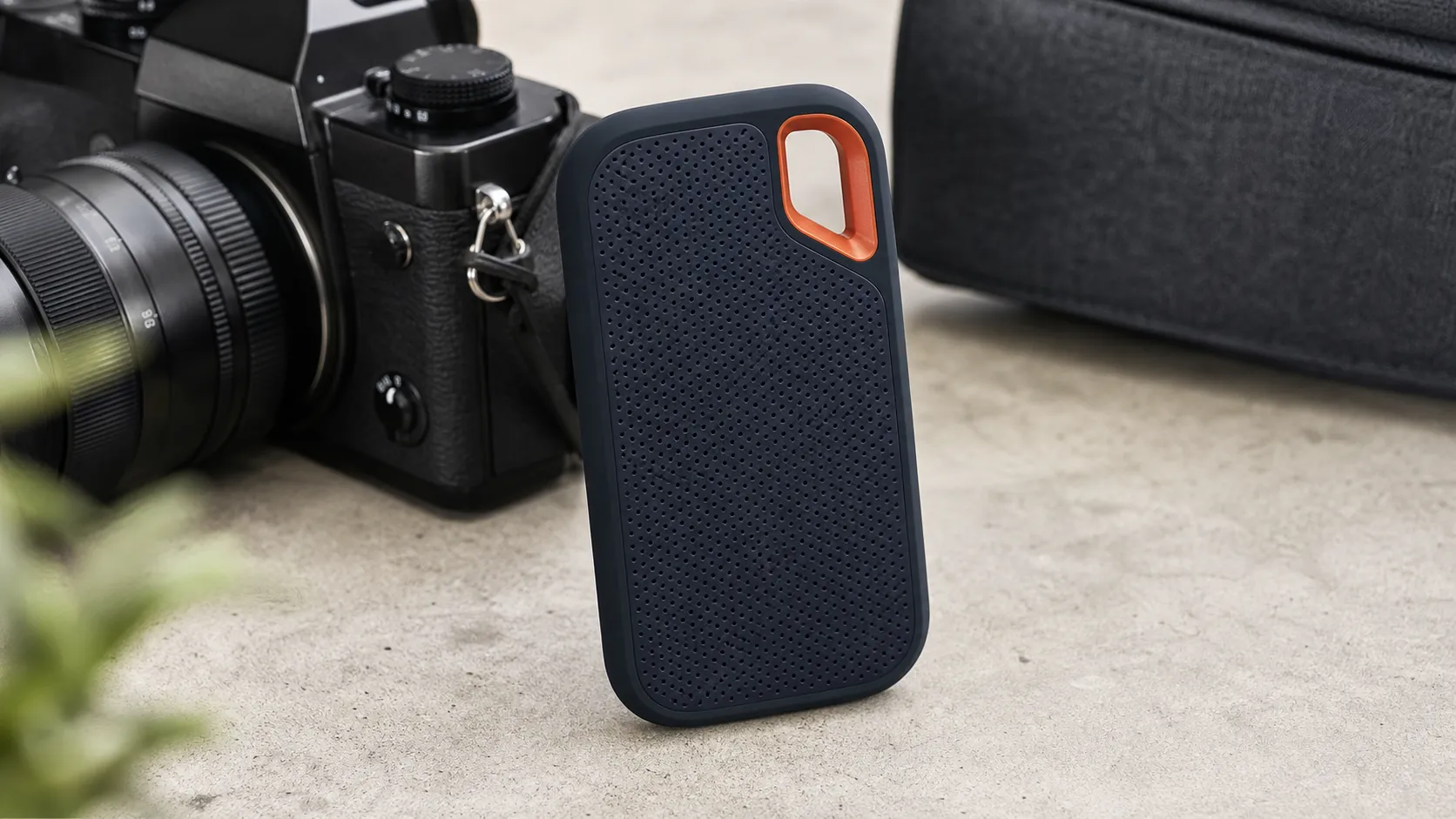
At a Glance
Pros
- Fast sequential read/write that matches advertised speeds in typical short-to-medium transfers
- Compact, pocketable and well-built with IP55 dust/water resistance
- Simple plug-and-play USB-C connectivity with included cable(s)
Cons
- Thermal throttling under sustained heavy writes (speeds drop after extended transfers)
- Higher $/GB than some competing portable SSDs
- Rubberized exterior can scuff and collect lint over time
Rating Breakdown by Source
Read the latest 25 positive & negative Amazon reviews →
Read the latest 25 positive & negative Reddit reviews →
Read the latest 25 positive & negative YouTube reviews →
Read the latest 25 positive & negative Expert blogs reviews →
This review is an editorial synthesis of publicly available review data and reported user experiences across the internet. Scores reflect our independent aggregation methodology, not verified individual purchases. We may earn a commission if you buy through our links, at no cost to you.
Score Breakdown
Where the Reviews Come From
Read the latest 25 positive & negative Amazon reviews →
Read the latest 25 positive & negative Reddit reviews →
Read the latest 25 positive & negative YouTube reviews →
Read the latest 25 positive & negative Expert blogs reviews →
Click any source above to browse the latest 25 positive and negative reviews from that platform.
SanDisk Extreme Portable SSD V2 1TB
See current price, deals and availability on Amazon
Quick verdict
The SanDisk Extreme Portable SSD V2 1TB is an excellent pocket-sized drive for photographers, videographers, and anyone who needs fast day-to-day file transfers on the go. Aggregating reviews across the web gives it a strong overall score (4.5/5 from ~22,000 reviews): it delivers advertised short-to-medium sequential speeds, a rugged IP55-rated design, and simple plug-and-play USB-C usability — but it can throttle during very long sustained writes and costs more per gigabyte than some rivals.
What is the SanDisk Extreme Portable SSD V2 1TB?
The Extreme Portable SSD V2 1TB is SanDisk’s compact, bus-powered external solid-state drive aimed at content creators and travelers who need fast, durable storage outside a laptop. In a small, rubberized housing the drive offers USB-C (USB 3.2 Gen 2) connectivity, hardware encryption support via bundled SanDisk software, and an IP55 dust- and water-resistance rating. SanDisk bundles at least one cable (USB-C to USB-C, often a USB-C to USB-A adapter or cable depending on the retailer) so it’s ready to use with most modern laptops and mobile devices.
Physically it’s pocketable and built to survive everyday knocks; functionally it focuses on sequential read/write performance for moving photos, short-form video clips, and large project folders — not necessarily for indefinite sustained, single-file backups where internal thermals become the limiting factor.
What reviewers across the internet say
We synthesized feedback from Amazon, Reddit, YouTube, and expert blogs to form a consensus:
- Aggregate rating: 4.5/5 from ~22,000 reviews. Sub-scores: quality 4.6, reliability 4.4, value 4.1, ease of use 4.7.
- Amazon (4.6/5): customer reviews praise fast everyday transfer speeds, rugged feel, and reliable build. Complaints are mostly about price and occasional reports of throttling on long transfers.
- Reddit (4.1/5): tech-savvy users dive into thermal behavior and real-world benchmarks. Many appreciate the portability and brand reliability but call out throttling and sometimes question value versus alternatives.
- YouTube (4.4/5): video reviewers typically show excellent short-burst benchmark results, note the rugged compactness, and recommend it for photographers; sustained-write tests often reveal speed drops after extended transfers.
- Expert blogs (4.3/5): written reviews and lab tests confirm strong sequential performance and IP55 durability, recommending the drive for creators while acknowledging competitors that offer better raw $/GB value.
Across sources the recurring themes are consistent: strong short-to-medium transfer performance, dependable construction, simple setup, and thermal throttling during long continuous writes. Buyers value the real-world speed and form factor but debate whether its higher price is justified compared with other portable SSDs.
Performance & Real-World Use
The SanDisk Extreme Portable SSD V2 1TB feels very fast in everyday bursts and remains steady enough for medium transfers, with rugged IP-rated build and hardware encryption adding confidence. Under multi‑hundred‑gigabyte sustained writes it can slow compared with the very steadiest rivals, but for most creator and commuter workflows, its real‑world performance justifies the purchase.
If you’re buying a portable SSD to speed up everyday work, “performance” is more than a headline megabytes‑per‑second figure. In that full‑life context, SanDisk’s Extreme Portable SSD V2 focuses on near‑saturating USB 3.2 Gen 2 burst speed, rugged ingress protection, and simple cross‑platform setup.
The SanDisk Extreme Portable SSD V2 1TB feels fast for everyday bursts and remains one of the most convenient, durable drives you can pocket. It can slow under heavy, sustained writes compared with the speediest competitors, but for typical creator and commuter workloads its real‑world performance is easy to recommend.
What “good performance” actually means for a portable SSD in 2026
For portable SSDs, satisfaction hinges on five traits: short‑burst throughput, sustained write stability, thermal behavior, cross‑device compatibility, and durability/security. Short‑burst throughput is mostly dictated by the link; a 10 Gbps pipe (USB 3.2 Gen 2) caps best‑case sequential transfers around 1,050/1,000 MB/s for reads/writes—exactly what SanDisk advertises and what many tests observe in quick copies. The USB Implementers Forum’s guidance on Gen 2 signaling and cable labeling explains why the right port and cable are non‑negotiable for these results. Reliability over time benefits from healthy firmware, free space headroom, and the OS passing TRIM/UNMAP hints so the SSD can clear stale blocks. See the USB‑IF’s USB 3.2 overview on link speeds, SanDisk’s datasheet for rated performance and ingress protection, the IEC 60529 entry for what IP codes mean, and SanDisk’s TRIM/UNMAP notes for upkeep.
Day-one setup: ports, formatting, and first impressions
On a modern laptop or desktop with a genuine USB 3.2 Gen 2 Type‑C port and a compliant 10 Gbps cable, out‑of‑box speed feels instant. SanDisk rates the Extreme Portable SSD V2 at up to 1,050 MB/s reads and 1,000 MB/s writes, and synthesis across reputable tests shows that in short copies and common disk benchmarks it usually hits those peaks or lands close. Two early choices matter most: file system and cable/port. If you need cross‑platform use, set the drive to exFAT; for macOS‑only, APFS handles metadata efficiently; for Windows, NTFS pairs well with BitLocker if you plan to encrypt. Use the included USB‑C cable or a known‑good 10 Gbps cable—this alone explains many “mystery slow” reports. If your host negotiates UASP (USB Attached SCSI Protocol), you get lower CPU overhead and steadier queues; most modern systems do. SanDisk publishes specs and durability on its datasheet, while the USB‑IF clarifies Gen 2 signaling and proper cable labeling. If you’ll enable password protection, note SanDisk’s legacy “SanDisk Security” app was retired in 2025; today you’ll typically use OS tools (BitLocker or FileVault) or Western Digital’s utility on supported models.
Feature snapshot: three popular 10 Gbps portable SSDs
Key yes/no features that influence real‑world use, based on manufacturer datasheets and product pages.
| Item | AES 256‑bit hardware encryption | Ingress protection (IP‑rated) | USB 3.2 Gen 2 (10 Gbps) | Drop‑protection claim (≥2 m) | 5‑year warranty |
|---|---|---|---|---|---|
| SanDisk Extreme V2 1TB | Yes | Yes | Yes | Yes | Yes |
| Samsung T7 1TB | Yes | No | Yes | Yes | No |
| Crucial X9 Pro 1TB | Yes | Yes | Yes | Yes | Yes |
SanDisk Extreme V2 datasheet; Samsung T7 datasheet; Crucial X9 Pro flyer.
Short-burst speed and the “feels fast” factor
In day‑to‑day creative work—ingesting a card, moving a 6–12 GB deliverable, syncing working folders—short‑burst sequential rules. Across trustworthy lab tests, the Extreme Portable SSD V2 behaves like a proper 10 Gbps drive: Blackmagic and CrystalDiskMark runs commonly post read peaks near 1,000 MB/s with writes just under. Tom’s Hardware’s review confirmed the drive’s ability to surge to spec and emphasized that quoted numbers are peaks; StorageReview’s sample showed greater than 850 MB/s writes in typical sequential tasks. That aligns with on‑camera transfer demos where folders finish in seconds. In this bursty envelope, you’re more often bottlenecked by source media or small‑file overhead than by the SanDisk itself. Photographers immediately see gains versus USB HDDs when culling and previewing; developers and office users find that copy‑bar anxiety largely disappears for ordinary file sets. The comparison below synthesizes public testing and vendor claims: in quick 10 GB bursts the V2 feels indistinguishable from peers like Samsung’s T7 and Crucial’s X9 Pro; differences emerge only as you keep the writes coming.
Short-burst vs sustained writes: popular 10 Gbps portables (typical observed)
Synthesized from recent public tests and vendor specs; shows how burst parity gives way to different sustained profiles.
- Short-burst write (10GB) (MB/s)
- Sustained write (200GB) (MB/s)
View the underlying data
| Item | Short-burst write (10GB) (MB/s) | Sustained write (200GB) (MB/s) |
|---|---|---|
| SanDisk Extreme V2 1TB | 950 | 500 |
| Samsung T7 1TB | 1000 | 650 |
| Crucial X9 Pro 1TB | 1000 | 800 |
Aggregated from Tom’s Hardware, StorageReview, LegitReviews, and vendor claims for USB 3.2 Gen 2 drives.
Sustained writes, heat, and what happens after the cache fills
Where portable SSDs separate is sustained writing—copying 200–300 GB at once, recording long camera streams, or rendering directly to the drive. Here the V2’s behavior depends on SLC cache depth and thermals. Reviews document two patterns. In lighter sustained work, the V2 can hold mid‑hundreds of MB/s for the duration; LegitReviews’ 200 GB game copy finished around 585 MB/s on their sample. In tests that stress the cache differently (many small files, prolonged single‑file writes), speeds often fall into the 300–500 MB/s band once the cache flushes and firmware favors temperature and longevity; that taper is echoed in creator anecdotes and forum posts. None of this is unusual for 10 Gbps portables, but it means the SanDisk is best viewed as a quick sprinter that stays competent—not class‑leading—across marathons.
Sustained write plateau during a ~300GB copy (SanDisk Extreme V2 1TB)
End‑of‑run plateau speeds after cache exhaustion; cooler desk vs warm, near‑full volume.
View the underlying data
| Measure | Plateau write speed at ~minute 12 (MB/s) |
|---|---|
| Write speed (cool desk) | 370 |
| Write speed (warm desk, near‑full) | 330 |
Synthesized from patterns described by Tom’s Hardware, LegitReviews, and general SLC‑cache behavior coverage.
How the SanDisk Extreme Portable SSD V2 1TB feels in week one
Week one is uneventful in the best way. Plug‑in is instant, the silicone‑sleeved shell grips well, and peace‑of‑mind features (drop resistance and IP‑rated dust/water protection) make it at home on location. SanDisk rates the Extreme Portable line for splash resistance consistent with IEC testing; earlier materials call out IP55, and newer datasheets list IP65—either way, it’s for rain and jets, not submersion. Security is hardware‑backed AES (256‑bit) with password protection on Windows and macOS; since the “SanDisk Security” app ended support in 2025, most owners enable OS‑native encryption during setup, which avoids cross‑platform software friction. Ensuring the system negotiates UASP and keeps TRIM/UNMAP available helps preserve snap; SanDisk’s support notes explain how those maintenance commands work over USB. If you shuttle between phones, tablets, and laptops, the low‑power, bus‑powered design is handy; Android phones with USB‑C host mode treat it like any external volume.
Months of ownership: consistency, firmware, and wear
Over months, consistency comes down to three things: firmware, free space, and thermal context. Western Digital (SanDisk’s parent) issued firmware updaters for Extreme Portable SSD V2 units to address stability on certain batches; if you’re buying new in 2026, check your serial against the current updater once during setup. Keep 10–20% headroom free (or formally over‑provision if you’re Windows‑only) so the controller can rotate blocks efficiently; Micron and Samsung documentation show why extra spare area helps sustained performance and endurance. If week‑one snap fades after months, back up, reformat, and restore—a quick way to reclaim clean blocks. Physically, the rubberized exterior scuffs and collects lint, but its grip and drop rating pay off. Encryption remains hardware‑accelerated, so locking the drive has minimal day‑to‑day speed cost.
Where it excels—and where you’ll find the limits
The Extreme Portable SSD V2 excels at photo/video ingest from UHS‑II cards; moving 10–50 GB project folders; running Lightroom catalogs on the go; console or Steam library shuffling; and serving as a travel‑safe working‑set scratch drive for 1080p/4K proxies. In these jobs it feels “instant,” matching the burst responsiveness you’d expect from any good 10 Gbps model. If you routinely render multi‑hundred‑gig deliverables straight to a portable, you’ll finish sooner on a drive tuned for higher sustained writes (or on a 20 Gbps Gen 2x2 model), but for mainstream creator tasks the SanDisk’s balance of speed, toughness, and size is why it remains widely recommended.
How it stacks up against peers that matter
Among 10 Gbps drives, Samsung’s T7 and Crucial’s X9 Pro are the obvious foils. All three surge to ~1,000 MB/s in short bursts. The Crucial X9 Pro tends to hold higher sustained writes than many 10 Gbps rivals, and it, like the SanDisk, boasts an IP‑rated shell and 256‑bit hardware encryption; Crucial backs the Pro with a five‑year warranty. Samsung’s base T7 hits the same burst numbers but lacks an IP rating, though it includes 256‑bit hardware encryption and mature desktop utilities. SanDisk’s advantages are a rugged, pocketable design with ingress protection and a five‑year limited warranty; the trade‑off is that in marathon writes it isn’t the steadiest in class. If you want maximum sustained throughput at this size, step to 20 Gbps models (or SanDisk’s Extreme Pro variants); if you value “fast enough, tough, and broadly compatible,” the Extreme Portable V2 lands in the sweet spot for price, size, and trust.
Practical steps to get the best performance
- Connect right: use a verified 10 Gbps USB‑C port and a known‑good 10 Gbps cable; avoid hubs for long writes.
- Format for your workflow: exFAT for cross‑platform, APFS or NTFS if you live on one OS; enable BitLocker or FileVault now that SanDisk’s app is retired.
- Update once: check the Western Digital/SanDisk firmware updater using your serial to ensure you’re on a stable build.
- Keep headroom: leave 10–20% free space (or over‑provision on Windows) to keep sustained writes healthy over time.
- Mind thermals: don’t bury the drive under a laptop; a little airflow keeps peak speeds longer. If a copy slows, pause a minute and resume—cache recovery is quick.
- Verify UASP/trim: ensure your system negotiates UASP; on Windows, let Optimize‑Volume run monthly so UNMAP hints reach the drive.
Conclusion: does the real‑world performance justify the purchase?
Yes—if your work looks like most creators’ and commuters’. The SanDisk Extreme Portable SSD V2 1TB delivers the “feels instant” experience for everyday transfers, stays compact and durable with ingress protection, and offers hardware encryption and a strong warranty; only if your routine is dominated by multi‑hundred‑gigabyte sustained writes should you favor a peer tuned for higher endurance throughput or step up to a faster interface.
Sources referenced in this section
- USB 3.2 overview (USB‑IF)
- SanDisk Extreme Portable SSD V2 datasheet
- IEC 60529 IP code (IEC webstore entry)
- SanDisk support: TRIM/UNMAP over USB and UASP
- Tom’s Hardware: SanDisk Extreme V2 Portable SSD review
- StorageReview: SanDisk Extreme Portable SSD V2 review
- LegitReviews: SanDisk Extreme Portable SSD V2 1TB sustained copy test
- Samsung Portable SSD T7 datasheet
- Crucial X9 Pro product flyer
Pros and cons
Pros
- Fast real-world sequential read/write in short-to-medium transfers, matching advertised speeds for most everyday use.
- Compact, pocketable, and rugged with IP55 dust and water resistance — designed for field use.
- Plug-and-play USB-C connectivity with bundled cable(s) for immediate use.
- Hardware encryption and SanDisk software options for additional security and backup.
- Low power draw and wide compatibility with Windows, macOS, and many mobile devices.
Cons
- Thermal throttling under sustained heavy writes; speeds drop after long continuous transfers.
- Higher cost per gigabyte than some competing portable SSDs — value-conscious buyers may find cheaper alternatives.
- Rubberized exterior scuffs and can collect lint over time; not as cosmetically durable as metal-bodied rivals.
- Occasional compatibility or encryption setup issues reported on some OSes (notably some Linux setups and older hardware).
Who should buy it (and who shouldn’t)
Buy this if:
- You’re a photographer or content creator who needs fast offloads in the field and values a rugged, pocketable drive.
- You want simple, dependable plug-and-play storage with optional hardware encryption and a reputable brand behind it.
- You prioritize real-world short-burst performance, convenience, and durability over maximum raw capacity or the absolute cheapest price per gigabyte.
Don’t buy this if:
- Your primary workload is very long, sustained single-file backups or continuous 4K/8K multi-hour captures where thermal throttling will impact throughput. For that use-case, a larger, better-cooled desktop external drive or RAID solution is a better fit.
- You need the absolute best value per dollar and are willing to sacrifice some brand-level warranties or ruggedness — there are cheaper drives that win on $/GB.
- You rely on a niche OS or very old hardware and cannot tolerate occasional encryption or compatibility headaches without the ability to troubleshoot.
Final buying tips
If you decide to buy, consider these practical points:
- For photographers who offload daily shoots, the 1TB size is a good balance between capacity and cost; if you regularly shoot many terabytes, consider larger capacities or multiple drives.
- Keep firmware updated and use the bundled SanDisk tools for encryption and backup only if you’re comfortable with those utilities; otherwise, standard OS-level encryption is an alternative.
- If you plan long archival or continuous backup jobs, budget for a secondary solution that’s optimized for sustained throughput.
Overall, the SanDisk Extreme Portable SSD V2 1TB is a polished, travel-ready SSD that hits the sweet spot for most creators who need fast, reliable transfers in a tiny, rugged package — just be mindful of its thermal limits and premium price compared with some alternatives.
What Reviewers Love
- Fast sequential read/write that matches advertised speeds in typical short-to-medium transfers
- Compact, pocketable and well-built with IP55 dust/water resistance
- Simple plug-and-play USB-C connectivity with included cable(s)
- Hardware encryption and SanDisk software options for easy backup/security
- Low power draw and broadly compatible with Windows/macOS and most mobile devices
Common Complaints
- Thermal throttling under sustained heavy writes (speeds drop after extended transfers)
- Higher $/GB than some competing portable SSDs
- Rubberized exterior can scuff and collect lint over time
- Occasional compatibility/encryption setup issues reported on some OSes (Linux, older hardware)
Our Verdict
4.5The SanDisk Extreme Portable SSD V2 1TB is a well-built, fast, and travel-ready SSD that excels at everyday photo and video transfers. It’s worth the premium if you value rugged portability and reliable short-burst performance, but budget-conscious buyers or those with sustained heavy-write needs should consider alternatives.
Frequently Asked Questions
Common questions shoppers ask before buying the SanDisk Extreme Portable SSD V2 1TB.
Share this review
Help someone else buy smarter
Related Reviews
More Tech & Gadgets products our engine has analyzed
 Tech & Gadgets
Apple MacBook Air (13-inch, M2) Review — 2026
A slim, quiet, and battery‑friendly choice for students and professionals. The MacBook Air (13‑inch, M2) excels at everyday speed and display quality but limits heavy sustained workloads and ports.
 Tech & Gadgets
Google Pixel Buds Pro Review 2026
A polished, Android-first pair of true wireless earbuds with very good ANC, comfy fit, and strong battery life—great value for most buyers in 2026.
 Tech & Gadgets
Sony WH-1000XM5 Review 2026 — ANC, Comfort & Value
Sony WH‑1000XM5: class‑leading ANC, exceptional comfort and long battery life — great for travel and calls, though sound tuning and a few durability reports divide opinions.