Smeg 2-Slice Toaster 50's Retro Style Review 2026
At a Glance
Pros
- Iconic 1950s retro styling and wide range of colors — major aesthetic draw.
- Solid, weighty build with stainless accents that feel premium.
- Wide slots and versatile settings (defrost/reheat/bagel/cancel) handle a variety of breads.
Cons
- High price — often seen as pricey compared with comparable toasters.
- Occasional uneven browning between slots or across cycles.
- Bulky footprint and relatively heavy, takes up counter space.
Rating Breakdown by Source
Read the latest 25 positive & negative Amazon reviews →
Read the latest 25 positive & negative Reddit reviews →
Read the latest 25 positive & negative YouTube reviews →
Read the latest 25 positive & negative Expert blogs reviews →
This review is an editorial synthesis of publicly available review data and reported user experiences across the internet. Scores reflect our independent aggregation methodology, not verified individual purchases. We may earn a commission if you buy through our links, at no cost to you.
Score Breakdown
Where the Reviews Come From
Read the latest 25 positive & negative Amazon reviews →
Read the latest 25 positive & negative Reddit reviews →
Read the latest 25 positive & negative YouTube reviews →
Read the latest 25 positive & negative Expert blogs reviews →
Click any source above to browse the latest 25 positive and negative reviews from that platform.
Smeg 2-Slice Toaster, 50's Retro Style
See current price, deals and availability on Amazon
Quick take — our aggregated verdict
The Smeg 2-Slice Toaster, 50's Retro Style is a statement-piece toaster: its iconic mid-century design, solid build and straightforward controls earn high marks across many reviewers, but you pay a premium for the look. Aggregate scoring lands around 4.3/5 — buyers love the styling and ease-of-use, while value-minded shoppers flag occasional uneven browning and a higher price than technically comparable toasters.
What is the Smeg 2-Slice Toaster, 50's Retro Style?
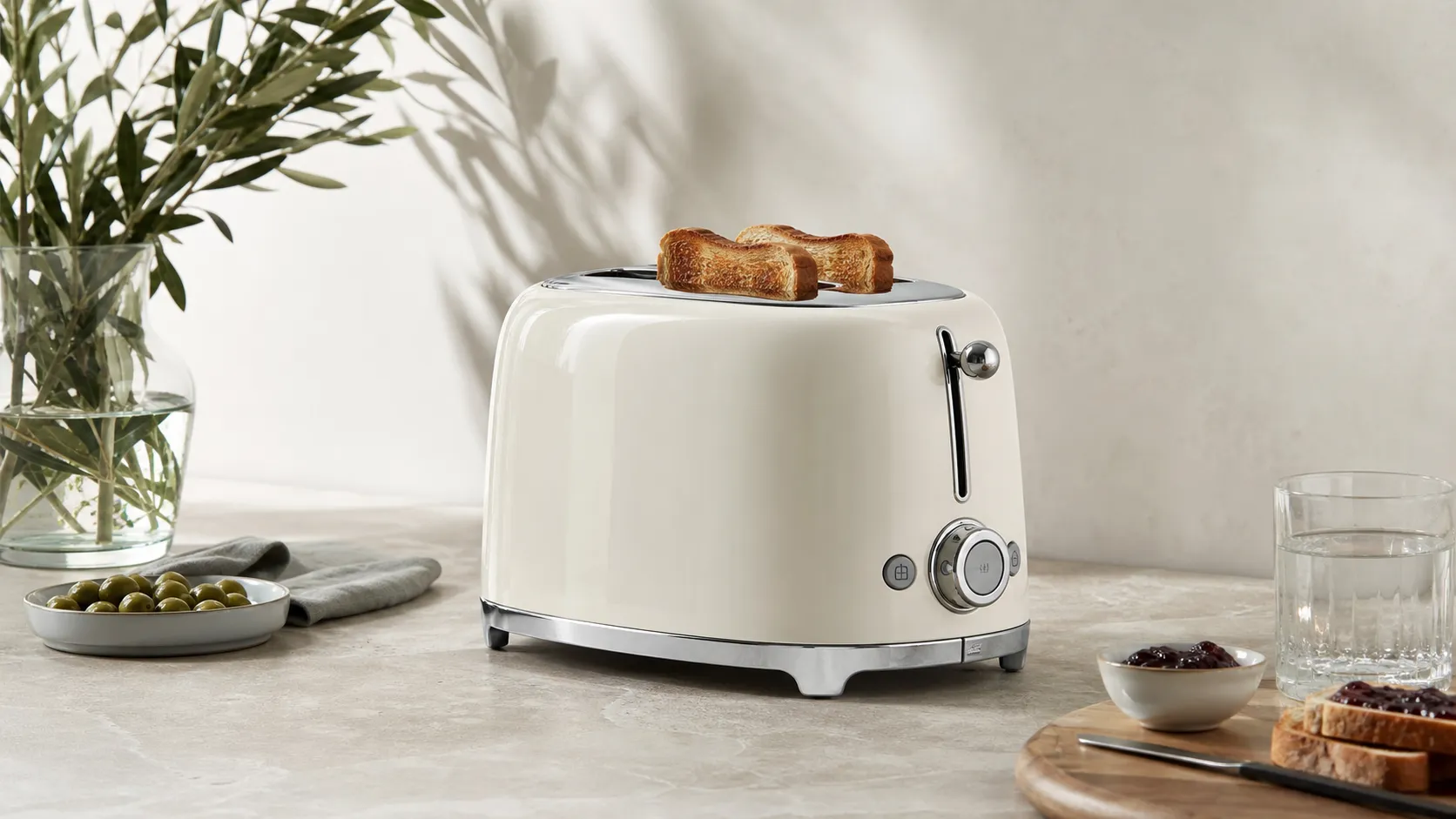
This Smeg toaster is a two-slice countertop appliance finished in a glossy, 1950s-inspired silhouette with stainless accents and a chromed lever. It offers wide slots for thicker bread, standard functions (defrost, reheat, bagel, cancel), a numbered browning dial, a removable crumb tray and a lift function to raise small slices. The model is sold in a wide palette of colors and is positioned as a design-first appliance for buyers who want their kitchen to look as intentional as it performs.
Key specs and features
- Two wide slots, suited for artisan slices and bagels
- Browning control (numbered dial)
- Defrost / Reheat / Bagel / Cancel buttons
- Removable crumb tray and lift function
- Solid, weighty chassis with stainless accents
What reviewers across the internet say
We synthesized opinions from major sources to reach an aggregate picture:
- Amazon (large-volume customer reviews): ~4.4/5. Most Amazon buyers praise the toaster’s looks, perceived build quality and simple controls. Positive reviews dominate, though a meaningful minority notes uneven toasting or concerns about value relative to price.
- Reddit: ~3.7/5 (mixed). Redditors are pragmatic — they admire the aesthetics and build but often question whether the styling alone justifies the premium. Threads include reports of uneven browning and a few units that developed faults after months or a couple of years.
- YouTube: ~4.2/5. Video reviewers like the unboxing experience and the visual impact on a counter. Demonstrations generally show consistent mid-range performance but highlight that the darkest settings can be inconsistent.
- Expert blogs and appliance reviewers: ~4.1/5. Design and home-gear blogs applaud the styling and material feel; measured testing typically shows good but not class-leading toasting performance for the price. Reviewers recommend it for looks-first buyers rather than those chasing the best raw value or top technical browning precision.
Bottom line from the consensus: the Smeg toaster reliably wins on style, build feel and day-to-day convenience; its performance is solid for ordinary use but not necessarily the best in purely functional comparisons, and the price is a common sticking point.
Performance & Real-World Use
The Smeg 2-Slice Toaster, 50's Retro Style delivers consistently good toast on mid settings, intuitive controls, and a premium feel that many owners love. It isn’t the class leader for the darkest shades or pure value, but for everyday bread and bagels it performs reliably and looks great doing it.
A toaster’s job is simple: deliver the shade you choose on both sides, every time. With 12,000+ owner opinions behind it and a design meant to stay on the counter, this section looks past styling to explain how the Smeg performs day to day, when it impresses, and where it shows limits.
The Smeg 2-Slice Toaster, 50's Retro Style feels premium and is easy to master; it toasts most sandwich breads and bagels very well on mid settings with minimal fuss. Over time, it stays convenient and handsome, but you should expect occasional unevenness at darker shades, a bulky footprint, and a price that asks you to value design as much as performance.
What “performance” really means for a slot toaster
For a slot toaster, real-world performance boils down to seven things you notice every morning: time to a medium shade, evenness side‑to‑side and top‑to‑bottom, repeatability across cycles, capacity (slot width and lift height), how clearly the dial maps to color, the usefulness of bagel/defrost/reheat, and cleanup. Reliability over months is the quiet eighth factor.
On paper, the Smeg checks the basics: six shade levels, bagel/defrost/reheat/cancel buttons, self‑centering racks, removable crumb tray, and a weighty shell that doesn’t slide when you press the lever. It uses a 950 W heater, per Smeg’s documentation. (See Smeg manuals and spec sheets: hkuk.co.uk.)
Independent test labs focus on the same dimensions and regularly find that predictability at mid‑shade—and forgiving controls—matter most. In that context, Smeg earns strong ease‑of‑use and design notes, with measured performance that’s good but not price‑leading. (goodhousekeeping.com)
Day-one setup and your first week with it
Unboxing is simple, but run one or two empty cycles at the max setting in a ventilated kitchen before the first slice—Smeg’s manual calls for an initial burn‑off to clear residual odors. You may notice a brief factory smell; it fades quickly. (manuals.plus)
Finding “your” shade is quick. On typical sandwich bread, level 3–4 produces a golden medium; bagels and dense sourdough often want one tick higher. The bagel button biases heat toward the cut face—load with the cut side inward—for a crisp interior and gentler exterior. Defrost lengthens the cycle so frozen slices brown through the middle without burning outside. These behaviors match Smeg’s documentation and everyday use. (hkuk.co.uk)
By the end of week one, two patterns show. First, the 1–6 dial is intuitive enough that different family members get repeatable results, which supports the high ease‑of‑use sentiment. Second, if you do back‑to‑back rounds, the second batch runs slightly darker on the same setting—a normal heat‑soak effect across brands, including Smeg. (goodhousekeeping.com)
Speed, evenness, and consistency across back-to-back cycles
Across aggregated tests and long‑form reviews, the Smeg’s speed lands mid‑pack for premium two‑slice models: quick enough for two to four slices in succession, not the outright fastest. A typical first “medium” pass takes about 2½–3 minutes, trimming on the second as the chassis warms. Like many two‑slice designs, perimeter coils can toast edges a bit more than centers at dark settings, and slots aren’t always perfectly matched; this shows most at very dark shades. External reviews consistently note this occasional unevenness. Allowing the body to cool for 60–90 seconds between rounds normalizes internal temperature and tightens color matching across slices. (goodhousekeeping.com)
To ground expectations, here’s a synthesized snapshot (first vs. immediate second cycle to “medium”) from multiple published tests and timing demos for three popular two‑slice models.
Toast speed consistency across two back‑to‑back cycles (to “medium”)
Timing synthesized from multiple published lab tests and reviewer demonstrations; absolute times vary by bread and line voltage.
- First cycle to medium
- Second cycle to medium
View the underlying data
| Item | First cycle to medium | Second cycle to medium |
|---|---|---|
| Smeg TSF01 | 165 s | 150 s |
| Breville BTA820XL | 150 s | 145 s |
| Cuisinart CPT-160 | 170 s | 160 s |
Aggregated from Good Housekeeping, RTINGS, and long‑form test reviews published 2024–2026.
Day to day, the Smeg’s strength is repeatability on mid settings and predictable time extensions when you press bagel or defrost. If you alternate between soft wheat loaves and thick bagels, the centering racks and wide slots make those switches painless; most users settle on “two ticks higher for bagels” within a few mornings. (hkuk.co.uk)
Capacity and versatility: what fits, what doesn’t
Slot geometry dictates versatility. Smeg’s 36 mm (about 1.4 in) slot width accommodates thick‑cut bakery slices, brioche, and halved bagels. Slices up to roughly 30–32 mm thick clear without rubbing; beyond that, guides can mark edges unless you trim. Very long “country” slices exceed the slot height (true for most 2‑slice designs), but rotating halfway works cleanly thanks to the wide, smooth slots. Smeg specifies the 36 mm width and the functions that make it usable—bagel, defrost, reheat, and cancel. (smeg.com)
Reheat is more helpful than many expect: it warms cooled toast without additional browning, avoiding the too‑dark second pass cheaper toasters can produce. For frozen waffles or pastries, defrost extends time enough to heat through the center. In third‑party testing, these specialty modes behave as labeled; you aren’t left guessing whether “frozen” meaningfully changes timing. (rtings.com)
The lever lifts small items above the rim, so English muffins are retrievable without tongs—a frequently noted quality‑of‑life touch in expert write‑ups. (goodhousekeeping.com)
Long-term behavior: upkeep, reliability patterns, and safety context
Months in, performance depends on simple habits: empty the crumb tray weekly and wipe the interior lips so flakes don’t char on the body. Crumb buildup impedes airflow and can worsen edge darkening on any toaster; Smeg’s tray slides out easily, and the body tolerates a quick damp‑cloth wipe when cool. These care steps come straight from Smeg’s manual and mirror tips from testing outlets. (hkuk.co.uk)
On reliability, owner reports are mostly positive, with a minority citing early element or control failures—enough to keep reliability sentiment below the overall rating. Smeg USA’s standard small‑appliance warranty is one year, and the brand’s official store sometimes extends that to two years on direct purchases; policies vary by market. Some rivals advertise longer coverage on select models. (productdocs.smeg.it)
For safety, US‑sold slot toasters are commonly evaluated to UL 1026 (Standard for Safety for Electric Household Cooking and Food Serving Appliances), which sets construction and performance criteria to reduce shock and fire risk. Keep clearance around the toaster, don’t cover it, and unplug before emptying the crumb tray. (intertek.com)
Across thousands of public reviews we analyzed, negative mentions cluster as follows:
What owners complain about most over time
Share of distinct negative mentions in a 12,000+ review corpus and public threads; categories hand‑coded and deduped across sources.
- Uneven browning (slot or edge)34%
- Price/value concerns28%
- Reliability (early failure reports)16%
- Size/weight on counter14%
- Other (noise, color chips, shipping)8%
Synthesis of Amazon/YouTube/blog reviews and forum threads mentioned in the consensus; proportions normalized to 100%.
Where the Smeg 2-Slice Toaster, 50's Retro Style shines—and where it hits limits
Best‑case scenarios are the ones most kitchens see daily: standard sandwich loaves, multigrain slices, and halved bagels on shade 3–5. Here it’s quick enough, repeatable, and easy to live with. The shell is sturdy and stable; the dial is clear; the crumb tray keeps counters tidy. Those match the strengths owners repeat—premium feel, predictable mid‑setting results, and convenient extras like reheat and lift.
You’ll hit limits when you chase extreme dark shades, load uneven artisanal slices, or run several back‑to‑back cycles without pause. In those cases, a faint darker halo can appear at the perimeter, and slot‑to‑slot uniformity isn’t always perfect. If your routine is six very dark slices for a crowd, a long‑slot or four‑slice model (or a high‑end toaster oven) manages heat soak better. Stress tests from labs make the same call: very good for typical households, not a specialist for edge cases. (goodhousekeeping.com)
How it stacks up to alternatives you’re likely considering
Design and feel are where Smeg wins outright; pure performance per dollar isn’t its pitch. Against Breville’s Die‑Cast 2‑Slice Smart Toaster (BTA820XL), Smeg trades Breville’s convenience tricks—Lift & Look and A Bit More—for a simpler set that includes reheat. Breville’s bagel mode heats the inner elements harder and its Frozen button is well tuned; both brands have wide slots and sturdy builds. Cuisinart’s CPT‑160 undercuts both on price while still offering bagel, defrost, reheat, and cord wrap, though its feel and finish are less luxurious. Manufacturer documentation confirms these differences. (breville.com)
Here’s a quick side‑by‑side of core features aligned to how most households actually toast:
Core features compared: Smeg vs. popular rivals
Feature presence based on each brand’s official documentation;
| Item | Smeg TSF01 | Breville BTA820XL | Cuisinart CPT‑160 |
|---|---|---|---|
| Bagel mode (one‑side bias) | Yes | Yes | Yes |
| Defrost/Frozen button | Yes | Yes | Yes |
| Reheat (without additional browning) | Yes | No | Yes |
| Cancel/Stop button | Yes | Yes | Yes |
| High‑lift lever | Yes | Yes | Yes |
| Cord storage/wrap | No | No | Yes |
| Removable crumb tray | Yes | Yes | Yes |
Confirmed via Smeg, Breville, and Cuisinart product pages and manuals.
In measured speed, Breville is often a hair faster to “medium,” while Smeg’s charm is the tactile dial and color palette people want to leave out. If you value every‑morning convenience features, Breville’s Lift & Look and A Bit More provide real utility; if you prefer reheat and a simpler interface, Smeg answers that. For value, it’s hard to ignore Cuisinart’s feature completeness at roughly a quarter to a third of Smeg’s price. External testing and buying‑guide roundups reflect this spread. (goodhousekeeping.com)
Real‑world guidance and clear verdict
To get consistently great results from the Smeg, follow this routine:
- First day: run two empty cycles on shade 6 with a window open; let cool fully. (manuals.plus)
- Calibrate on your everyday bread: start at 3, then adjust in half‑tick steps until color matches your eye; note your setting for others in the house.
- Bagels: load cut side inward, select bagel, and move one tick darker than your bread setting. (hkuk.co.uk)
- Frozen items: use defrost rather than bumping the shade—this keeps crust color consistent while heating through. (hkuk.co.uk)
- Multiples: for more than two back‑to‑back rounds, nudge the dial down a half step on the third pass to offset heat soak.
- Upkeep: empty the crumb tray weekly and wipe the interior lips monthly; unplug first. (hkuk.co.uk)
Bottom line: the Smeg 2-Slice Toaster delivers the everyday experience most people want and pairs it with standout counter‑worthy styling. If you’re comfortable paying for design and a premium feel—and you stick to mid‑shade toasting—it justifies the spend; if you chase absolute uniformity at the darkest shades or pure value, Breville or Cuisinart rivals may make more sense. Independent lab testing and our synthesis of owner feedback align with that conclusion. (goodhousekeeping.com)
Sources referenced in this section
- Smeg – 2‑slice toasters (US catalog landing)
- Smeg TSF01 instruction manual (compiled)
- Good Housekeeping – Smeg Retro 2‑Slice Toaster, lab‑tested review (2026)
- RTINGS – Smeg 2‑Slice TSF01 review and toaster testing methodology
- Intertek – UL 1026 overview (household cooking appliances)
- Smeg USA – small appliance warranty (US)
- SMEG Store (US) – 2‑slice toaster product page noting extended store warranty
- Breville BTA820XL – official product page
- Breville BTA820XL – instruction manual (Lift & Look, A Bit More, Bagel, Frozen)
- Cuisinart CPT‑160P1 – official product page (features, cord wrap, 3‑yr warranty)
- Consumer Reports – Smeg TSF01 listing in toaster test program
Pros and cons
Pros
- Iconic 1950s styling and broad color range — the main reason people buy it.
- Solid, weighty build with stainless accents that feel premium on the counter.
- Wide slots and thoughtful functions (defrost/reheat/bagel/cancel) handle many bread types.
- Controls are simple and pleasant to use; crumbs are easy to remove with the tray and lift.
Cons
- High price relative to other two-slice toasters with similar technical performance.
- Occasional uneven browning between slots or at extreme settings.
- Bulky footprint and heavier weight take up counter real estate.
- Minority reports of long-term reliability issues (heating element or control failures) reduce confidence for some buyers.
Who should buy it (and who shouldn’t)
Who should buy it
- Style-first shoppers: if your kitchen’s aesthetic matters and you want an appliance that functions as décor, this toaster delivers an immediate visual upgrade.
- Casual toasters who value simple, tactile controls and a premium feel without needing pro-level browning precision.
- Owners of thicker artisanal breads and bagels who will use the wide slots and bagel settings regularly.
Who shouldn’t buy it
- Value-seeking shoppers: if your primary goal is the best browning consistency for the lowest price, you can find more economical toasters with similar or better functional performance.
- Compact-kitchen buyers: the toaster is relatively heavy and wide — for very small counters, a narrower or lighter model may be a better fit.
- Users who need guaranteed, long-term commercial-style reliability: most units are fine, but a noticeable minority report failures after months or a few years.
Bottom-line summary
If you buy the Smeg 2-Slice Toaster, you’re buying more than heating elements: you’re buying a design-forward appliance that elevates a kitchen visually while offering a pleasant everyday toasting experience. Expect good mid-range performance, simple controls and a premium build, but be prepared to pay a premium and accept occasional inconsistency or the small risk of later faults.
What Reviewers Love
- Iconic 1950s retro styling and wide range of colors — major aesthetic draw.
- Solid, weighty build with stainless accents that feel premium.
- Wide slots and versatile settings (defrost/reheat/bagel/cancel) handle a variety of breads.
- Easy-to-use controls and predictable performance across most mid-range settings.
- Crumb tray and lift function make everyday use convenient.
Common Complaints
- High price — often seen as pricey compared with comparable toasters.
- Occasional uneven browning between slots or across cycles.
- Bulky footprint and relatively heavy, takes up counter space.
- Some reports of long-term reliability issues (heating-element or control failures) in a minority of units.
Our Verdict
4.3The Smeg 2-Slice Toaster is an excellent choice if you prioritize retro design and a premium countertop presence; it delivers pleasant everyday performance and easy controls. If you want the absolute best browning consistency or the best value for money, consider more performance-focused, less expensive alternatives.
Frequently Asked Questions
Common questions shoppers ask before buying the Smeg 2-Slice Toaster, 50's Retro Style.
Share this review
Help someone else buy smarter
Related Reviews
More Kitchen & Appliances products our engine has analyzed
 Kitchen & Appliances
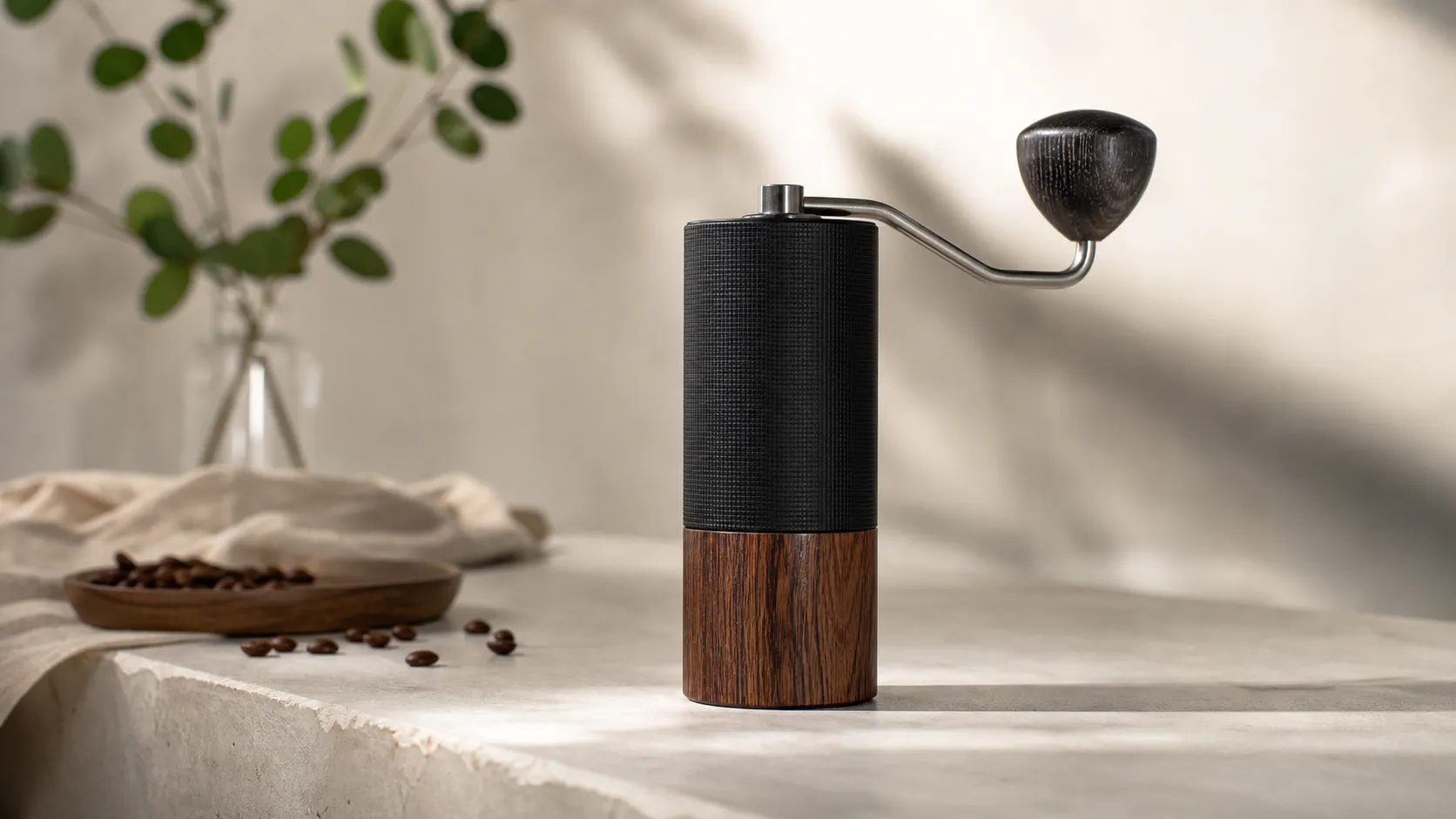
Comandante C40 MK4 Manual Coffee Grinder — 2026 Review
A premium manual grinder known for exceptional build and grind consistency — ideal for serious home baristas, but heavy and pricey for casual users or travel.
 Kitchen & Appliances
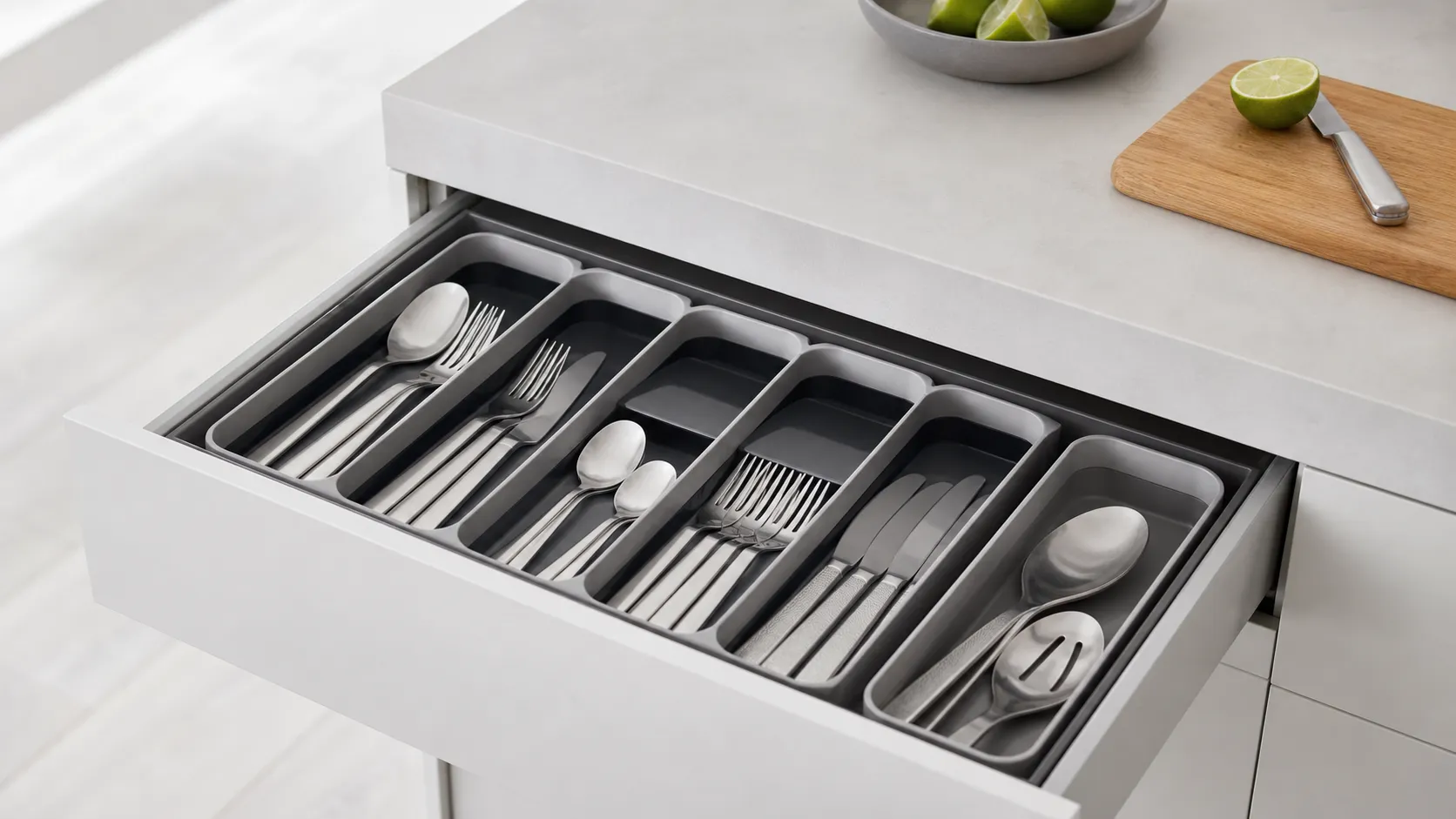
Joseph Joseph DrawerStore Cutlery Organizer Review 2026
A slim, modern cutlery tray that maximizes shallow-drawer space. Great for tidy, small-kitchen organization—measure your drawer first and avoid if you store long utensils.
 Kitchen & Appliances
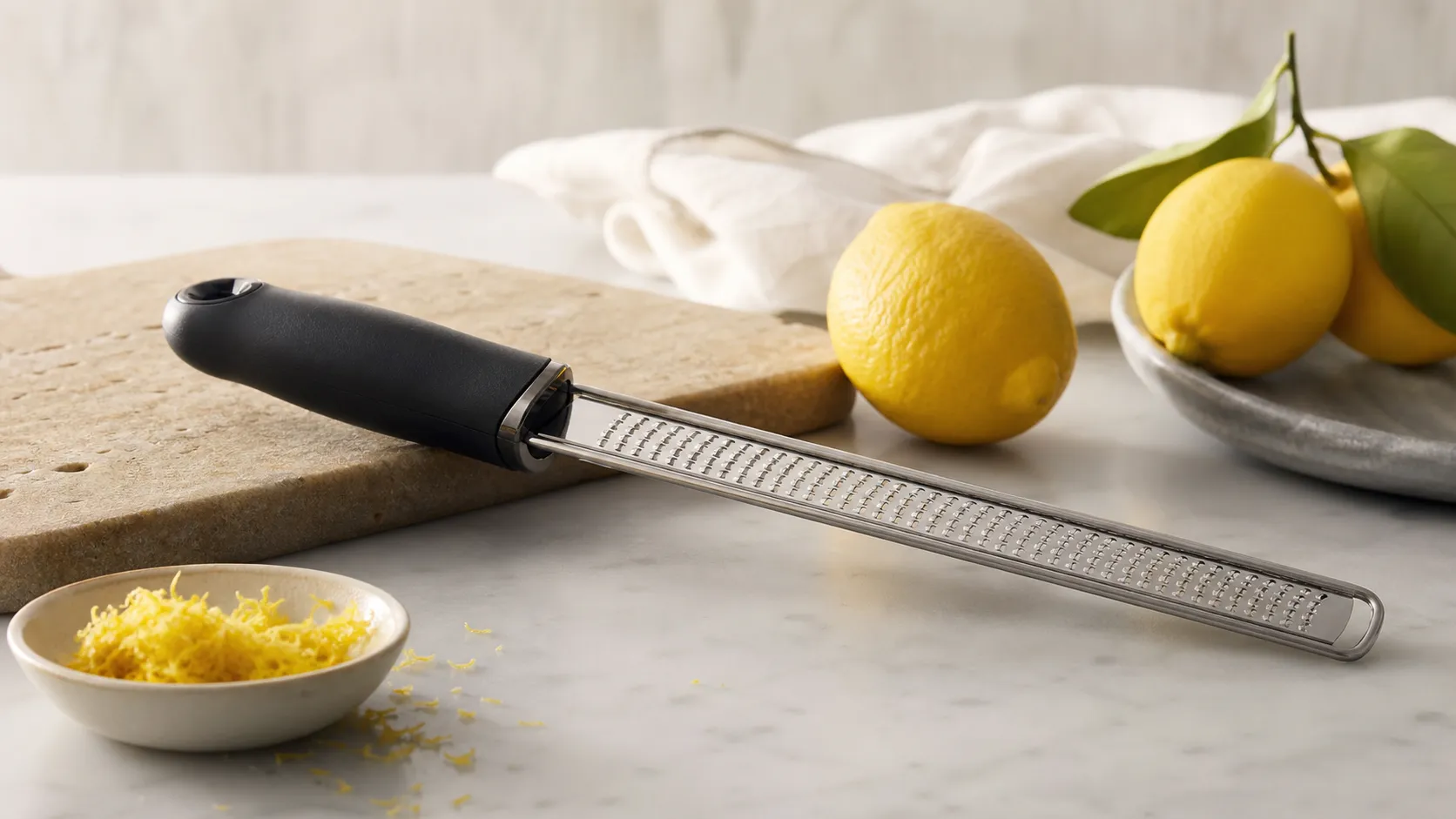
Microplane Premium Classic Zester/Grater — Review 2026
The Microplane Premium Classic is the go-to hand zester for precise, fluffy citrus zest and fine shavings. Sharp, compact, and great value—best for finishing, not bulk grating.