ThermoPro TP20 Dual Probe Wireless Meat Thermometer Review 2026
At a Glance
Pros
- Accurate, consistent temperature readings for home grilling/smoking
- Dual-probe capability lets users monitor two pieces or probe plus ambient meat temp
- Long advertised wireless range — typically works well in open yards
Cons
- Probe wires (not truly wireless) and limited probe cable length compared to single-piece wireless probes
- Occasional connectivity/range drops in obstructed environments or around heavy metal/brick
- Probe jack/cable durability — some users report bent jacks or probe failure over long-term heavy use
Rating Breakdown by Source
Read the latest 25 positive & negative Amazon reviews →
Read the latest 25 positive & negative Reddit reviews →
Read the latest 25 positive & negative YouTube reviews →
Read the latest 25 positive & negative Expert blogs reviews →
This review is an editorial synthesis of publicly available review data and reported user experiences across the internet. Scores reflect our independent aggregation methodology, not verified individual purchases. We may earn a commission if you buy through our links, at no cost to you.
Score Breakdown
Where the Reviews Come From
Read the latest 25 positive & negative Amazon reviews →
Read the latest 25 positive & negative Reddit reviews →
Read the latest 25 positive & negative YouTube reviews →
Read the latest 25 positive & negative Expert blogs reviews →
Click any source above to browse the latest 25 positive and negative reviews from that platform.
ThermoPro TP20 Dual Probe Wireless Meat Thermometer
See current price, deals and availability on Amazon
Intro
If you want a dependable, budget-friendly way to monitor two temperatures at once — whether you’re grilling steaks, smoking brisket, or roasting a holiday bird — the ThermoPro TP20 Dual Probe Wireless Meat Thermometer is a hard-to-ignore option. Aggregating roughly 51,900 reviews and a consensus score of about 4.5/5, the TP20 delivers accurate readings, simple controls, and dual-probe flexibility at a price most home cooks find irresistible. Our verdict up front: it’s one of the best value-focused thermometer kits for home use, with caveats around probe durability and occasional connectivity hiccups in obstructed environments.
Overall aggregated score: 4.5/5 (from ~51,900 reviews)
- Quality: 4.4
- Reliability: 4.1
- Value: 4.6
- Ease of use: 4.5
What Is the ThermoPro TP20 Dual Probe Wireless Meat Thermometer?
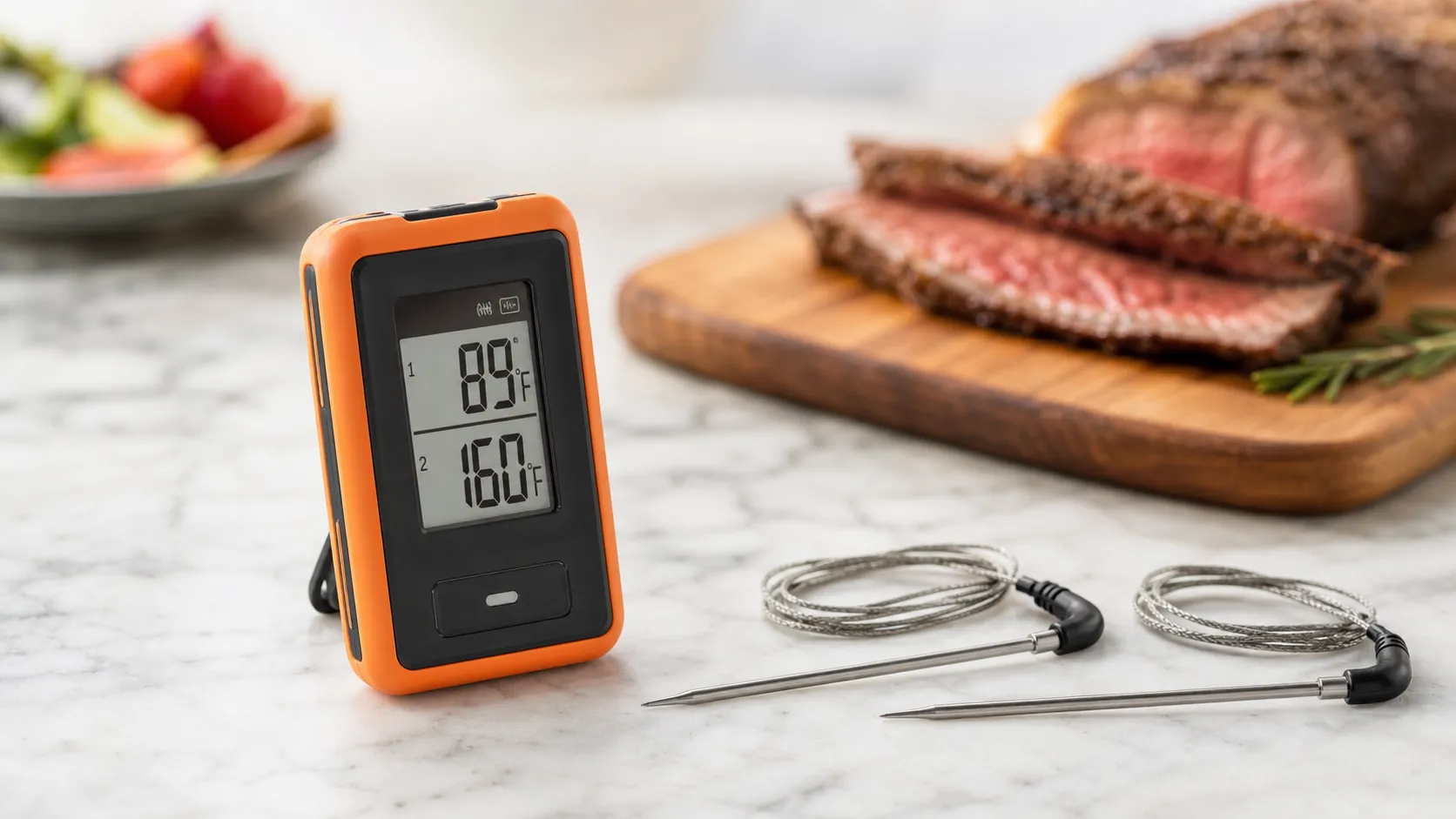
The TP20 is a digital meat thermometer system with two wired stainless-steel probes that plug into a wireless transmitter. The transmitter sits near the grill or oven and sends temperature data to a handheld receiver that you can carry up to the advertised wireless range. Key consumer-facing features include:
- Dual probe monitoring (two temperatures at once — e.g., two cuts of meat or meat + ambient)
- Large, easy-to-read receiver display with preset temperature programs
- Audible and visual alarms and temperature presets for a variety of proteins
- Magnetic backing for the transmitter and receiver mounting options
- Claimed long wireless range for open yards (real-world performance varies)
It’s sold and discussed widely across retail sites, hobbyist forums, video reviews, and expert roundups — and it’s commonly recommended as a strong value pick for home cooks who want more functionality than a single probe instant-read thermometer but don’t want to pay pro-level prices.
What Reviewers Across the Internet Say
When we synthesized reviews from Amazon, Reddit, YouTube, and expert blogs, a consistent picture emerged.
-
Amazon (large volume): Overall positive sentiment (≈4.5/5). Buyers praise accuracy, easy setup, dual-probe usefulness, and excellent value. The most common negatives are probe wire/connector wear and occasional unit failures after heavy use. The sheer volume of praise on Amazon is the main reason the aggregate score is high.
-
Reddit (hobbyist discussions): Practical, slightly more critical. Users trade tips on maximizing range, protecting probe connectors, and long-term care. Real-world range limits and probe durability show up repeatedly in long-term threads.
-
YouTube (hands-on demonstrations): Reviewers commonly highlight accurate readings, the convenience of two probes, and strong value. Video tests usually show good range in open settings and favorable comparisons to other budget models, but creators note that this isn’t a truly wireless probe system.
-
Expert blogs and grill guides: Generally recommend the TP20 as a budget-friendly, accurate option for home cooks. Experts caution against treating it as a professional-grade instrument: probe longevity and a more limited feature set separate it from pricier models.
Taken together, the consensus: very good for the price, very usable for everyday grilling and smoking, but watch your expectations on probe hardware longevity and extreme-range performance.
Performance & Real-World Use
The ThermoPro TP20 Dual Probe Wireless Meat Thermometer delivers reliable, accurate temperatures and a stable long‑range RF link that works best in open spaces or through a couple of typical interior walls. It’s easy to live with week after week if you route the probe cables smartly, avoid moisture ingress, and treat probes as consumables you’ll eventually replace.
The ThermoPro TP20 checks those boxes for most home pitmasters by pairing two cabled probes with a dedicated RF receiver you can clip to your belt—no phone, apps, or Wi‑Fi required.
In two sentences: The ThermoPro TP20 Dual Probe Wireless Meat Thermometer delivers reliable, accurate temperatures and a stable long‑range RF link that works best in open spaces or through a couple of typical interior walls. It’s easy to live with week after week if you route the probe cables smartly, avoid moisture ingress, and treat probes as consumables you’ll eventually replace.
What “performance” means for a leave‑in BBQ thermometer
The TP20’s published measurement range (32–572°F) and accuracy (±1.8°F from 32–212°F) cover all common home cooking scenarios; hitting safe minimum internal temperatures is non‑negotiable, and those USDA numbers—145°F for whole cuts of pork and beef (with a 3‑minute rest) and 165°F for poultry—are precisely where a dependable probe thermometer earns its keep. (thermopro.com.sg)
Because the TP20 includes two cabled probes, you can track both a brisket flat and the cooker’s ambient temperature (or two different proteins) at once. The device’s out‑of‑box USDA presets reduce setup friction for newer cooks, while the manual settings give experienced users control for low‑and‑slow smoking or reverse searing. Expect a satisfying “set it and forget it” workflow: insert, set alarms, clip the receiver to your belt, and go tackle sides or hang with guests until it beeps. (thermopro.com.sg)
ThermoPro TP20 Dual Probe Wireless Meat Thermometer: day‑one setup and your first week
They ship pre‑paired; if you ever need to re‑sync, holding the Mode button on the receiver for a couple of seconds reenters pairing. The receiver presents meat type and doneness presets conforming to USDA guidance; you can switch to PROG to set your own high/low alarms for ambient smoking temps. (thermopro.com.sg)
During week one, verify accuracy using an ice‑bath check: pack a small bowl full of crushed ice, add just enough water to fill gaps, stir, and confirm the probe reads near 32.0°F (±1.8°F). This is an accepted reference check across the industry and lets you catch a bent tip or moisture ingress early. Do the same at a full rolling boil if you want a second data point (adjusting for elevation). (thermoworks.com)
Two care rules to start forming as habits: don’t immerse probes or their connectors, and don’t exceed the published upper temperature limit (572°F for the sensor tip). Wipe the transmitter/receiver with a damp cloth, wash only the metal probe tips in hot soapy water, and route cables so they’re not pinched in a lid seam. These little choices pay off months down the road. (thermopro.com.sg)
Wireless range and connectivity in the real world
ThermoPro advertises a 300‑foot line‑of‑sight range for the TP20’s 433 MHz RF link; in practice, owners find that open‑yard cooks (kettle grills, offset smokers, pellet grills) generally maintain a clean connection across typical suburban backyards. Brick walls, metal doors, foil‑back insulation, and HVAC runs can sap signal strength; independent radio‑propagation work shows masonry and metal can introduce 15–30 dB of extra attenuation compared with a clear path, which explains why RF links that are rock‑solid outdoors can falter through multiple interior barriers. The good news: the TP20 will automatically relink when you move the receiver closer to the transmitter. (thermopro.com.sg)
How does that range compare? A MEATER Plus, which is a truly wireless in‑meat probe using Bluetooth with a booster in the charger, lists up to 165 ft in open air. On the other end, pro‑leaning multi‑probe rigs like ThermoWorks’ Smoke X4 use a long‑range RF system rated to 6,562 ft (1.24 mi) line‑of‑sight—massive overkill for a patio but great for competitions or complex house layouts. The TP20 sits in the sensible middle: more robust than Bluetooth‑only probes when you’re moving around the yard, but not designed for whole‑property coverage through dense obstacles. (support.meater.com)
Wireless range (advertised, line‑of‑sight)
Advertised line‑of‑sight wireless range: TP20 sits between Bluetooth‑only and long‑range pro RF systems (published specs).
View the underlying data
| Measure | Advertised LOS range |
|---|---|
| ThermoPro TP20 | 300 ft |
| MEATER Plus | 165 ft |
| ThermoWorks Smoke X4 | 6562 ft |
Sources: ThermoPro TP20 manual, MEATER support, ThermoWorks Smoke X4 product page.
Accuracy, tracking behavior, and food‑safety peace of mind
The TP20’s claimed ±1.8°F accuracy through the most critical range (32–212°F) means it can cleanly hit USDA targets for pork, poultry, and beef without adding its own guesswork. If you see “LLL/HHH,” let the probe return to room temp and reseat the plug firmly; persistent errors can indicate heat or moisture damage to the probe’s internal wiring. (thermopro.com.sg)
Most leave‑in systems—including higher‑end models from ThermoWorks—expect probes to read within ±1.8°F at 32°F when healthy, so if your TP20 is outside that, contact support and consider a fresh probe. (blog.thermoworks.com)
Maximum measurable temperatures by sensor type
Maximum measured temperatures by sensor type highlight why cable‑based systems can monitor both meat and ambient heat without fuss; MEATER’s probe limits are split between its internal and ambient sensors (per manuals).
- Internal sensor max (°F)
- Ambient/air sensor max (°F)
View the underlying data
| Item | Internal sensor max (°F) | Ambient/air sensor max (°F) |
|---|---|---|
| ThermoPro TP20 | 572°F | 572°F |
| MEATER Plus | 212°F | 527°F |
| ThermoWorks Smoke X4 | 572°F | 572°F |
Sources: ThermoPro TP20 manual; MEATER Plus user manual; ThermoWorks Smoke/Pro‑Series probe docs.
Probe and cable durability over months of cooks
The TP20 manual is explicit—don’t immerse the plugs or submerge the probe, keep the cable off flames, and cap temps at 572°F—because moisture and over‑temp are the two primary killers of thermistor probes. If your cooks skew long and humid (e.g., pork shoulder overnight with a water pan), treat probes as consumables you’ll eventually replace, no matter the brand. (thermopro.com.sg)
Industry guidance from probe makers echoes the same theme: repeated kinking and moisture ingress shorten probe life; keep spares on hand if you smoke often. (blog.thermoworks.com)
Batteries, upkeep, and what changes as you own it
Both the TP20 transmitter and receiver run on replaceable AAA cells; there’s no charging routine to remember, which many users prefer. Brand support guidance pegs typical battery life for AAA‑powered cooking thermometers at roughly 6–12 months depending on how often you cook and use the backlight or alarms. The receiver also has a failsafe auto‑off if it loses signal for 30 minutes (disabled when a timer is running) to conserve battery. Store the unit indoors between cooks, and wipe splatter off the housings with a damp cloth—neither module is rainproof. (thermopro.com.sg)
If you cook every weekend, consider keeping a spare set of alkaline AAAs or quality low‑self‑discharge NiMH cells in your BBQ drawer. As probes age, do a quick ice‑bath spot check monthly during heavy season; stable readings there usually translate to dependable behavior on a long smoke. If you start seeing erratic spikes on a familiar cooker after rain or a boil‑over, suspect a compromised probe first, then reseat connectors and replace batteries before blaming the base units. (thermoworks.com)
Where the TP20 shines—and where you’ll hit its limits
Best‑case scenarios for the TP20 are backyard and patio cooks where the receiver maintains a mostly unobstructed path to the transmitter—think offset or pellet smoker on the deck while you prep inside the kitchen. The 433 MHz link generally tolerates a couple of interior walls; once you layer in brick, foil‑back insulation, or multiple metal doors, expect the margin to shrink. (itu.int)
On the feature front, the TP20 favors simplicity over smart‑home flair. Its alarms are audible but basic, there’s no app history or cloud monitoring, and the wired probes mean you can’t spin a roasting pan without minding cable slack. If you want phone graphs, remote notifications, or multi‑home coverage, you’ll be happier with a Bluetooth‑app probe like MEATER Plus (165 ft open‑air) or a long‑range RF system like ThermoWorks Smoke X4 (6,562 ft LOS). If you want a reliable, affordable, no‑app two‑probe setup that just works, the TP20 nails that brief. (support.meater.com)
Feature comparison (Yes/No)
Feature comparison across three common choices at this price tier.
| Item | ThermoPro TP20 | MEATER Plus | ThermoWorks Smoke X4 |
|---|---|---|---|
| Dual probes included | Yes | No | Yes |
| Truly wireless probe (no cable) | No | Yes | No |
| Standalone receiver with display | Yes | No | Yes |
| App required for basic use | No | Yes | No |
| User‑replaceable AAA/AA batteries | Yes | Yes | Yes |
| Built‑in USDA presets (on device) | Yes | No | No |
Specifications and manuals from ThermoPro, MEATER, and ThermoWorks.
Practical steps to get the best performance
- Before the first cook, perform a 32.0°F ice‑bath spot check on both probes; repeat monthly in heavy season.
- For two‑probe workflows, dedicate one probe to ambient grate temps using a clip 1–2 inches above the grate; set HI/LO alarms to your smoker’s targets.
- Insert the meat probe into the geometric center of the thickest part; avoid bone and large fat seams to prevent false highs.
- Route cables in a smooth arc to the transmitter; avoid sharp lid pinches and keep the cable off hot metal.
- Keep the transmitter out of direct heat and weather. If signal drops indoors, move the transmitter a little closer to the door or reduce the number of walls in the path.
- Clean only the stainless tips with hot soapy water; never immerse the connectors or submerge probes.
- Stock spare probes and AAA batteries so a failing cable or dead cell never ruins a cook. (thermopro.com.sg)
How it compares—and what you’re choosing
- Versus a truly wireless probe (MEATER Plus): You gain a dedicated handheld receiver and often better yard‑scale stability but give up the cable‑free convenience inside the oven or rotisserie. MEATER’s 165 ft open‑air spec can degrade quickly in thick appliances or behind multiple walls; the TP20’s RF link is less susceptible to immediate line‑of‑sight issues but still obeys physics through masonry and metal. (support.meater.com)
- Versus pro‑leaning RF rigs (ThermoWorks Smoke X4): You trade some extreme‑range capability and app/ecosystem options for a lower price and simpler operation. If you compete, cook across sprawling properties, or want graphing/expandability, the X‑series is the right tool; for most patios, the TP20 does the job. (thermoworks.com)
Conclusion: does real‑world performance justify the purchase?
Yes. The TP20’s combination of accurate readings, a robust mid‑range RF link, dual‑probe flexibility, and dead‑simple operation makes it one of the easiest ways to hit safe, repeatable doneness at home. Keep expectations realistic about the cabled probes and treat them well, and you’ll have a reliable weeknight‑to‑weekend companion that delivers the value owners praise.
Sources referenced in this section
- USDA FSIS Safe Minimum Internal Temperature Chart
- ThermoPro TP20 Instruction Manual (official)
- MEATER Plus — official support: Range of MEATER Plus
- ThermoWorks Smoke X4 product page — range specification
- TempPro (ThermoPro) support: Battery Life guidance
- ITU-R Report P.2346-2 — Building entry loss measurements
- ThermoWorks blog: Probe Safety — causes of probe failure and care
Pros and Cons
Pros
- Accurate, consistent temperature readings for home grilling, smoking, and roasting
- Dual-probe capability adds useful flexibility (two meats or meat + ambient)
- Strong perceived value — competitive feature set for the price
- Easy-to-read display, simple presets, and straightforward pairing
- Long advertised range generally performs well in open, unobstructed settings
Cons
- Probes are wired (not fully wireless) and probe cable length is limited compared with some single-piece wireless probes
- Probe jack and cable durability are the most common long-term complaints
- Wireless performance can drop in obstructed environments or near heavy metal/brick
- Basic alarm/customization options compared with premium units
Who Should Buy It (and Who Shouldn’t)
Who should buy the TP20
- Home cooks and weekend grillers who want reliable, dual-probe monitoring without spending a premium.
- People who value ease of use: simple pairing, presets, and a bright, portable receiver.
- Shoppers looking for strong value — feature-for-dollar makes the TP20 a frequent recommendation.
Who shouldn’t buy the TP20
- Professional pitmasters or commercial kitchens that need ultra-robust probes and industrial-grade connectors.
- Users who insist on fully wireless (no wired probe) solutions — this uses wired probes with a wireless transmitter.
- Buyers who need advanced app ecosystems, cloud features, or highly granular alerts found on higher-end models.
Practical tips if you buy
- Handle probe connectors gently and avoid kinking the wires at the plug.
- Test transmitter placement for best line-of-sight to the receiver before a long cook.
- Keep spare probes or replacement connectors on hand if you plan heavy use.
What Reviewers Love
- Accurate, consistent temperature readings for home grilling/smoking
- Dual-probe capability lets users monitor two pieces or probe plus ambient meat temp
- Long advertised wireless range — typically works well in open yards
- Strong value — feature-rich compared with competitors at the price point
- Easy-to-read display and simple controls (magnetic/transmitter mounting and presets)
Common Complaints
- Probe wires (not truly wireless) and limited probe cable length compared to single-piece wireless probes
- Occasional connectivity/range drops in obstructed environments or around heavy metal/brick
- Probe jack/cable durability — some users report bent jacks or probe failure over long-term heavy use
- Basic notifications/alarms (volume/options) and feature set are more limited than premium competitors
Our Verdict
4.5The ThermoPro TP20 is a top-value choice for home cooks who want dependable dual-probe monitoring, easy setup, and clear on-unit readouts. If you need industrial-grade probe durability or fully wireless probes, step up to a premium model; otherwise, the TP20 is hard to beat for everyday grilling and smoking.
Frequently Asked Questions
Common questions shoppers ask before buying the ThermoPro TP20 Dual Probe Wireless Meat Thermometer.
Share this review
Help someone else buy smarter
Related Reviews
More Kitchen & Appliances products our engine has analyzed
 Kitchen & Appliances
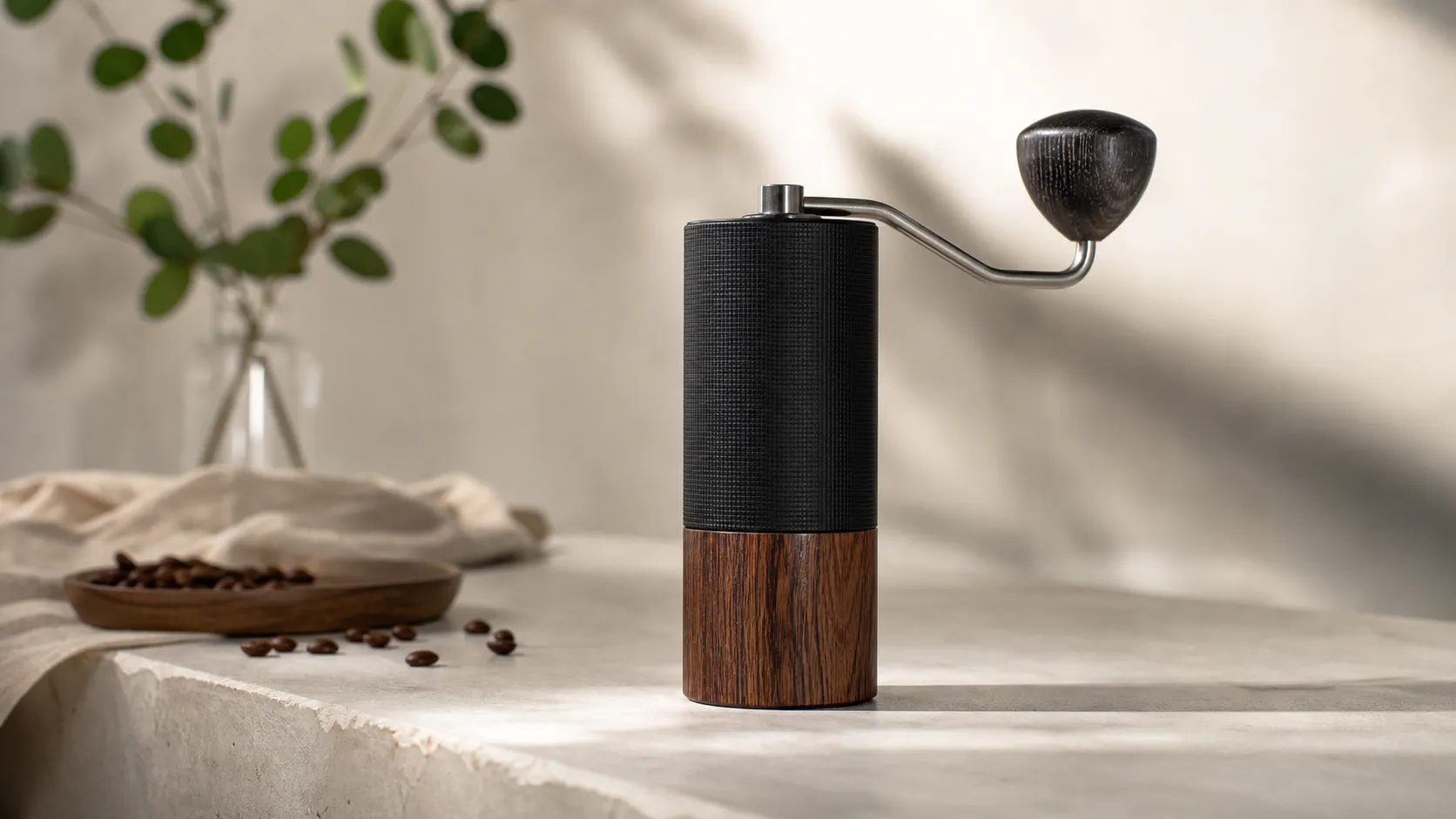
Comandante C40 MK4 Manual Coffee Grinder — 2026 Review
A premium manual grinder known for exceptional build and grind consistency — ideal for serious home baristas, but heavy and pricey for casual users or travel.
 Kitchen & Appliances
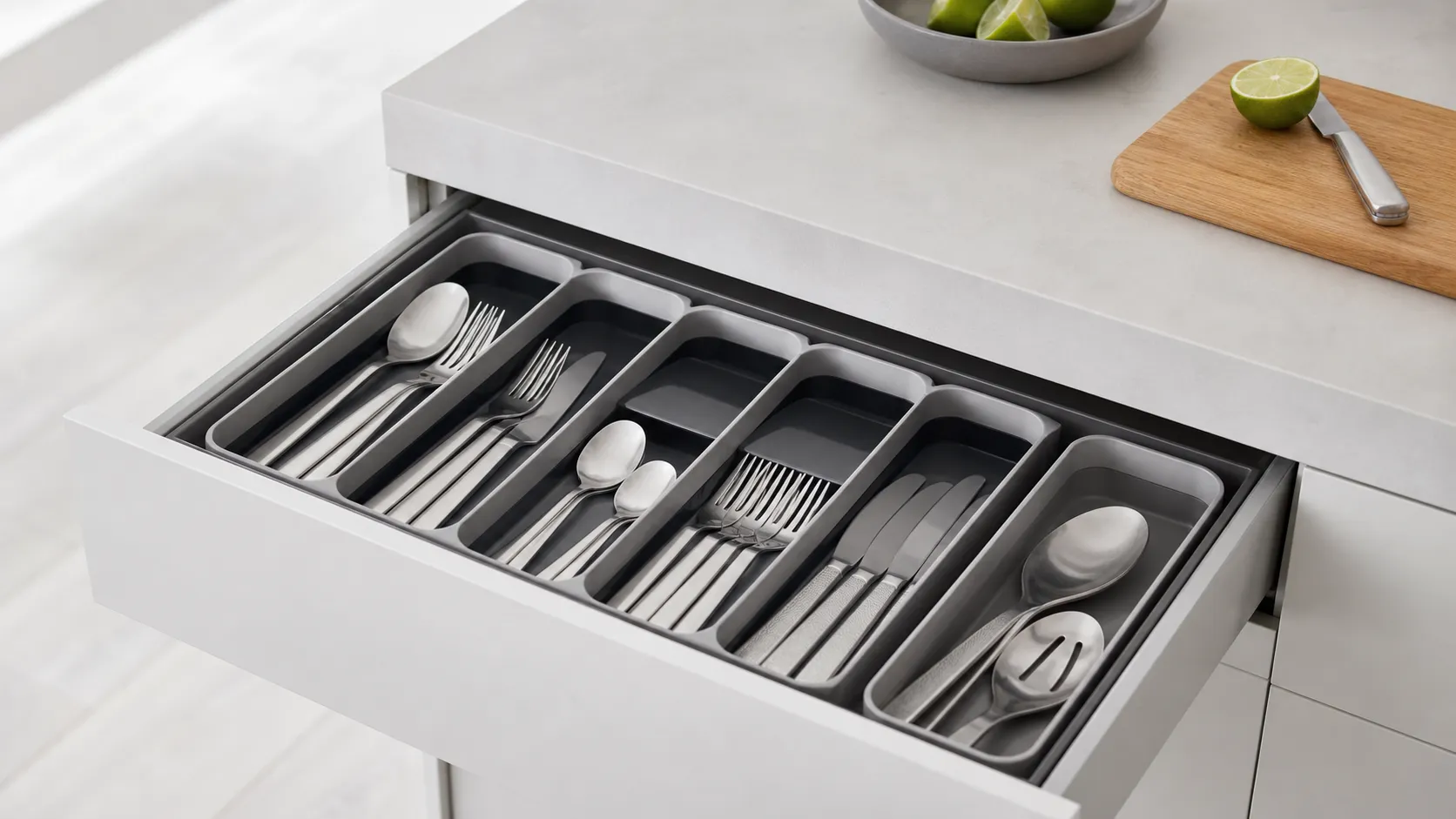
Joseph Joseph DrawerStore Cutlery Organizer Review 2026
A slim, modern cutlery tray that maximizes shallow-drawer space. Great for tidy, small-kitchen organization—measure your drawer first and avoid if you store long utensils.
 Kitchen & Appliances
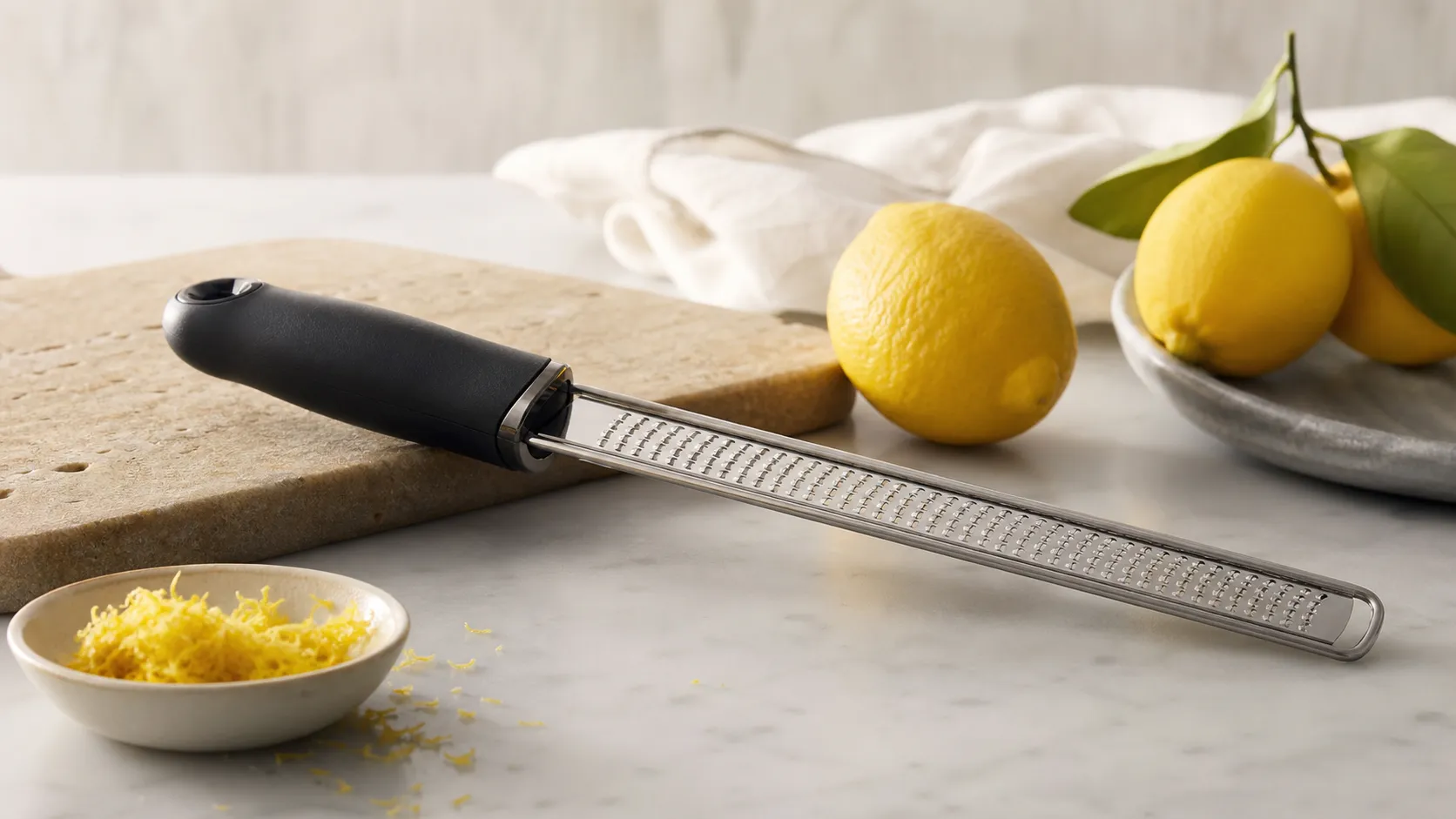
Microplane Premium Classic Zester/Grater — Review 2026
The Microplane Premium Classic is the go-to hand zester for precise, fluffy citrus zest and fine shavings. Sharp, compact, and great value—best for finishing, not bulk grating.